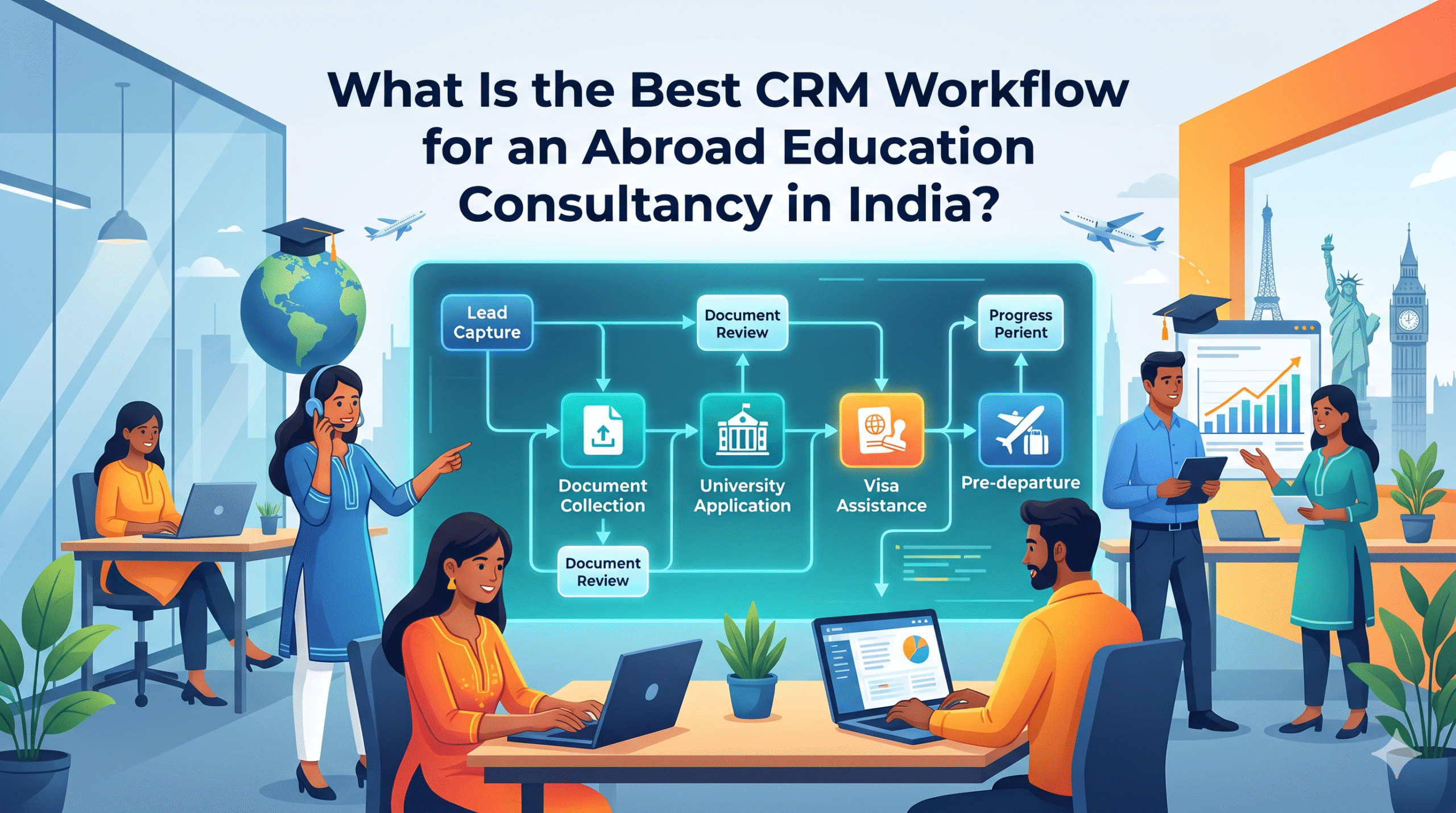
The best CRM workflow for an abroad education consultancy in India is a staged pipeline that moves every student through eight checkpoints: enquiry capture, qualification, counselling, documentation, application, offer and fees, visa, and post-landing follow-up. Each stage needs one owner, one exit rule and one automated trigger, so no student waits without a next action.
Most Indian consultancies do not lose students because their counsellors are weak. They lose students because the process lives in WhatsApp chats, personal spreadsheets and memory. A student asks about Canada on Monday, a counsellor promises a call back, a document request goes unanswered, and by Friday the student has signed with another agency.
This guide lays out a practical, stage-by-stage CRM workflow built for the way an Indian education consultancy CRM actually runs. You will see the stages, the owner for each, the automation that keeps things moving, the KPIs worth tracking and the mistakes that quietly drain enrolments. If you want a shorter overview first, read our earlier piece on the best CRM workflow for an abroad education consultancy in India, then come back here for the detailed blueprint.
Key Takeaways
- A workflow is a set of stages, owners, rules and triggers. A pipeline view alone is not a workflow.
- Eight stages cover the full journey from first enquiry to post-landing referral.
- Every stage should have an exit rule, so a student cannot advance with missing information.
- Automate reminders, document chasing and status updates. Keep counselling and decisions human.
- Track stage-to-stage conversion, response time and stuck cases, not just total leads.
What Is a CRM Workflow for an Abroad Education Consultancy?
A CRM workflow for an abroad education consultancy is the defined sequence of stages, tasks, owners and automations that carries a student from first enquiry to enrolment and beyond. It turns a loose list of leads into a controlled process where every student has a status, an owner and a next step.
Think of it as the operating manual your team follows inside the software. The CRM is the tool, and the workflow is the agreed way of using it. Two consultancies can buy the same study abroad CRM and get very different results because one configured a clear workflow and the other let each counsellor improvise.
A complete workflow answers five questions for every student at any moment: where are they, who owns them, what is the next action, when is it due, and what happens automatically if nobody acts. If your team cannot answer all five in seconds, the process is relying on memory rather than the system. For a plain-language primer on the software itself, see what CRM means in an overseas consultancy.
Why Do Indian Abroad Education Consultancies Need a Defined CRM Workflow?
Indian abroad education consultancies need a defined workflow because enquiries arrive from many channels, the student journey runs for months across several countries, and small delays cause students to switch agents. A shared process protects every lead from depending on one counsellor’s availability or memory.
Several conditions make the Indian market unusually demanding:
- Many entry points. Leads come from Meta ads, Google, walk-ins, education fairs, referrals, sub-agents and WhatsApp forwards. Without one intake process, duplicates and gaps are guaranteed.
- Long, multi-country journeys. A single student may compare Canada, the UK and Germany, each with different documents, deadlines and visa steps.
- Counsellor dependency. When a counsellor leaves, their students often go cold because notes sat in a personal phone.
- Hard deadlines. Intakes, offer acceptance windows, deposit dates and visa slots do not move for anyone.
- Chat-first communication. Students expect answers on WhatsApp within minutes, not days.
A written workflow solves these together. It standardises intake, spreads accountability and gives managers a live view of the pipeline. Our guide on why abroad education consultants in India need CRM software explains the wider business case, and the article on how a CRM helps manage student enquiries for abroad education consultants covers the intake side in depth.
What Are the Stages of the Best CRM Workflow for Abroad Education Consultancies?
The best workflow has eight stages: enquiry capture, qualification and assignment, counselling and shortlisting, documentation, application, offer and fees, visa, and post-landing follow-up. Each stage has a named owner, a clear exit rule and a target response time.
| Stage | Primary owner | Exit rule | Suggested target |
|---|---|---|---|
| 1. Enquiry capture | Front desk or system | Lead deduplicated and consent recorded | First reply within 15 minutes |
| 2. Qualification and assignment | Team lead | Profile scored and counsellor assigned | Assigned within 1 hour |
| 3. Counselling and shortlisting | Counsellor | Shortlist shared and student agrees | First call within 24 hours |
| 4. Documentation | Documentation executive | Checklist complete and verified | Reminders every 48 hours |
| 5. Application | Application officer | Submitted with proof of submission | Submit within 3 working days of a clean file |
| 6. Offer and fees | Counsellor and accounts | Offer accepted and deposit recorded | Follow up within 24 hours of an offer |
| 7. Visa | Visa officer | Visa decision recorded | Weekly status check |
| 8. Post-landing | Counsellor | Arrival confirmed and referral asked | Check-in within 14 days of landing |
These targets are practical starting points, not universal standards. Adjust them to your team size and your busiest intake months. The sections below explain each stage in detail.
Stage 1: How Should You Capture and Deduplicate Student Enquiries?
Capture every enquiry into one CRM through automatic integrations, check for duplicates by phone number and email, and record consent at the point of entry. A student should never exist in two places, and no lead should wait on a person to copy details by hand.
Connect your website forms, ad lead forms, landing pages and WhatsApp number to the CRM, and tag each lead with its source. Source tagging lets you see later which channel produces enrolments rather than just enquiries. Add a rule that merges or flags duplicates, because the same student often enquires through an ad and then again through a sub-agent.
Record consent here, since India’s Digital Personal Data Protection Act expects clear handling of personal data. Our education consultancy CRM data security guide walks through what to configure. For the intake and admissions side, the page on education CRM software for student enquiries and admissions shows how the pieces connect.
Stage 2: How Do You Qualify Leads and Assign the Right Counsellor?
Qualify each lead with a short set of fields: preferred country, course level, intake, budget range, English test status and academic background. Then assign by rule, such as country expertise, language, workload or lead score, so the best-matched counsellor gets the student quickly.
Qualification stops your senior counsellors from wasting time on students who are not ready or not a fit. A simple score based on budget fit, intake urgency and profile strength is enough to separate hot leads from long-term nurture. Round-robin assignment works for small teams, but rule-based assignment performs better once you serve several destinations.
Set the exit rule firmly: no lead moves to counselling without a country, intake and budget band filled in. This single rule improves data quality for every later stage. To see which fields deserve a place in your forms, read what CRM data an abroad education consultancy in India should track.
Stage 3: How Do You Run Counselling and Shortlisting Inside the CRM?
Log every counselling session in the CRM, share a written shortlist of universities and courses, and set a decision date. The counsellor owns this stage, and the exit rule is a shortlist the student has actively agreed to, not just received.
Counselling is where trust is built, so the workflow should support the counsellor rather than burden them. Use call notes templates, a quick course search linked to your partner universities, and reminders for the next touchpoint. A built-in university course finder saves the hunt across portals and keeps shortlists consistent.
Schedule the follow-up before the call ends. The most common leak in this stage is a pleasant conversation with no booked next step. If the student is silent for several days, an automated, personal-sounding WhatsApp message should prompt them, which connects directly to how you handle follow-ups. Our guide on how Indian consultants can manage student follow-ups with CRM gives a full cadence you can copy.
Stage 4: How Do You Collect and Verify Student Documents?
Create a country-specific document checklist inside the CRM, request each item through automated reminders, and verify files before the student advances. The exit rule is a complete, verified checklist, because incomplete files cause most application delays.
Different destinations need different paperwork, so build one checklist template per country and course level. Typical items include passport, transcripts, English test scores, statement of purpose, recommendation letters, financial proof and, for some programmes, portfolios or work experience letters. Store everything against the student record, not in email threads.
Automate the chasing. A reminder every 48 hours that names the missing item works far better than a general “please send documents” message. Give the documentation executive a daily view of files stuck for more than a week. A dedicated document management module keeps uploads, versions and verification status in one place, and the ability to organise student applications in a CRM is covered in our article on organising student applications for education consultants.
Stage 5: How Do You Track Applications and Offers?
Track each application as its own record linked to the student, with university, course, intake, portal reference, submission date and status. The exit rule is documented proof of submission, and the workflow should alert the team when offers or queries arrive.
One student often submits three to six applications, so a single status on the student profile is not enough. Use one record per application, and view them together on the student’s page. Add fields for application fee payment, conditional offer requirements and deadlines, then trigger a task whenever a status changes.
Offers raise their own tasks: confirm conditions, advise the student, and set an acceptance deadline reminder. This is where a dedicated application management system earns its place, because spreadsheets cannot reliably notify the right person when a university replies. For a wider view, see how the CRM can track student application progress and enquiry-to-admission movement.
Stage 6: How Do You Manage Offer Acceptance, Fees and Funding?
Record the accepted offer, the deposit or tuition payment, the funding route and any education loan progress against the student. The exit rule is an accepted offer with the payment or deposit confirmed, and the accounts team should be notified automatically.
This stage joins counselling and finance. Capture the confirmation documents universities issue after acceptance, such as the CAS for the UK, the I-20 for the US, the CoE for Australia or the letter of acceptance for Canada. Requirements change often, so confirm current rules with the official source for each country before advising students.
Track your own service fee and any instalments here too, so finance can reconcile receipts without chasing counsellors. Add a loan or funding sub-status, because many students stall waiting on sanction letters and need a nudge. A reminder 24 hours after each offer, and a deposit-deadline alert, prevents the costly case where a student simply forgets.
Stage 7: How Do You Track Visa Filing and Decisions?
Open a visa record with the country, category, appointment date, submission date, biometrics, interview details and decision. The exit rule is a recorded decision, and the workflow must also handle refusals with a clear re-apply or alternative-route path.
Visa work is deadline-driven and emotionally heavy, so clarity matters. Create a visa checklist per country, set reminders for medicals, biometrics and interview preparation, and show the student the status in plain language. A purpose-built visa management module and visa tracking view help visa officers see everything pending in one list.
Build the refusal path in advance. When a visa is refused, the workflow should create a review task, log the stated reason and offer next options, such as re-applying, a different intake or another destination. Preparing for these moments is easier with the ideas in our guide on how to never miss student visa or university deadlines.
Stage 8: How Do You Handle Post-Landing Follow-Up and Referrals?
Check in after arrival, record the student’s status and ask for a review or referral once they are settled. The exit rule is confirmed arrival, and the workflow keeps the student active in your database for future referrals and testimonials.
Most consultancies stop tracking at the visa stage, which wastes their best marketing asset. A check-in two weeks after landing shows care, surfaces problems early and creates a natural moment to request a Google review or a referral. Tag happy students as advocates, and record which friends or relatives they refer.
Referrals are also the cheapest lead source you have. Tracking them in the CRM tells you which past students bring in new ones, so you can thank them properly and reinforce the loop.
Which Automations Make a CRM Workflow Work Without Extra Staff?
The most valuable automations are instant lead acknowledgement, rule-based counsellor assignment, follow-up reminders, document chasing, deadline alerts and status updates over WhatsApp. They remove repetitive chasing so counsellors spend their time on advice rather than administration.
Keep the list short and meaningful. Start with these six:
- Instant acknowledgement. A WhatsApp or email reply within minutes of an enquiry.
- Smart assignment. Route by country, language and current workload.
- Stage-based task creation. Moving a student to a new stage creates the next task automatically.
- Document reminders. Named, repeated and escalated to a manager after a set period.
- Deadline alerts. Offer acceptance, deposit, biometrics and visa slots.
- Stuck-case alerts. A flag when a student stays in one stage longer than the target.
WhatsApp is central in India, so connect it directly rather than copying messages by hand. See how consultants use WhatsApp automation inside a study abroad CRM for a practical setup. Automate the routine, but keep counselling, visa strategy and difficult conversations human.
What KPIs Should You Track to Measure Your CRM Workflow?
Track stage-to-stage conversion, first response time, lead source quality, average days per stage, stuck cases, counsellor load and offer-to-enrolment conversion. These numbers show where students leak out of the process, which total lead counts hide completely.
Review a weekly dashboard with these seven measures:
- First response time: how fast new enquiries get a real reply.
- Qualification rate: the share of leads that become qualified students.
- Counselling-to-application rate: how many counselled students apply.
- Application-to-offer rate: a quality signal for your shortlisting.
- Offer-to-enrolment rate: the clearest measure of persuasion and follow-up.
- Days in stage: the bottleneck detector.
- Source-to-enrolment rate: which channels deserve more budget.
Use CRM reports to build these once and review them on a fixed weekly rhythm. Compare counsellors fairly by adjusting for lead quality and country mix, and use the numbers to coach rather than to punish.
What Mistakes Break an Education Consultancy CRM Workflow?
The most damaging mistakes are too many stages, no exit rules, unclear ownership, heavy manual data entry and no review rhythm. Each one lets students stall silently while the dashboard still looks busy.
Avoid these common traps:
- Over-engineering. Twenty stages confuse the team. Eight is enough for most consultancies.
- Soft exit rules. If a student can advance with missing data, your reports will mislead you.
- Shared ownership. When two people own a student, nobody does.
- Manual-only updates. If the CRM needs constant typing, counsellors will return to spreadsheets.
- No stuck-case review. A weekly ten-minute review of old cases recovers more students than new ads do.
- Ignoring sub-agents. Leads from partners need their own rules and visibility.
If you are still choosing a platform, our checklist of questions to ask a CRM provider before choosing software in India will help you avoid costly mistakes.
How Does SmartX CRM Support This Workflow?
SmartX CRM supports this workflow through its Educa CRM platform, which brings lead management, application management, document management, visa management, reporting and WhatsApp communication into one system built for overseas education consultancies.
Each stage above maps to a working area in the product. Enquiries flow in through integrations with forms and messaging. Application, document and visa records live in their own modules but connect to a single student profile. Consultancies that work with partners can use B2B sub-agent management to keep partner-sourced students visible without losing control of the process.
You can explore the platform on the Educa CRM page and compare options in our guide to the best study abroad CRM software. To check which features matter most for your team, see CRM features that matter most for education consultants in India. For budgeting, read about the cost of CRM implementation for a counselling team and review SmartX CRM pricing.
How Can You Implement This Workflow in Four Weeks?
You can implement the workflow in four weeks by mapping your current process, configuring stages and fields, importing data and training the team, then reviewing results weekly. Start simple and refine after real use rather than designing the perfect version first.
- Week 1: Map and agree. Write down your real journey, remove duplicate steps and name an owner for each of the eight stages.
- Week 2: Configure. Set up stages, mandatory fields, country checklists, lead sources and assignment rules.
- Week 3: Import and automate. Clean and import existing leads, connect forms and WhatsApp, and switch on the six core automations.
- Week 4: Train and launch. Run short role-based sessions, go live, and hold a daily ten-minute check for the first fortnight.
After launch, review the KPI dashboard weekly and adjust stage targets after one full intake cycle. Teams that want to see the setup in action can start a free demo and test the stages with their own data. If you are comparing how to select a platform, our guide on choosing the right CRM for an abroad education consultancy in India is a useful companion.
Frequently Asked Questions
What is the best CRM workflow for an abroad education consultancy in India?
The best workflow is an eight-stage pipeline covering enquiry capture, qualification, counselling, documentation, application, offer and fees, visa, and post-landing follow-up. Each stage has one owner, an exit rule and automated reminders, so no student stalls without a next action.
How many stages should a study abroad CRM pipeline have?
Most consultancies do well with eight stages. Fewer than six hides important handovers, while more than ten creates confusion and slows data entry. Add sub-statuses inside a stage, such as loan progress or biometrics, instead of creating extra main stages.
Which tasks should a CRM automate for education consultants?
Automate lead acknowledgement, counsellor assignment, follow-up reminders, document chasing, deadline alerts and WhatsApp status updates. Keep counselling, shortlisting advice and visa strategy with your team, because students value personal guidance at those moments.
How long does it take to set up a CRM workflow for a consultancy?
A focused setup takes about four weeks: one week to map the process, one to configure, one to import data and automate, and one to train and launch. Larger teams with several branches may need extra time for roles and permissions.
What data should be captured at the enquiry stage?
Capture name, phone, email, preferred country, course level, intake, budget range, English test status, academic background, lead source and consent. These fields support qualification, assignment and later reporting without forcing students through a long form.
How can a CRM reduce lead leakage in an education consultancy?
A CRM reduces leakage by replying instantly, assigning every lead to an owner, scheduling the next follow-up automatically and flagging stuck cases. Managers can then spot students waiting too long in any stage and act before the student moves to another agency.
Conclusion: Build the Workflow First, Then Let the CRM Enforce It
The best CRM workflow for an abroad education consultancy in India is simple enough for every counsellor to follow and strict enough to protect every student. Eight stages, clear owners, firm exit rules and a handful of automations will do more for your enrolments than any extra marketing spend.
Begin by writing your current journey on one page, then compare it with the eight stages in this guide. Close the gaps, configure them in your CRM and review the numbers weekly. If you would like to see these stages running in a purpose-built system, book a demo with SmartX CRM and explore the full study abroad CRM in action.


Leave a comment: