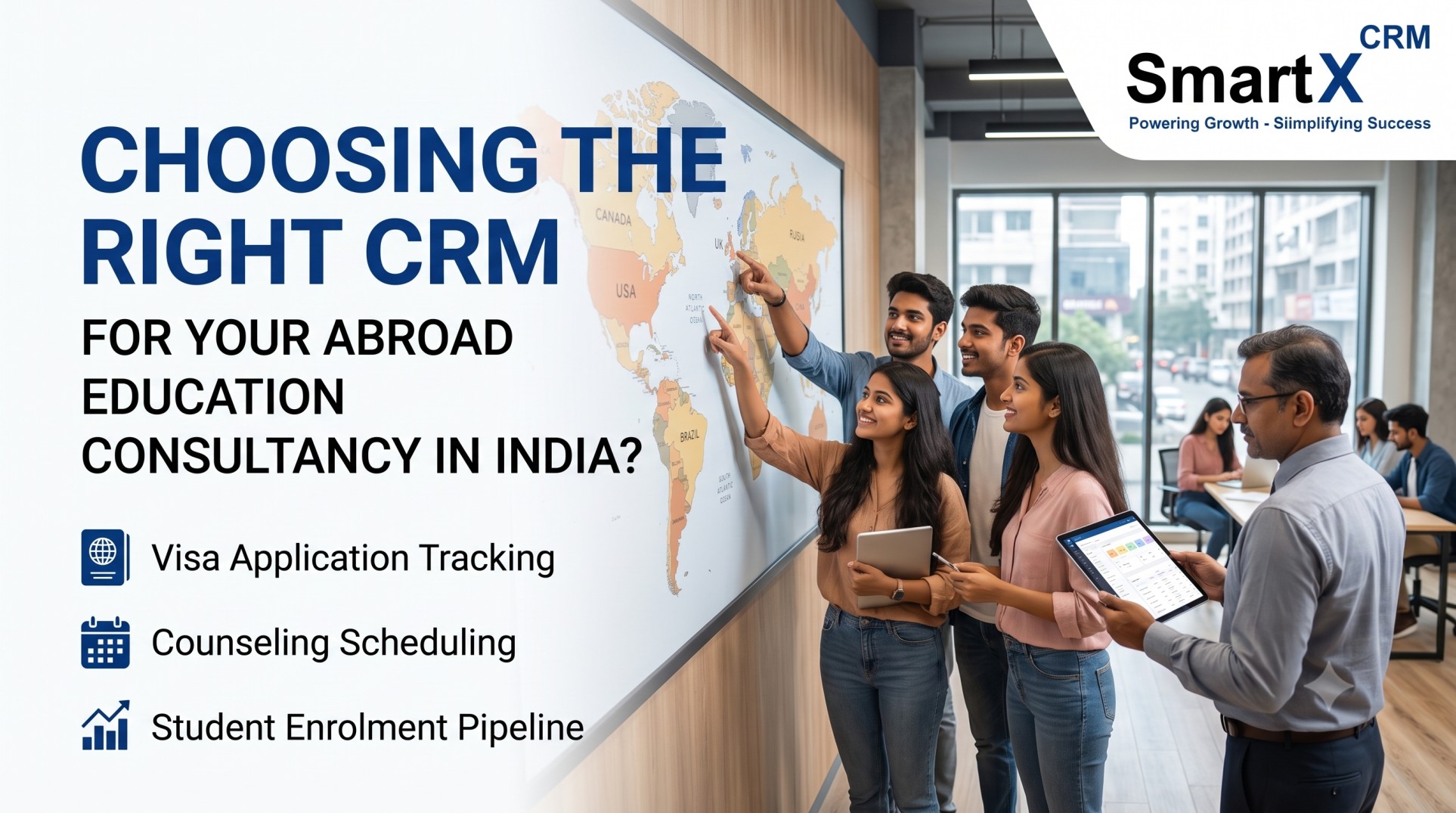
If you run an overseas education consultancy in India, you already know the daily chaos. Student inquiries pour in from Facebook ads, Instagram, WhatsApp, walk-ins, and referral partners, all at once. Counsellors juggle spreadsheets, WhatsApp chats, and email threads trying to track who applied where, whose visa interview is next week, and which sub-agent sent which lead. One missed follow-up and a student walks straight to your competitor.
This is exactly why choosing the right CRM for an abroad education consultancy in India is no longer optional. It is the single decision that determines whether your counselling team spends its day chasing information or actually counselling students. But with dozens of CRMs claiming to be “built for education,” how do you actually pick the one that fits your consultancy, your team size, and your growth stage?
This guide walks through every factor that matters, explains the mistakes most consultancies make while shortlisting a CRM, and shows where a purpose-built platform like SmartX CRM fits into the decision.
Why a Generic CRM Fails an Overseas Education Consultancy
Most CRMs in the market, including well-known sales CRMs, are built for linear B2B sales cycles: lead, demo, negotiation, closed deal. An overseas education consultancy does not work that way.
A single student’s journey can stretch across:
- Initial inquiry and counselling session
- Shortlisting universities and countries
- Document collection and SOP/LOR drafting
- Application submission to multiple universities
- Offer letter tracking across countries
- Visa document preparation
- Visa interview scheduling
- Post-visa services like forex, accommodation, and flight bookings
A generic sales CRM has no concept of “university applications,” “offer letters,” or “visa stages.” Counsellors end up bolting on Excel sheets and WhatsApp groups to track what the CRM cannot, which defeats the entire purpose of having a CRM in the first place.
This is the core reason education consultancy CRM software needs to be purpose-built, not repurposed. The right platform should already understand the vocabulary and workflow of overseas education consulting, the way study abroad CRM software built specifically for this industry does.
Step 1: Map Your Consultancy’s Actual Workflow Before Comparing CRMs
Before opening a single comparison spreadsheet, sit down and map your consultancy’s real workflow, not the ideal one from a brochure. Ask:
- How many leads do we receive weekly, and from which sources?
- How many counsellors and back-office staff will use the CRM?
- Do we work with sub-agents or B2B partners who need their own access?
- How many countries and universities do we typically process applications for?
- Do we handle visa filing in-house or outsource it?
- What reports does management actually check every week?
Consultancies that skip this step tend to buy a CRM based on a flashy demo, then discover six months later that it cannot handle sub-agent commissions or multi-university application tracking. Answering these questions first turns CRM shopping from a guessing game into a checklist match.
Step 2: The Non-Negotiable Features for an Overseas Education Consultancy CRM
Once your workflow is mapped, evaluate every CRM against these core capabilities. This is where most software falls short of being a true fit for an abroad education consultancy CRM.
1. Lead Capture From Every Channel
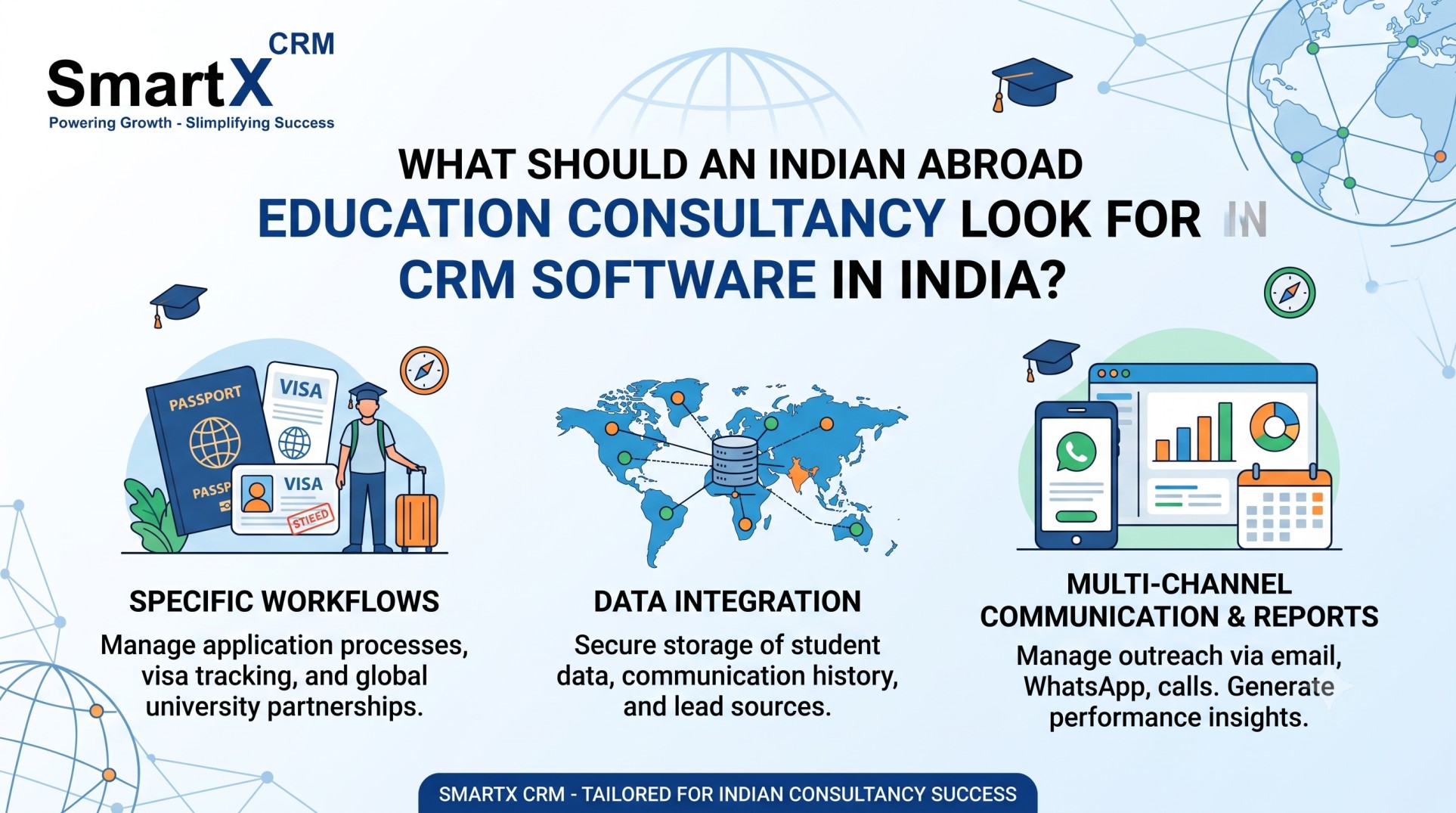
Your CRM should automatically pull in leads from Facebook and Instagram lead ads, Google forms, your website, WhatsApp, and walk-ins, all landing in one dashboard instead of five different inboxes. Manual copy-pasting of leads from ad platforms into spreadsheets is one of the biggest reasons consultancies lose inquiries within the first hour.
2. Built-In WhatsApp and Communication Automation
Indian students and parents overwhelmingly prefer WhatsApp over email. A CRM without native WhatsApp automation, including bulk messages, automated follow-up sequences, and two-way chat inside the CRM, will always be a step behind. This is why WhatsApp automation for education consultants has become a deciding factor rather than a nice-to-have feature.
3. University and Application Tracking
The CRM must let you track, per student, which universities were shortlisted, which applications were submitted, which offers came back, and the status of each one, side by side. A generic pipeline view with generic stages like “contacted” and “negotiation” simply cannot represent this.
4. Visa and Document Management
Visa filing has hard deadlines. A missed document or a late interview slot can cost a student their intake. Your CRM should flag upcoming visa deadlines automatically, store documents against each student profile, and never let a case go silent. This is the exact gap that CRM solutions for overseas education consultants are designed to close.
5. Sub-Agent and B2B Partner Management
Many Indian consultancies work with a network of sub-agents across smaller towns who source students on commission. Your CRM needs a separate portal or access level for these partners, with commission tracking and lead attribution built in, similar to how B2B sub-agent management works inside a consultancy-focused CRM.
6. Immigration and Visa Case Handling
If your consultancy also offers immigration services alongside study visas, your CRM needs to separate and track these case types distinctly. This is a common blind spot in generic CRMs, and it is why automated CRM for immigration consultants exists as its own category, with dedicated case stages, document checklists, and follow-up automation for visa and immigration files.
7. Data Security and Compliance
You are handling passport copies, academic transcripts, bank statements, and other sensitive personal data every single day. With India’s data protection rules tightening, your CRM vendor’s security practices are not a footnote, they are a hard requirement. Review this carefully using a resource like an education consultancy CRM data security guide before signing any contract.
8. Reporting That Management Actually Uses
Owners and directors need to see conversion rates by source, counsellor performance, country-wise application success, and revenue forecasts, without asking someone to build a manual report every Monday. If the CRM’s reporting requires an analyst to interpret, it is the wrong CRM for a small or mid-sized consultancy.
Step 3: Common Mistakes Consultancies Make While Choosing a CRM
Mistake 1: Choosing Based on Price Alone
The cheapest CRM is rarely the cheapest in practice. If it cannot automate WhatsApp follow-ups or track visa deadlines, your team will spend hours doing manually what the software should be doing automatically. That lost counsellor time costs far more than the subscription difference.
Mistake 2: Ignoring the Learning Curve
A CRM with a complicated interface will simply not get adopted. If your counsellors go back to WhatsApp and Excel within two weeks because the CRM feels clunky, you have wasted the onboarding time and the subscription fee. Always ask for a live demo with your own team members, not just a sales pitch to the owner.
Mistake 3: Not Checking for Industry-Specific Workflow Support
This is the single biggest mistake. Many consultancies sign up for a generic sales CRM, spend weeks customizing fields to somewhat resemble a university application tracker, and still end up missing the mark. Comparing platforms using a dedicated study abroad CRM comparison guide before committing saves this pain entirely.
Mistake 4: Overlooking Data Migration
Moving years of student records, application history, and documents from Excel or an old CRM into a new system is a serious undertaking. Ask your shortlisted vendors exactly how migration works, how long it takes, and whether it is included in your onboarding.
Mistake 5: Forgetting About Scalability
Your consultancy processing 200 leads a month today may be processing 2,000 a month in two years, possibly across multiple branches and countries. Choose a platform built to scale with you rather than one you will outgrow in twelve months, the way CRM for overseas education and immigration company growth stories typically play out.
Step 4: Build a CRM Evaluation Scorecard
Rather than relying on a gut feeling after a sales demo, score each shortlisted CRM out of 10 on the following parameters:
| Parameter | Weight | Why It Matters |
|---|---|---|
| Lead capture automation | High | Determines how many inquiries you actually retain |
| WhatsApp and communication tools | High | Matches how Indian students actually communicate |
| University and application tracking | High | Core to the consultancy workflow |
| Visa and document management | High | Prevents missed deadlines and lost cases |
| Sub-agent and partner support | Medium | Relevant if you work with a partner network |
| Reporting and dashboards | Medium | Needed for management decision-making |
| Data security practices | High | Non-negotiable given sensitive student data |
| Ease of use for counsellors | High | Directly affects adoption |
| Pricing transparency | Medium | Watch for hidden per-user or per-feature charges |
| Onboarding and support quality | Medium | Affects how quickly you go live |
Score every CRM on your shortlist against this table with your actual team present, not just the founder. The platform with the highest weighted total, not the flashiest demo, is your answer.
Step 5: Understand the Real Cost of Sticking With Spreadsheets
Many consultancy owners delay buying a CRM because “the current system works fine.” It is worth putting an actual number on what that system is costing you.
Consider a mid-sized consultancy handling 300 inquiries a month across two counsellors. Without automated lead routing, a portion of those leads sit unattended for hours before anyone responds. Industry data across service businesses consistently shows that response time is one of the strongest predictors of conversion, and every hour of delay reduces the odds of that student ever replying again.
Now add the cost of manual work. A counsellor spending even 90 minutes a day manually updating spreadsheets, copying WhatsApp numbers, or chasing document status is losing roughly 7 to 8 hours a week that could otherwise go into actual counselling calls and closing applications. Across a team of five counsellors, that is close to a full extra employee’s worth of productivity lost every month simply because there is no system automating the busywork.
Then there is the risk side. A single missed visa interview slot or a forgotten document deadline does not just cost that one student, it costs referrals, reviews, and reputation in a market where word of mouth drives a large share of new inquiries for any overseas education consultancy CRM user base. When you frame the decision this way, the monthly cost of a purpose-built CRM starts looking like one of the cheapest line items in your budget, not an added expense.
Step 6: Plan the Implementation, Not Just the Purchase
Buying the right CRM is only half the job. Consultancies that get real value from their CRM investment treat the first 60 days as a structured rollout, not a quiet software switch. A practical implementation plan usually looks like this:
Week 1 to 2: Data migration and setup. Move existing student records, contact details, and document files into the new CRM. Set up your pipeline stages to match your actual workflow, from first inquiry through to visa approval, rather than accepting generic default stages.
Week 2 to 3: Team training. Every counsellor, not just the manager, should go through hands-on training with real student records, not a demo dataset. This is where adoption is won or lost.
Week 3 to 4: Automation setup. Configure WhatsApp automation sequences, lead assignment rules, and visa deadline reminders so the CRM starts doing the repetitive work from day one rather than being used as a glorified contact list.
Week 4 to 8: Monitor and refine. Review weekly reports, check which automations are actually being used, and adjust pipeline stages or messaging templates based on what the data shows about where students are dropping off.
Vendors who offer dedicated onboarding support during this window, rather than a one-time setup call, are far more likely to see their consultancy clients actually stick with the platform past the first quarter.
Step 7: Match the CRM to Your Consultancy’s Growth Stage
Not every abroad education consultancy needs the same CRM setup. It helps to think in terms of three growth stages:
Early stage (under 100 leads a month, one to three counsellors). At this stage, the priority is simple lead capture, WhatsApp automation, and a clean pipeline view. Avoid over-investing in complex sub-agent or multi-branch features you are not yet using.
Growth stage (100 to 500 leads a month, four to ten counsellors, possibly one or two branches). Here, university and application tracking, visa deadline automation, and manager-level reporting become essential. This is usually the stage where consultancies feel the most pain from generic CRMs or spreadsheets and actively start comparing dedicated study abroad CRM software.
Scale stage (500-plus leads a month, multiple branches, sub-agent networks, possibly multiple countries of operation). At this point, sub-agent portals, B2B partner management, advanced analytics, and role-based access controls across branches move from nice-to-have to mandatory. Choosing a platform that already supports this stage, even if you are not there yet, avoids a painful CRM migration later.
Being honest about which stage your consultancy is actually in, rather than which stage you aspire to be in six months from now, keeps you from either overpaying for features you cannot use yet or under-buying a system you will outgrow within a year.
Step 8: Ask These Questions Before You Sign
Once you have a shortlist of two or three CRMs, put these questions directly to each vendor:
- Can the CRM track multiple university applications per student, with individual status updates for each?
- Does it automate WhatsApp follow-ups without needing a separate third-party tool?
- How does it handle visa deadline reminders and document checklists?
- Is there a separate login and dashboard for sub-agents or B2B partners?
- What does the pricing include, and what triggers an additional charge?
- How is student data secured, and where is it stored?
- What does onboarding look like in the first 30 days?
- Can we speak to an existing consultancy client using the CRM?
A vendor that answers these clearly and confidently, backed by real client examples, is worth prioritizing over one that dodges specifics with generic marketing language.
Where SmartX CRM Fits Into This Decision
SmartX CRM was built specifically around the workflow described above, not adapted from a general sales tool. It brings together lead capture from Facebook, Instagram, Google, and WhatsApp into one dashboard, tracks multi-university applications per student, automates visa deadline reminders, and gives sub-agents their own portal for commission and lead tracking.
For consultancies weighing SmartX CRM directly against other platforms, the study abroad and education consultant CRM guide for 2026 breaks down feature-by-feature comparisons, and the best CRM for abroad education consultancy in India resource covers pricing tiers and what each plan includes. If your consultancy also runs a course-matching process for students, the built-in university course finder CRM module removes another manual step from your counsellors’ day.
You can check current plans on the SmartX CRM pricing page, or get in touch with the SmartX CRM team directly to request a live walkthrough with your own counselling staff before making a final decision.
Frequently Asked Questions
What is the most important feature in a CRM for an abroad education consultancy?
University and application tracking combined with visa deadline management is the most critical feature, since these two areas cause the most lost students when handled manually.
Is WhatsApp automation really necessary in an education consultancy CRM?
Yes. Since the majority of Indian students and parents respond faster on WhatsApp than email, a CRM without native WhatsApp automation will consistently underperform one that includes it.
How long does it take to migrate from Excel or an old CRM to a new one?
This varies by data volume, but most consultancies can expect a migration and onboarding window of one to three weeks with a vendor that offers dedicated onboarding support.
Can one CRM handle both study visa consulting and immigration consulting?
Yes, provided the CRM has separate case-type tracking for study visas and immigration cases. This is a key feature to confirm during your evaluation rather than assuming it exists.
Should a small consultancy with under five counsellors still invest in a dedicated CRM?
Yes. Lead leakage and missed follow-ups happen at any team size. A CRM built for this industry pays for itself quickly by reducing lost inquiries alone.
Red Flags to Watch For While Shortlisting Vendors
Beyond features and pricing, a few warning signs tend to predict a poor experience down the line, regardless of how polished the sales demo looks.
Vague answers about data hosting. If a vendor cannot clearly explain where student data is stored, how backups work, and who has access internally, treat that as a serious concern given the sensitivity of passport and financial documents you will be uploading.
No client references in your specific niche. A CRM vendor that only shows case studies from retail or real estate businesses, with nothing from education consultancies, has likely not built the deep workflow understanding this industry needs.
Locked-in long-term contracts with no trial period. Any vendor confident in their product should be comfortable offering a trial period or a short initial commitment. Being pushed into a one-year contract before you have tested the platform with your own team is a red flag.
Support that disappears after the sale. Ask specifically how support tickets are handled after onboarding, what the average response time is, and whether support is available in a time zone and language convenient for your team.
No visible product roadmap. CRM needs evolve as visa rules, popular study destinations, and student expectations change. A vendor that is not actively updating their platform, adding new destination-specific workflows, or improving automation over time will leave you stuck with today’s feature set indefinitely.
Bringing It All Together
Choosing a CRM is ultimately a decision about how your consultancy will operate for the next several years, not just which software has the nicest looking dashboard. The consultancies that get this right treat it as seriously as hiring a senior counsellor: they map the workflow first, test with their actual team, check references, and only then commit.
Final Thoughts
Choosing the right CRM for an abroad education consultancy in India comes down to matching software capability to your actual daily workflow, not to a features list in a sales brochure. Map your process, insist on industry-specific features like university tracking, visa deadline automation, and sub-agent management, and score every option honestly against your own team’s needs before signing a contract.
A platform like SmartX CRM was built around exactly this workflow, which is why so many overseas education consultancies in India are moving away from generic sales CRMs and Excel sheets toward a system designed for the way study abroad counselling actually works.
Leave a comment: