
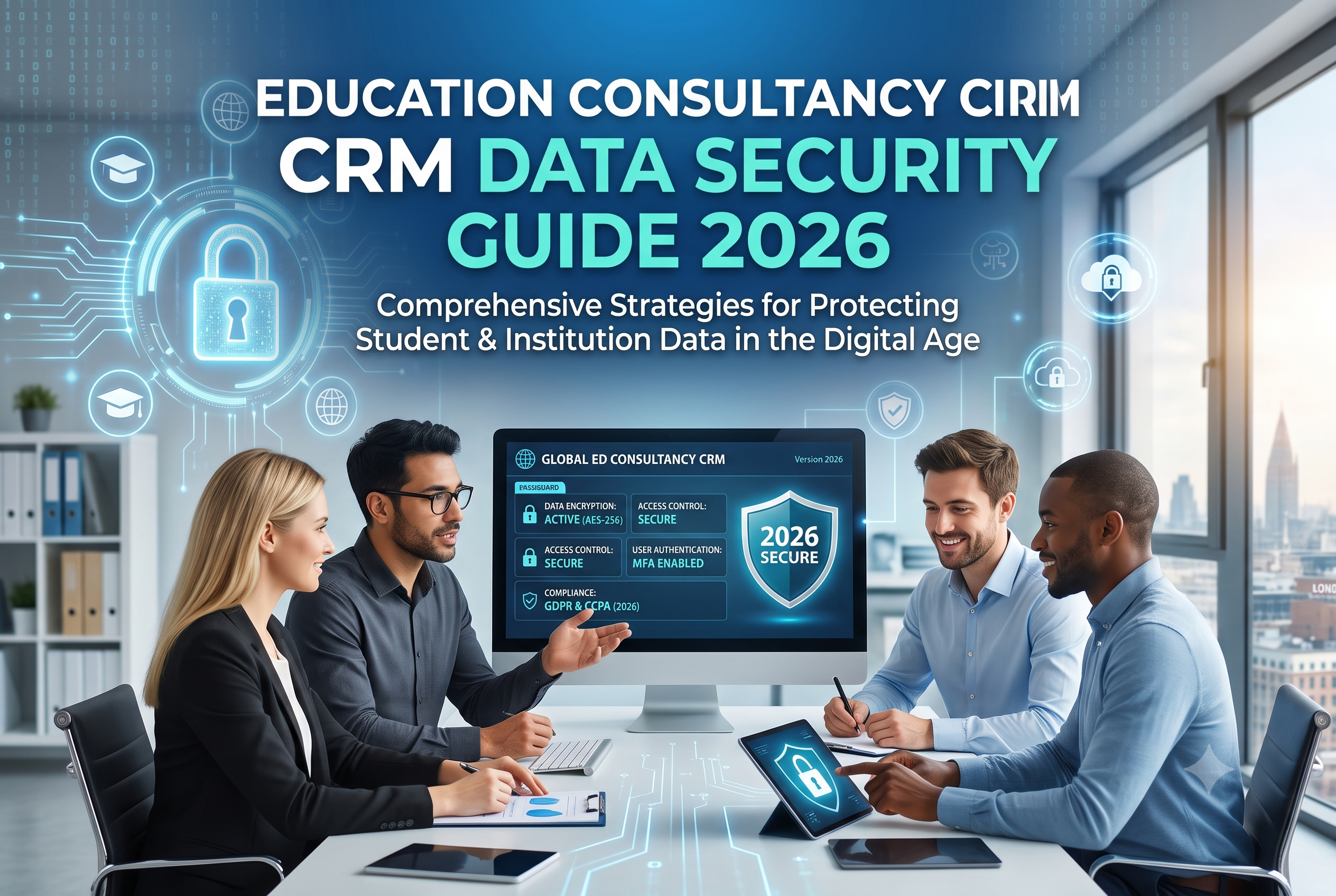
Education Consultancy CRM Data Security: The Complete Compliance Guide (2026)
Every study abroad consultancy sits on top of one of the most sensitive data piles in the services industry. Passport scans. Visa application status. Bank statements and sponsorship letters. Academic transcripts. Parent contact details for minor applicants. WhatsApp threads with a student’s entire admissions journey in them.
A generic sales CRM was never built to protect any of that. And for an education consultancy, a data breach or a compliance lapse isn’t just an IT headache — it’s the kind of thing that ends relationships with university partners, triggers regulatory penalties under India’s DPDPA, and destroys the trust that your entire referral pipeline runs on.
This guide breaks down exactly what data your consultancy is responsible for, which regulations actually apply to you, the specific security features a education consultancy CRM software needs to have, a checklist you can use while evaluating vendors, and how SmartX CRM handles each of these requirements.
Why Data Security Is Non-Negotiable for Education Consultancy CRMs
Data security for an education consultancy isn’t a “nice to have” compliance checkbox — it’s core to how the business survives. Consider what’s actually at stake:
- Trust with students and families. Parents handing over a minor’s passport and financial documents expect that information to be protected, not sitting in an unsecured spreadsheet or a shared inbox.
- Trust with university and visa partners. A leaked or mishandled document can jeopardize a consultancy’s standing with the institutions and visa offices it depends on.
- Regulatory exposure. India’s Digital Personal Data Protection Act treats mishandled personal data — especially a minor’s data — as a compliance failure with real financial and legal consequences, not just a reputational one.
- Business continuity. A single breach involving hundreds of students’ passport and financial data can be an existential event for a small-to-mid-size consultancy in a way it wouldn’t be for a larger enterprise.
The rest of this guide works through what that actually means in practice — starting with the data itself.
What Student Data Does a Study Abroad Consultancy Actually Handle?
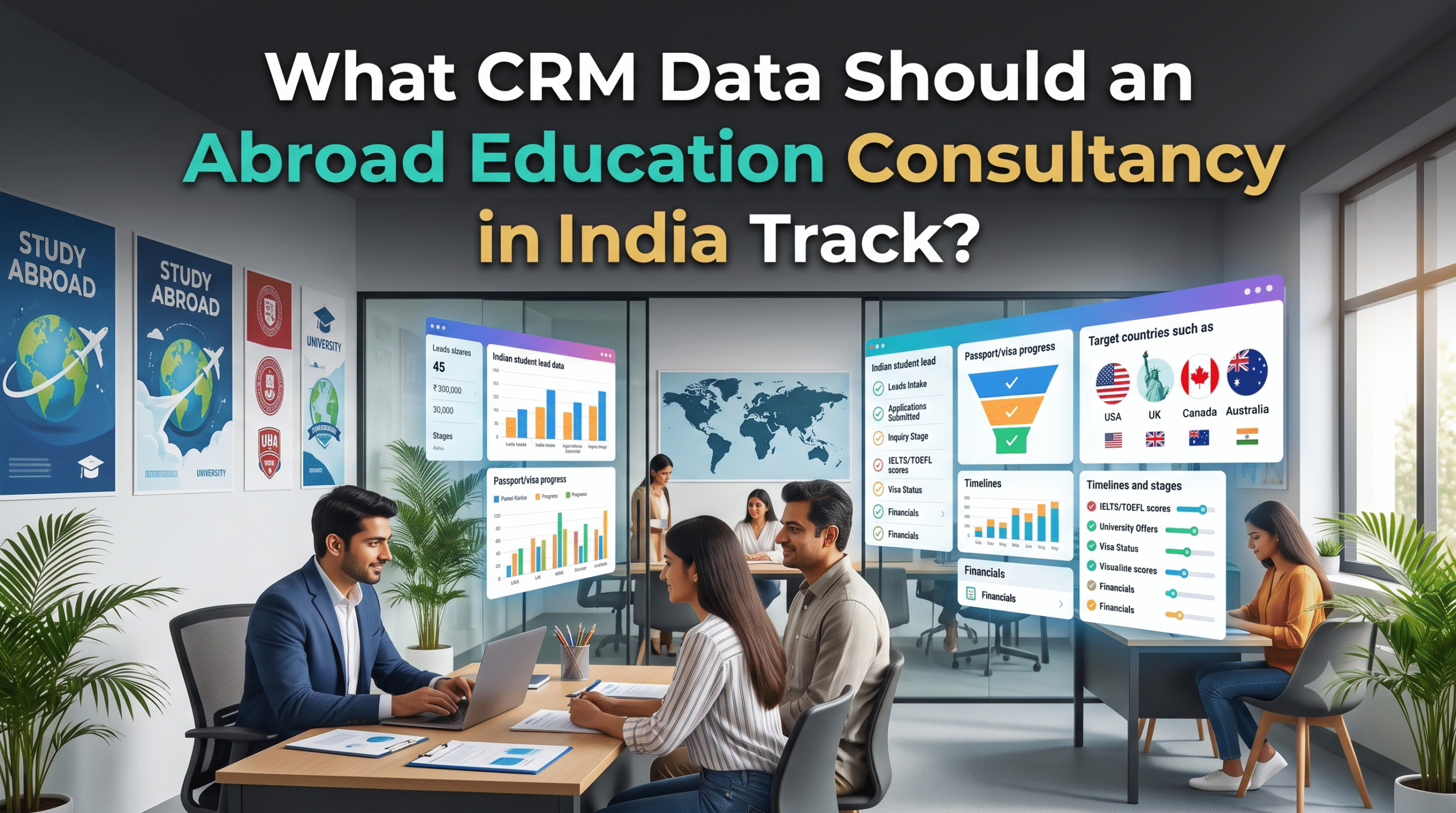
Before evaluating any CRM’s security, it helps to be precise about what you’re actually protecting. A typical study abroad consultancy’s document management workflow touches:
- Passport and government ID scans
- Visa application forms and supporting documents
- Academic transcripts, certificates, and letters of recommendation
- Financial and sponsorship documents (bank statements, loan sanction letters, income proofs)
- Parent or guardian contact details, required for applicants under 18
- Payment and fee transaction records
- Full communication history across email, WhatsApp, and phone
That’s a materially different — and more sensitive — data set than a typical B2B sales CRM handles. It’s also why generic CRMs, built for managing deals and contacts, routinely fall short for this specific use case.
India’s DPDPA vs GDPR: What Actually Applies to Your Consultancy
If your consultancy serves Indian students, India’s Digital Personal Data Protection Act (DPDPA), 2023, along with its 2025 Rules, applies to you — regardless of which country the university or visa office your students are applying to is based in. If you also handle inquiries from students who are EU residents, GDPR obligations layer on top of that.
| DPDPA (India) | GDPR (EU) | |
|---|---|---|
| Who it covers | Any entity processing digital personal data of individuals in India | Any entity processing personal data of EU residents, regardless of the entity’s location |
| Consent model | Consent-first: explicit, informed consent required before processing, with narrow “legitimate use” exceptions | Accountability-based: multiple lawful bases for processing, of which consent is one |
| Minors’ data | Requires verifiable parental/guardian consent for anyone under 18 | Similar parental consent requirement, typically for under-16s (varies by member state) |
| Data localization | Government can mandate that certain categories of data be stored within India | No blanket localization requirement, but strict rules on cross-border transfers |
| Penalties | Financial penalties up to ₹250 crore per instance, depending on the violation | Up to €20 million or 4% of global annual turnover, whichever is higher |
For a consultancy based in Surat or anywhere else in India, the practical takeaway is this: DPDPA’s rules on parental consent for minors and its consent-first model directly affect how you should be capturing, storing, and sharing student data inside your CRM — especially since a large share of study abroad applicants are 17 or 18 at the time of first inquiry.
This section is for general awareness and isn’t legal advice — consultancies should confirm specifics with a data protection professional for their exact situation.
Must-Have Security Features in an Education Consultancy CRM
Not every CRM security feature matters equally for this industry. Here’s what to actually prioritize.
Encryption at Rest and in Transit
Every passport scan, visa document, and financial record stored in your CRM should be encrypted both while it sits on the server (at rest) and while it moves between your team’s devices and the CRM (in transit, via TLS). This is the baseline that prevents a server breach or an intercepted connection from exposing raw student documents.
Role-Based Access Control
Not everyone on your team — or your extended network of sub-agents — needs to see everything. A counselor working with 30 students shouldn’t automatically have visibility into another counselor’s pipeline, and a sub-agent or partner consultant should only see the students they’ve personally referred, not your entire database. Role-based access is what makes that possible without manual, error-prone workarounds.
Audit Logs and Activity Tracking
If a document goes missing or a student disputes what was shared with whom, you need to be able to answer: who viewed this record, who edited it, and when. Audit logs are what turn “we’re not sure what happened” into a documented answer.
Two-Factor Authentication
A password alone isn’t enough protection for accounts that can access hundreds of students’ passport and financial documents. Two-factor authentication closes the most common way accounts get compromised — a stolen or guessed password.
Consent Management
Under DPDPA, your consultancy needs a defensible record of consent — particularly parental consent for minor applicants, and communication opt-ins for WhatsApp, email, and SMS outreach. A CRM that tracks this natively is far more reliable than trying to reconstruct consent history from old email threads after the fact.
Secure Document Storage
Passport and visa documents shouldn’t be circulating as email attachments, which are easy to forward, hard to track, and impossible to permission granularly. A permissioned document vault inside the CRM — tied to the same role-based access controls — keeps sensitive files contained to the people who actually need them.
Data Security Checklist for Choosing an Education Consultancy CRM
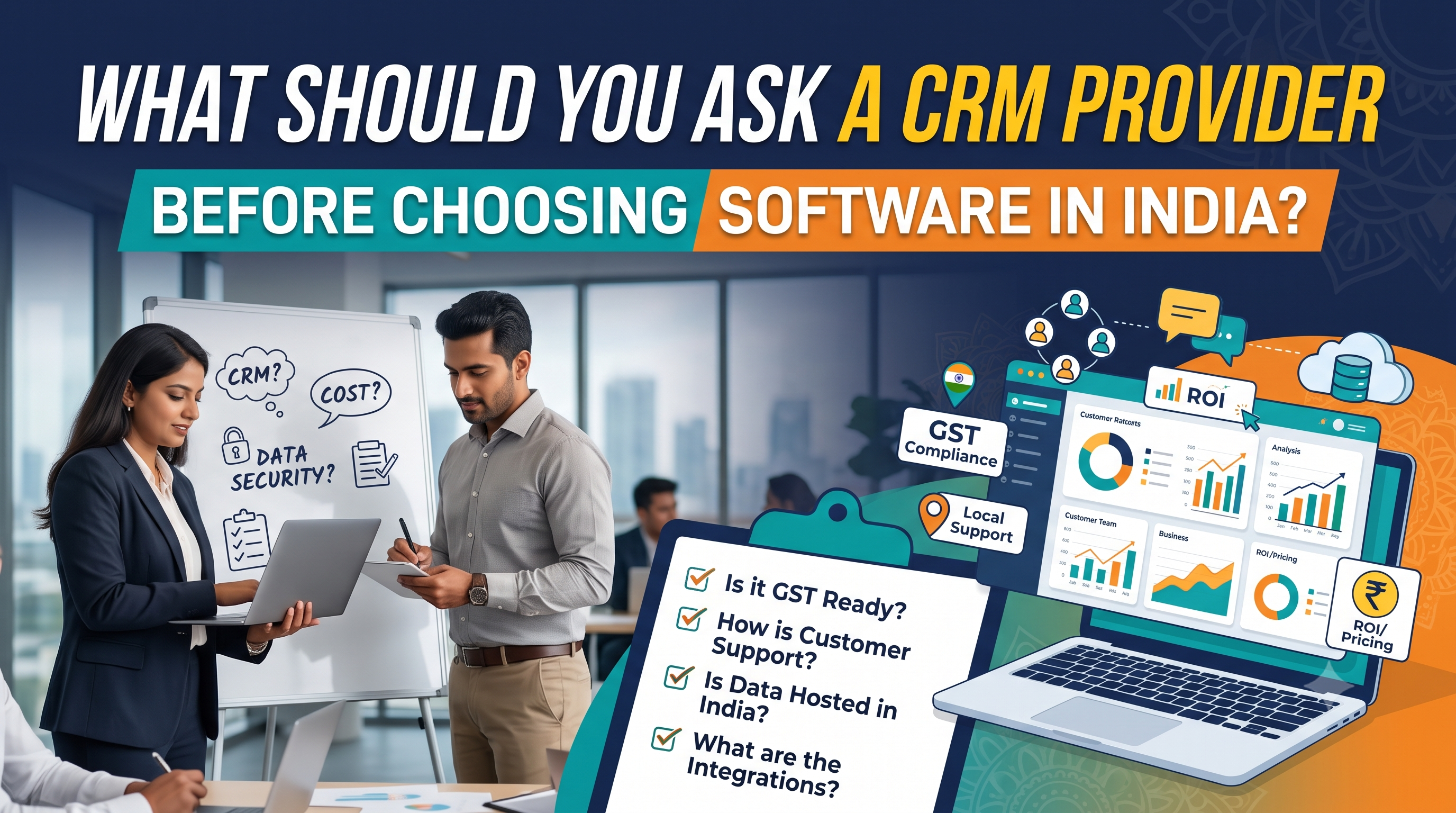
Use this while evaluating any CRM vendor — not just SmartX:
| Requirement | What to ask the vendor |
|---|---|
| Encryption | Is data encrypted both at rest and in transit? |
| Two-factor authentication | Is 2FA available and enforceable for all users? |
| Role-based access | Can permissions be set separately for counselors, admins, and sub-agents? |
| Audit logs | Can you see who accessed or edited a specific student’s record? |
| Consent tracking | Does the CRM log parental consent and communication opt-ins? |
| Secure document vault | Are passport/visa documents stored with permissioned access, not as email attachments? |
| India data handling | Can the vendor clearly explain how they handle DPDPA requirements? |
| Sub-agent permission granularity | Can a sub-agent see only their own referred students? |
| Breach notification process | Does the vendor have a documented process for notifying you of a security incident? |
| Data export/deletion on cancellation | What happens to your student data if you cancel your subscription? |
| Backup and recovery | How frequently is data backed up, and how is it restored? |
If a vendor can’t give you a clear, specific answer to each of these, treat that as a red flag rather than an oversight. This checklist pairs well with our broader CRM buying guide for education consultants, which covers evaluation criteria beyond security.
Common Data Security Gaps in Consultancy CRMs (and Red Flags to Watch For)
Watch for these warning signs when evaluating a CRM — or auditing the one you already use:
- Spreadsheet or Excel-based lead sharing with sub-agents. No access control, no audit trail, and files that keep circulating long after they should have been deleted. If this sounds familiar, it’s worth reading why consultancies need to upgrade from spreadsheets.
- No audit trail. If you can’t answer “who accessed this student’s passport scan,” you have a visibility gap, not just a security one.
- Documents stored as email attachments. Easy to forward, impossible to permission, and effectively impossible to delete once sent.
- No clear answer on data residency. A vendor that can’t explain where your data is physically stored, or how they handle DPDPA obligations, is a compliance risk you’re inheriting.
- No documented offboarding process. If you cancel your subscription, what happens to your students’ documents? If the vendor doesn’t have a clear answer, assume the worst.
How SmartX CRM Secures Your Consultancy’s Student Data
SmartX CRM was built specifically for the operational reality of study abroad consultancies — which means data security was designed around the checklist above, not bolted on afterward.
- Encrypted document storage for passport scans, visa documents, and financial records, so sensitive files aren’t circulating as unsecured email attachments.
- Role-based access control that extends to sub-agents and partner consultants through the B2B sub-agent management module — each partner sees only the students they’ve referred, nothing more.
- Audit visibility into who has accessed or updated a student’s record, so you’re never guessing when a discrepancy comes up.
- Consent and communication tracking across WhatsApp, email, and SMS, built to support DPDPA’s consent-first requirements — including the parental consent that matters for the large share of applicants who are minors at first inquiry.
- India-based operational understanding of DPDPA requirements, since SmartX CRM is built for Indian consultancies first, not adapted from a generic Western CRM.
This is also why SmartX CRM is positioned as the best CRM for abroad education consultancy in India — security built around how Indian consultancies actually operate, not retrofitted onto a generic platform.
Data Security FAQs for Education Consultancy CRM
Is student data safe in a cloud-based CRM? Yes, provided the CRM uses encryption at rest and in transit, role-based access control, and audit logging. Cloud storage itself isn’t the risk — how the vendor secures and permissions that storage is what determines safety.
Is SmartX CRM DPDPA compliant? SmartX CRM is built with India’s DPDPA requirements in mind, including consent tracking and role-based access for sensitive student data. For your consultancy’s specific compliance obligations, we recommend confirming details with a data protection professional alongside our team.
What happens to our data if we cancel our subscription? SmartX CRM provides a documented data export and deletion process at cancellation — you retain access to export your records, and stored data is handled according to the terms outlined in our terms and conditions.
Can sub-agents see all student data, or only what’s assigned to them? Sub-agents and partner consultants only see the students they’ve personally referred, through role-based permissions in the B2B sub-agent module — not your full consultancy database.
Does SmartX CRM store passport and visa documents securely? Yes. Passport, visa, and financial documents are stored in an encrypted, permissioned document vault rather than as email attachments, with access limited by role.
Do I need separate consent for parents when a student applicant is a minor? Under DPDPA, processing a minor’s personal data generally requires verifiable parental or guardian consent. SmartX CRM’s consent tracking is designed to help you document this, though consultancies should confirm the specifics of their own consent workflows with a compliance professional.
Choosing a Secure, Compliant CRM: Next Steps
Data security isn’t a feature you check off a list once and forget — it’s what protects your consultancy’s license to operate, the trust of every family you work with, and your standing with university and visa partners. Use the checklist in this guide with any CRM you’re evaluating, including SmartX CRM.
Ready to see how it works in practice? Start a free demo and walk through the security and permission settings yourself, or contact our team with any compliance questions specific to your consultancy.
Leave a comment: