The Software Approach in Educational Technology: Meaning, Principles & Examples
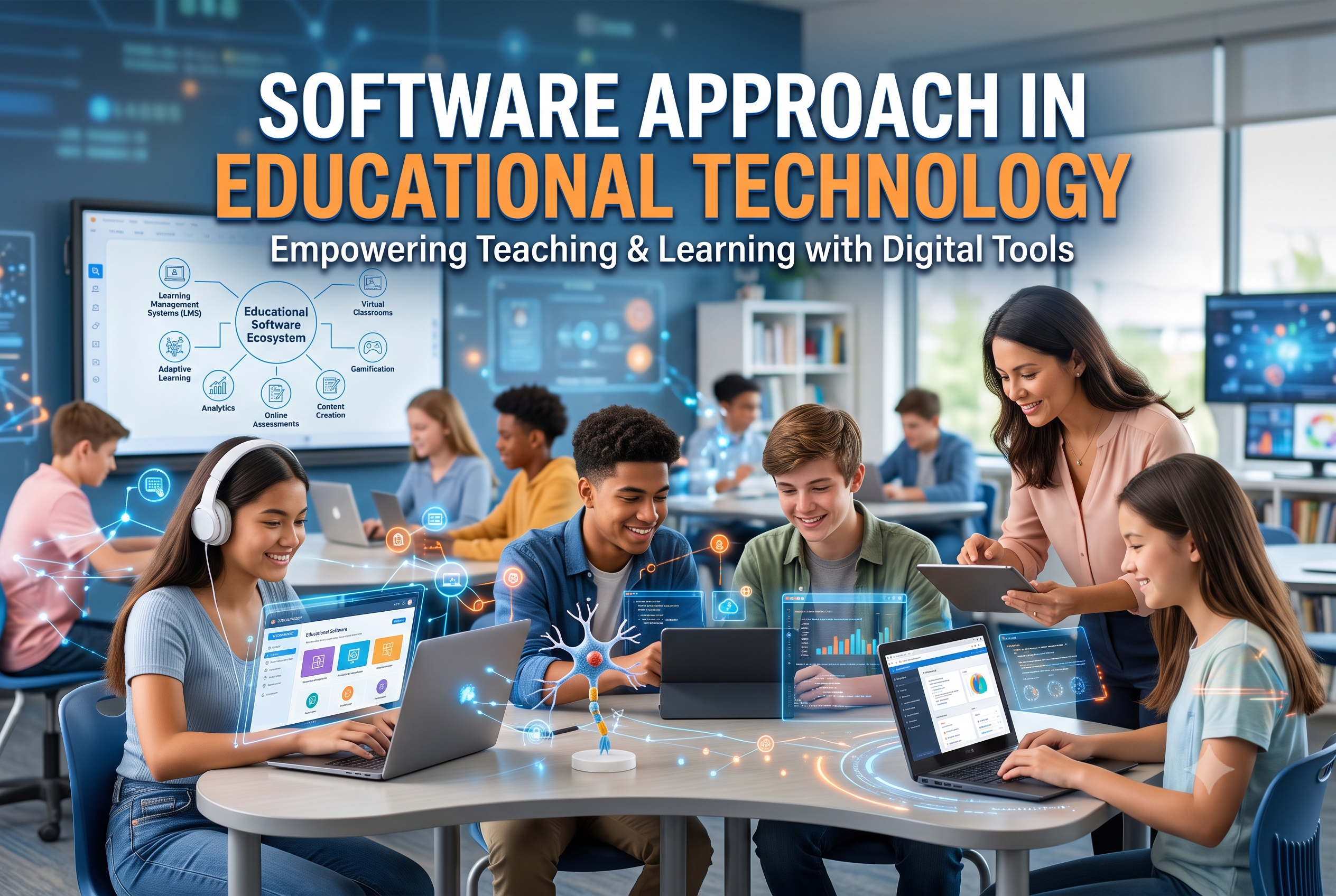
When people talk about “technology in education,” most minds jump straight to devices — smartboards, tablets, projectors. But long before any of that hardware existed, educators were already grappling with a deeper question: how do you design instruction so it actually works? That question is what gave rise to the software approach in educational technology — a framework built not around machines, but around the deliberate, psychology-based design of teaching and learning.
This article breaks down what the software approach actually means, where it came from, how it compares to the hardware approach, what it looks like in a real classroom today, and where its limits are. It’s part of our ongoing education technology resources and insights, where we cover the ideas shaping how modern institutions teach, manage, and support students.
What Is the Software Approach in Educational Technology?
The software approach in educational technology refers to the systematic use of psychology-of-learning principles to shape how teaching is planned, delivered, and evaluated — independent of any particular device. Rather than asking “what machine can help me teach this,” the software approach asks “what sequence of instruction, feedback, and reinforcement will actually produce learning.”
Its theoretical roots lie in behavioural science, most notably the work of B.F. Skinner on programmed instruction and behaviour modification. Skinner’s insight was simple but powerful: learners progress faster when material is broken into small steps, each followed by immediate feedback. That idea — task analysis, precise objectives, and constant reinforcement — became the backbone of the software approach.
Because of this behavioural-science foundation, the software approach in educational technology is also known by several other names across the literature:
- Instructional Technology
- Teaching Technology
- Behavioural Technology
- Constructive Educational Technology (a term coined by Silverman in 1968)
All of these describe the same underlying idea — technology as a process for designing learning, not a product you plug in.
Hardware Approach vs. Software Approach — Key Differences
The software approach is almost always discussed alongside its counterpart, the hardware approach. The two aren’t rivals; they’re complementary halves of the same broader field of educational technology. The hardware approach mechanises teaching using physical devices — radios, projectors, computers — and has its roots in physical science and engineering. The software approach, by contrast, is concerned with how instruction is designed and delivered, and it draws on psychology and behavioural science instead.
| Aspect | Hardware Approach | Software Approach |
|---|---|---|
| Origin / discipline | Physical science and applied engineering | Behavioural science and psychology of learning |
| Focus | Physical devices and equipment | Instructional design, teaching strategy, learning materials |
| Examples | Radio, TV, projectors, computers, teaching machines | Programmed learning material, flash cards, lesson sequencing, educational software |
| Orientation | Product-oriented — delivers a finished service | Process-oriented — designs the material the hardware later delivers |
| Scale / mass appeal | High — one broadcast or device reaches many learners at once | Lower — depends on how the material is distributed, not the device itself |
| Dependency | Needs software (content, design) to be useful — hardware alone delivers nothing | Can function without hardware — a printed programmed-learning workbook works with no device at all |
In short: hardware mechanises delivery; software designs what gets delivered and how. A computer (hardware) is inert without a well-designed lesson sequence or learning app (software) running on it — and a well-designed lesson sequence can, in principle, still work with nothing more than a printed worksheet.
Core Principles of the Software Approach
Across the literature, the software approach in educational technology is consistently defined by five core characteristics:
- Task analysis — breaking a learning goal down into its smallest teachable components before designing instruction around it.
- Precise, behavioural objectives — stating exactly what a learner should be able to do after instruction, in observable, measurable terms.
- Selection of appropriate learning strategies — choosing the teaching method (drill, discovery, discussion, practice) that fits the objective, rather than defaulting to one style for everything.
- Immediate reinforcement of responses — giving learners fast feedback on whether they got something right, which is what makes learning stick.
- Continuous evaluation — checking outcomes constantly and adjusting the approach, rather than waiting until a final exam to find out what didn’t work.
Together, these principles describe a process, not a product — which is exactly why the software approach can be applied with almost any tool, from a 1960s programmed-learning textbook to a modern AI tutor.
The Software Approach in Practice — 5 Real Examples
The theory behind the software approach is decades old, but it shows up constantly in classrooms and learning platforms today. Here are five concrete examples:
- Open access to information. Connected learning platforms and open educational resources let students reach primary sources, journals, and tutorials directly, instead of relying solely on a teacher’s lecture. This reflects the software approach’s emphasis on well-designed access to material, not just the device used to view it.
- Automated testing and instant feedback. Online quizzes that grade themselves and show a student their result immediately are a direct, modern descendant of Skinner’s core principle: reinforcement has to be immediate to be effective. The device (a laptop or phone) is incidental — the design of instant feedback is the software approach at work.
- Teacher-student backchannels. A simple live chat or Q&A channel lets students ask questions in real time and get help without waiting for the next class. This is a software-approach solution because it’s about how communication and feedback are structured, not which app happens to carry it.
- Accessibility tools for students with disabilities. Text-to-speech, screen readers, and adaptive interfaces are designed around the specific learning needs of the student — a hallmark of the software approach’s learner-centred, psychology-driven design philosophy.
- Self-paced, programmed learning sequences. Step-by-step course modules that only unlock the next lesson once a student demonstrates mastery of the current one are the clearest living example of Skinner’s original programmed instruction — just delivered digitally instead of on paper cards.
From Programmed Learning to Modern Adaptive Software
It’s worth pausing on why a mid-20th-century behavioural theory still matters to anyone building or choosing educational software today. Skinner’s original programmed instruction was rigid — a fixed sequence of steps every learner followed in the same order. Modern adaptive learning platforms and AI-assisted tools take the same core principles — task analysis, immediate feedback, continuous evaluation — and make them dynamic: the sequence itself adjusts based on how each individual learner performs.
That’s the real throughline of the software approach in educational technology: it was never really about programmed cards or flash cards specifically. It was about designing instruction around how people actually learn. Every generation of tools since — from the tape recorder to the LMS to today’s AI-driven platforms — has just been a new hardware layer running on the same underlying software-approach logic. If you’re curious how this plays out in institutional software specifically, our AI capabilities page walks through where automation and adaptive logic show up in day-to-day education-sector tools.
Limitations of the Software Approach
The software approach isn’t without its drawbacks, and it’s worth being honest about them:
- Rigid objectives can feel mechanical. Because the approach relies on precise, behaviourally-stated objectives, it can undervalue open-ended, exploratory learning that doesn’t reduce neatly to a measurable outcome.
- Lower mass-scale reach than the hardware approach. A radio broadcast or television lesson can reach thousands of learners simultaneously; a carefully designed instructional sequence generally can’t scale the same way without good delivery infrastructure.
- Still depends on some delivery mechanism. Well-designed software-approach material needs a way to actually reach learners — a workbook, a platform, a teacher trained to use it — so it can’t be considered entirely independent of hardware or infrastructure in practice.
- Demands skilled instructional design. Task analysis, writing precise objectives, and designing feedback loops well is a specialised skill. Not every school or institution has that expertise in-house, which is part of why the systems approach — which combines hardware and software approaches under one coordinated plan — is often recommended as the more complete framework.
Frequently Asked Questions
What is the software approach in educational technology? It’s the use of psychology-of-learning and behavioural-science principles to design how teaching and learning happen — covering objectives, methods, feedback, and evaluation — independent of any specific device.
Who introduced the software approach to educational technology? Its theoretical foundation comes from B.F. Skinner’s work on programmed instruction and behaviour modification. The term “Constructive Educational Technology,” used as an alternative name for the software approach, was coined by Silverman in 1968.
What is the difference between the hardware and software approach? The hardware approach uses physical devices (radios, computers, projectors) rooted in engineering, while the software approach uses instructional design and psychology-of-learning principles rooted in behavioural science. Hardware delivers; software designs what gets delivered.
What are examples of the software approach in the classroom? Common examples include instant-feedback online quizzes, self-paced learning modules that unlock progressively, teacher-student backchannels for real-time Q&A, and accessibility tools designed around individual learner needs.
How does the software approach relate to the systems approach? The systems approach combines both the hardware and software approaches into one coordinated plan — setting objectives, choosing media, and evaluating outcomes continuously — so it’s often seen as the more complete framework that addresses the individual limitations of each approach on its own.
Conclusion
The software approach in educational technology is fundamentally about instructional design and learning psychology, not about any particular device. From Skinner’s original programmed instruction to today’s adaptive learning platforms, its core principles — task analysis, precise objectives, immediate feedback, and continuous evaluation — remain the backbone of how effective digital learning tools are built. Understanding it isn’t just an academic exercise: it’s the theory quietly underpinning nearly every piece of educational software in use today.
For more explainers like this, browse our full knowledge base.




Leave a comment: