
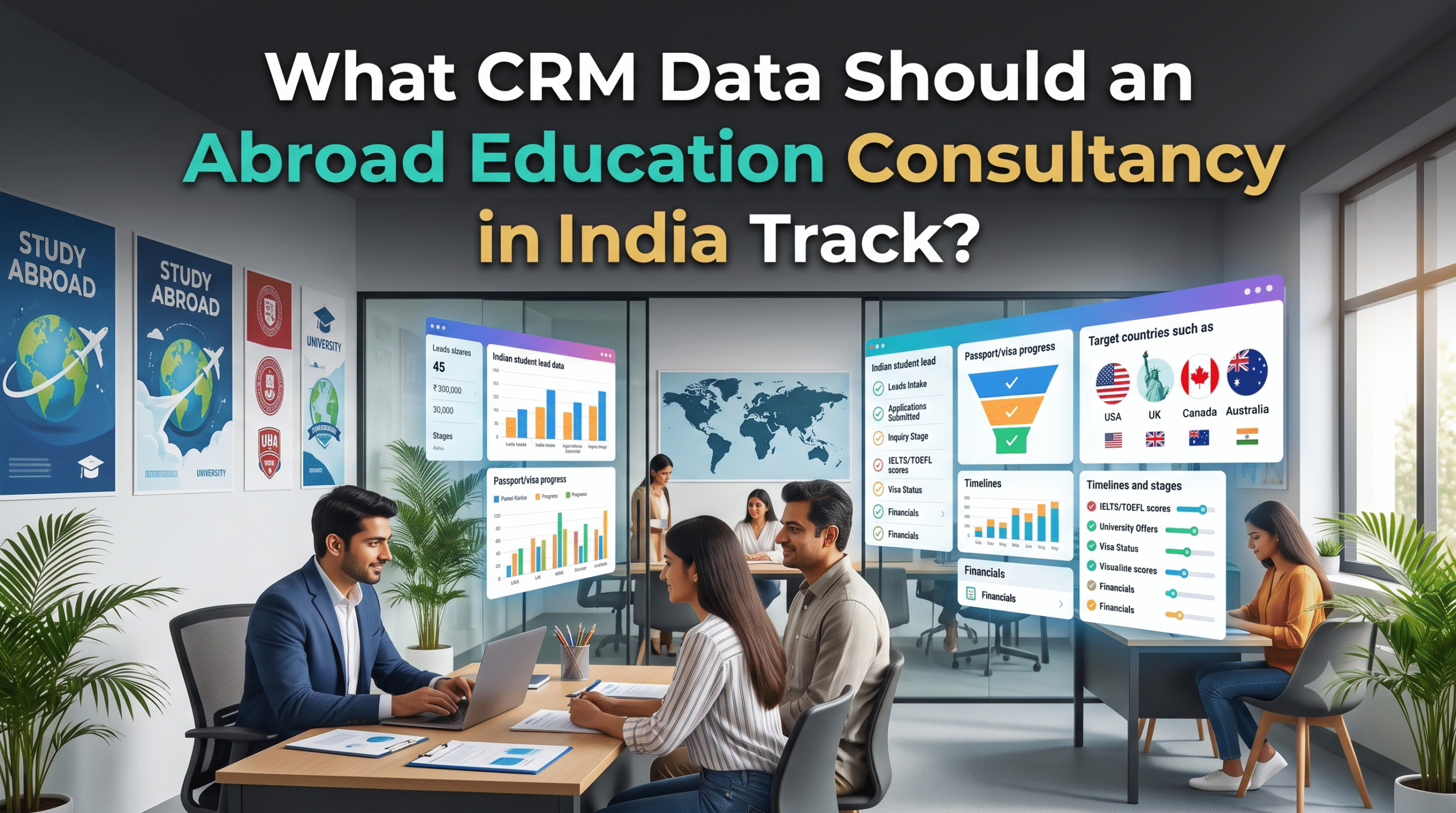
What CRM Data Should an Abroad Education Consultancy in India Track?
An abroad education consultancy in India should track nine types of CRM data: student profile data, lead source data, study preference data, counselling and communication history, test score and eligibility data, document status, application and university data, visa and finance data, and sub-agent and team performance data. Together, these fields show where every student stands today and which stage of the pipeline is losing enrolments.
Most consultancies already collect this information. The problem is where it lives: an IELTS score in one WhatsApp chat, the budget in a counsellor’s notebook, the shortlist in a spreadsheet. When that counsellor leaves, the student’s history goes with them.
This guide lists exactly what CRM data an abroad education consultancy in India should track, field by field, and explains why each group matters. It also covers reporting metrics, data hygiene, consent records under Indian data protection law, and a practical rollout plan. If you are still deciding on software, read our guide on how to choose the right CRM for an abroad education consultancy in India alongside this one.
Key Takeaways
- Track data across the full student journey, from first enquiry to post-visa pre-departure, not only leads.
- Capture lead source and campaign data on day one, because it decides where your marketing budget goes.
- Store documents, application stages and visa milestones as structured fields with dates, not as free-text notes.
- Record consent and communication preferences for every student to stay aligned with India’s data protection rules.
Why Does CRM Data Tracking Matter for Abroad Education Consultancies?
CRM data tracking matters because an overseas education business runs on long, multi-step relationships. A single student may talk to your team for six months or more, involve parents, switch target countries twice, and submit applications to several universities before a visa decision arrives. Each step creates data, and each missed step costs money.
Without structure, leads from different channels get mixed together, counsellors ask families the same questions repeatedly, document gaps surface a week before a deadline, and owners cannot answer simple questions such as how many UK September applicants are waiting on a financial document.
A well-designed study abroad CRM solves these problems only if the right data goes into it. For a deeper look at the business case, see why abroad education consultants in India need CRM software.
What Are the 9 Types of CRM Data an Abroad Education Consultancy Should Track?
The table below summarises the nine data groups, the example fields in each, and the business question each one answers. The sections that follow explain each group in detail.
| # | Data group | Example fields | Question it answers |
|---|---|---|---|
| 1 | Student profile | Name, phone, email, city, parent contact, education level | Who is this student and how do we reach them? |
| 2 | Lead source | Channel, campaign, referrer, enquiry date | Which channels produce enrolled students? |
| 3 | Study preferences | Country, course, intake, budget, scholarship need | What does this student actually want? |
| 4 | Counselling history | Calls, WhatsApp, meetings, notes, next follow-up | What was said and what happens next? |
| 5 | Test and eligibility | IELTS, PTE, GRE, GPA, backlogs, work experience | Which universities can this student realistically target? |
| 6 | Documents | Checklist, upload status, verification, expiry dates | What is missing before the deadline? |
| 7 | Applications | University, course, portal ID, status, offer type | Where is each application right now? |
| 8 | Visa and finance | Funds proof, loan status, visa file date, decision | Is the student on track to fly? |
| 9 | Partners and team | Sub-agent, counsellor, commission, conversion rate | Who and what is driving results? |
1. Student Profile and Contact Data
Student profile data is the base record that every other field attaches to. Keep it clean and complete, because a duplicate or incomplete profile creates problems at every later stage.
Fields to track:
- Full name exactly as printed on the passport, since applications and visa forms depend on it
- Primary mobile number, WhatsApp number (if different) and email address
- City, state and preferred language for communication
- Date of birth and current education level
- Parent or guardian name, phone number and relationship
Parents often fund and influence the decision in India, so give them a separate contact record with their own communication preferences. For how this connects to a full enquiry workflow, read about how a CRM can manage student enquiries for abroad education consultants in India.
2. Lead Source and Enquiry Data
Lead source tracking tells you where students come from and which channels turn into enrolments. This is the data that turns marketing from guesswork into a measurable system.
Fields to track:
- Lead channel: website form, Facebook or Instagram ad, Google ad, WhatsApp click, walk-in, education fair, referral, sub-agent or alumni
- Campaign name, ad set and landing page, where applicable
- Referrer name for word-of-mouth leads
- Enquiry date and time
- First response time, meaning the gap between enquiry and the first counsellor contact
- Duplicate flag, to catch the same student enquiring through two channels
The most useful metric built from this data is cost per enrolled student by channel, not cost per lead. A channel that brings cheap leads but few enrolments is more expensive than one that brings fewer, better-qualified leads. You can only calculate this if the source field is mandatory and standardised. Use a fixed dropdown list so “Insta”, “Instagram” and “IG ads” do not become three sources.
First response time deserves its own field, because students often contact several consultancies at once and the fastest reply usually wins the first serious conversation. Our guide to education CRM software for student enquiries and admissions shows how automated assignment can reduce that gap.
3. Study Preference and Intent Data
Study preference data captures what the student wants, and it should be updated whenever the student changes their mind. Students rarely stay with their first choice, so treat this data as living information.
Fields to track:
- Preferred countries, ranked in order of priority
- Level of study: foundation, undergraduate, postgraduate, MBA or PhD
- Interested course or field, and a backup option
- Target intake, such as January, May or September, and year
- Budget range for tuition and living costs
- Scholarship or assistantship requirement
- Funding source: self-funded, family, education loan or sponsor
Budget and intake most often decide a student’s timeline. When these two fields are blank, counsellors waste calls on options the family cannot afford.
Add a simple intent score too: “exploring”, “shortlisting” or “ready to apply”. It helps counsellors prioritise follow-up.
4. Counselling and Communication History
Counselling history is the running record of every interaction with the student and family. It is the data that protects continuity when staff change and prevents students from repeating themselves.
Fields to track:
- Date, channel (call, WhatsApp, email, in-person, video) and counsellor for every interaction
- A short outcome note covering what was discussed and decided
- Next follow-up date and the purpose of that follow-up
- Counselling session type: first consultation, profile evaluation, shortlist discussion, SOP guidance, visa counselling
- Parent involvement: whether parents attended or were updated
- Reasons for delay or objection, selected from a standard list such as budget, family approval, test score, country change or competing consultancy
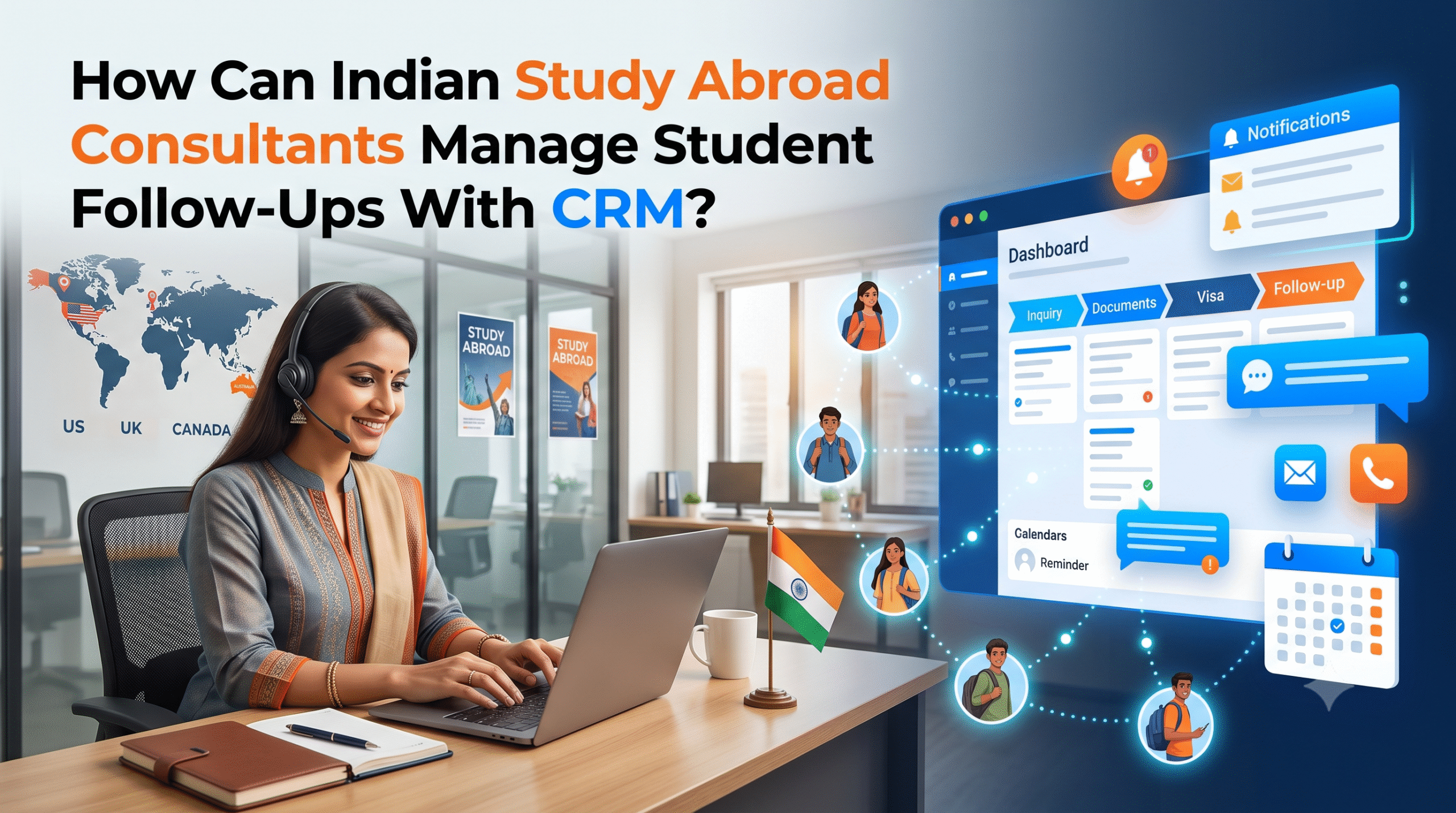
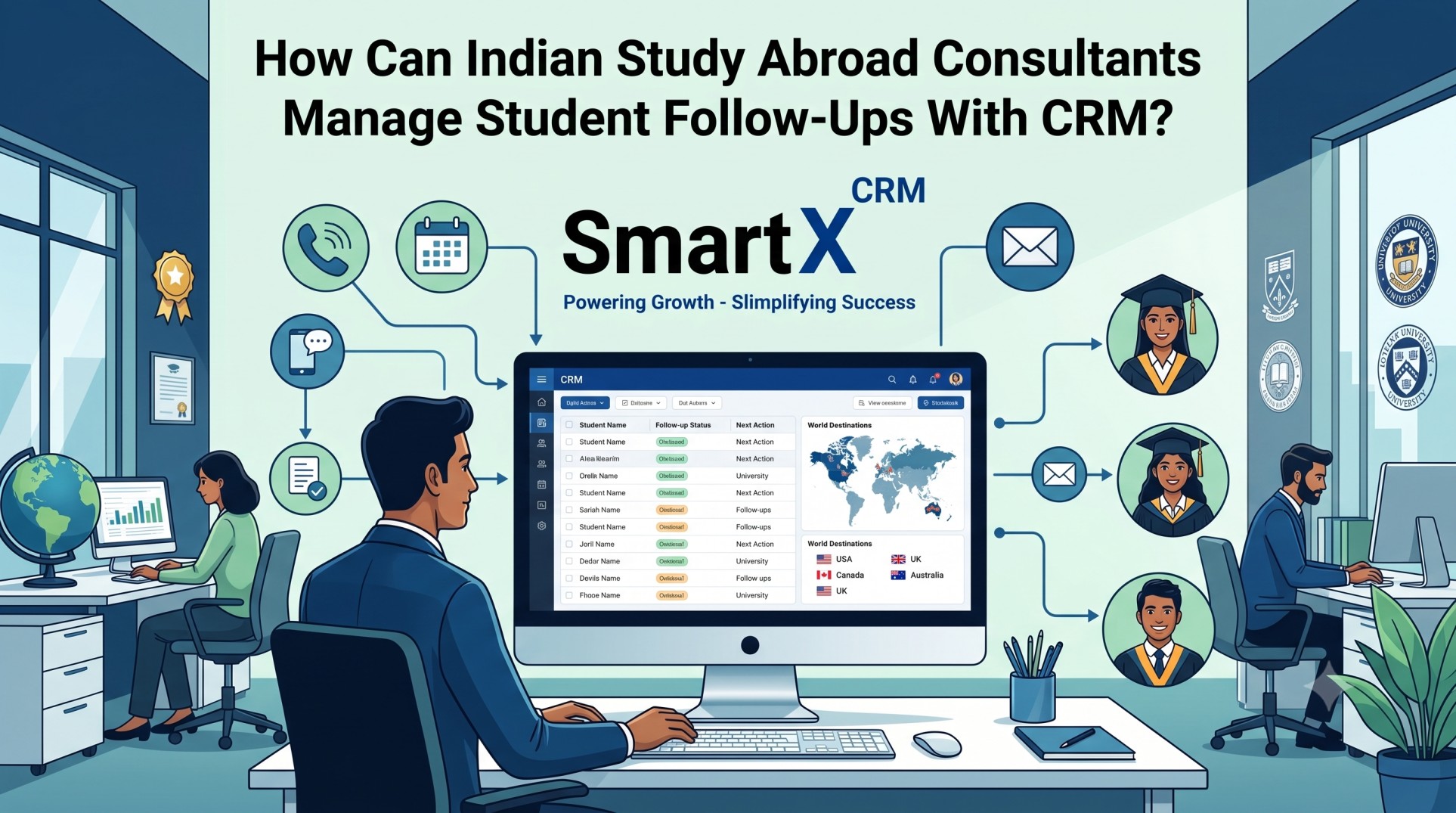
The “next follow-up date” is the single most valuable field in this group. A lead with no scheduled next step is effectively abandoned. Setting this field every time and reporting on overdue follow-ups turns the CRM into an active task manager rather than a passive database. Read more about this in our guide on how Indian study abroad consultants can manage student follow-ups with a CRM.
For messaging data, record WhatsApp conversations inside the CRM rather than on individual phones. A WhatsApp-enabled CRM for study abroad agents keeps the conversation linked to the student record automatically, so the history survives any change in the team.
5. Test Score and Eligibility Data
Test score and eligibility data determines which universities and countries are realistic for each student. Capturing it in structured fields lets you filter and shortlist in seconds.
Fields to track:
- English test type, overall score, section scores, test date and validity period (IELTS, TOEFL, PTE, Duolingo)
- Aptitude tests where relevant: GRE, GMAT, SAT
- Planned test dates and coaching status, if the student is still preparing
- Academic percentage or CGPA, board or university, and year of passing
- Active and past backlogs
- Gap years, with a short reason
- Work experience in months, with employer and role
Validity dates are easy to forget and expensive to miss. Most English test scores expire after two years, so your CRM should flag a score that will lapse before the visa stage. Backlogs and study gaps should also be visible fields, because they affect which universities will consider the file.
Numeric scores also feed course matching. A university and course finder inside the CRM makes this a one-step task rather than a manual comparison across dozens of university websites.
6. Document Checklist and Verification Data
Document data should be tracked as a checklist with a status, a date and an owner for every item. This is the stage where most consultancies lose time, and it is the stage most improved by structure.
Fields to track for each document:
- Document type: passport, academic transcripts, degree certificates, English test report, SOP, letters of recommendation, CV, work experience letters, bank statements, income proof, medical and police clearance where needed
- Status: requested, received, under review, approved, rejected or expired
- Date requested and date received
- Reviewer name and review notes
- Expiry date for time-sensitive items such as bank statements and test reports
- Country-specific requirement flags, since the UK, Canada, Australia, Germany and the USA all ask for different sets
A country-wise checklist template is one of the highest-value assets a consultancy can build. When a student selects Canada, the CRM should generate the Canada checklist automatically, which reduces rejected files. SmartX CRM’s document management module is built around this idea, linking each file to the student and the application it supports.
7. Application and University Data
Application data records every university application you submit on a student’s behalf and its exact status. Without it, owners cannot see pipeline health, and students cannot get reliable updates.
Fields to track:
- University, campus, course, level and intake
- Application route: direct, through a representative or through a centralised portal
- Application portal ID and login reference (stored securely)
- Application stage: not started, in progress, submitted, under review, additional documents requested, offer received, rejected or withdrawn
- Offer type: conditional, unconditional or scholarship offer, with conditions listed
- Offer acceptance deadline and deposit due date
- CAS, I-20, COE or equivalent document status, depending on the country
Track conditional offers carefully. A conditional offer is not an enrolment, so each condition, such as a final transcript or an English score, needs its own due date and owner.
A dedicated application management workflow also protects your relationship with partner universities, because clean, complete submissions improve your reputation with admissions teams. For deadline-focused tracking, see how consultants can avoid missing visa and university deadlines with a CRM.
8. Visa, Finance and Pre-Departure Data
Visa and finance data tracks the final and most sensitive stage of the student journey. A student can hold a perfect offer letter and still miss the intake because of a visa or funding delay.
Fields to track:
- Visa type, country and application date
- Biometrics or interview appointment date
- Visa file status: preparing, submitted, additional documents requested, approved, refused or reapplying
- Refusal reason and reapplication plan, where relevant
- Proof of funds status and expiry date
- Education loan details: bank, application date, sanction status and disbursal date
- Pre-departure briefing completed: yes or no, with date
Visa refusal reasons are especially valuable, because patterns such as weak financial documentation improve your counselling before the next file goes in. A dedicated visa management module and visa tracking workflow keep these milestones visible in one view.
9. Sub-Agent, Partner and Commission Data
If your consultancy works with sub-agents, referral partners or university representatives, you need a separate data layer for them. Mixing partner data with student data makes commission tracking and performance review very difficult.
Fields to track:
- Sub-agent name, contact, city and agreement date
- Leads submitted, applications filed and enrolments completed per sub-agent
- Commission rate, commission earned, commission paid and payment dates
- University partner commission terms, claim status and payment status
- Document and lead quality score per partner, such as the share of files returned for missing documents
With this data you can see which partners send quality files and which send incomplete ones, and commission disputes shrink. SmartX CRM’s B2B sub-agent management module is designed for this type of partner network, where every sub-agent sees only their own students.
10. Team Performance and Conversion Metrics
Team performance data turns all the fields above into decisions. Choose a small set of metrics and review them on a fixed rhythm, rather than building dashboards no one reads.
| Metric | How to calculate it | What it tells you |
|---|---|---|
| Lead to counselling conversion | Counselled students divided by total leads | Quality of lead sources and speed of first response |
| Counselling to application conversion | Applications filed divided by counselled students | Counsellor effectiveness and shortlist quality |
| Application to offer rate | Offers divided by applications | Profile strength and university fit |
| Offer to visa approval rate | Visa approvals divided by offers | File quality and visa counselling |
| Visa approval to enrolment rate | Students who joined divided by visa approvals | Pre-departure support |
| Average days per stage | Mean time spent between pipeline stages | Where students get stuck |
| Overdue follow-ups | Count of follow-ups past due date | Discipline and workload balance |
| Cost per enrolled student by channel | Channel spend divided by enrolments | True return on marketing spend |
Review these by counsellor, country and intake. Read about the CRM features that matter most for education consultants in India to see how reporting fits into the wider toolset, and explore the CRM reports module to see how pipeline data becomes dashboards.
How Do You Keep CRM Data Clean and Reliable?
You keep CRM data reliable by making important fields mandatory, using dropdowns instead of free text, assigning clear ownership, and auditing the database on a regular schedule. Good data is a habit, not a one-time import.
Use these data hygiene rules:
- Make core fields mandatory at stage changes. A student cannot move to “Application Submitted” without a university, course and intake selected.
- Standardise values. Use fixed lists for lead source, country, intake and rejection reason.
- Block duplicates at entry. Match on mobile number and email so one student has one record.
- Assign an owner to every record. Unowned leads are the first to be forgotten.
- Run a monthly audit. Check for missing phone numbers, overdue follow-ups, expired test scores and stale applications.
Clean spreadsheets before migrating, because importing messy data only moves the problem. Our comparison guide on what an Indian abroad education consultancy should look for in CRM software includes import and customisation checks worth running before you commit.
What Consent and Privacy Data Should You Track Under Indian Law?
You should track who consented to data collection, what they consented to, when they agreed and how they prefer to be contacted. Education consultancies handle passports, financial records, academic history and family details, so privacy practice is part of data tracking.
India’s Digital Personal Data Protection Act, 2023 sets out obligations for organisations that process personal data, including notice, consent and purpose limitation. Rules and timelines continue to be phased in, so confirm current requirements with a qualified legal advisor before finalising your policy.
Consent and privacy fields worth tracking:
- Consent given: yes or no, with date, time and source (form, call or WhatsApp)
- Purpose of consent, such as counselling, marketing messages or sharing data with universities
- Communication preferences: preferred channel, language and quiet hours
- Opt-out status for promotional messages
- Data sharing log showing which university or partner received which documents
Role-based access is not optional: a sub-agent should never see another agent’s students. For a fuller treatment, read our education consultancy CRM data security guide.
How Does SmartX CRM Help You Track This Data?
SmartX CRM gives abroad education consultancies a single workspace to capture, structure and report on each of the nine data groups above. It is built for the study abroad and immigration workflow, rather than adapted from a generic sales tool.
Educa CRM brings together lead management, student profiles, application tracking, documents and visa milestones. Supporting modules cover sub-agent management, reporting and integrations with the communication tools your team already uses. Consultancies that rely on WhatsApp can explore SmartX WA Daddy for bulk messaging and conversation tracking.
If you are comparing options, our study abroad CRM comparison guide explains how to evaluate platforms side by side, and the pricing page outlines current plans.
How Can You Roll Out CRM Data Tracking in 30 Days?
Start small. In week one, define pipeline stages and the mandatory fields for each. In week two, build the pipeline, add country-wise document checklists, clean your spreadsheet and import active leads only. In week three, train counsellors on three habits: log every interaction, set the next follow-up date and update the stage the same day. In week four, run your first pipeline review and fix the stage with the longest delay. For wider context, see our explainer on what CRM means in overseas consultancy and learn what makes CRM software suitable for abroad education consultants in India.
Frequently Asked Questions
What is the most important CRM data for an abroad education consultancy?
The most important data is the lead source, the study preferences (country, course, intake and budget) and the next follow-up date. These three groups decide whether a lead gets contacted, matched to the right options and converted into an application.
How many fields should a study abroad CRM have?
Start with 25 to 40 well-chosen fields across the student journey, and make only the stage-critical ones mandatory. Add more only when a specific report or workflow needs them. Too many mandatory fields reduce data quality.
Should I track parent details in my CRM?
Yes. In India, parents often influence or fund the decision. Record the parent’s name, contact number, relationship and communication preference, and note whether they have consented to receive updates.
How do I track visa refusals in a CRM?
Create a visa outcome field with approved, refused and reapplying options, plus a refusal reason from a standard list. Over time this reveals patterns, such as financial documentation gaps, that you can fix before the next submission.
What KPIs should an overseas education consultancy track?
Track lead to counselling conversion, counselling to application conversion, application to offer rate, offer to visa approval rate, visa to enrolment rate, average days per stage, overdue follow-ups and cost per enrolled student by channel.
Is it legal to store student passports and documents in a CRM?
Storing documents with consent and for a stated purpose is common practice, but you must handle them securely and in line with the Digital Personal Data Protection Act, 2023. Use role-based access, record consent and consult a legal advisor about current rules.
Can a CRM track sub-agent commissions?
Yes. A good CRM records each sub-agent’s leads, applications and enrolments, along with the commission rate, amount earned and payment status. That gives both sides a transparent record and reduces disputes.
How often should I clean my CRM data?
Run a light audit weekly for overdue follow-ups and a full audit monthly for duplicates, missing fields, expired test scores and stale applications. Quarterly, review whether your fields and lists still match your workflow.
Conclusion: Track the Whole Journey, Not Just the Lead
The CRM data an abroad education consultancy in India should track covers far more than names and phone numbers. It spans lead source, study preferences, counselling history, test scores, documents, applications, visa and finance milestones, partner performance and consent records. Each group answers a question that affects revenue, student experience or compliance.
Start with the fields that unlock the most value: standardised lead source, intake and budget, next follow-up date, document status and application stage. Make them mandatory at the right moments, review the core metrics weekly and expand gradually.
Ready to see this data model in a working system? Book a SmartX CRM demo or start a free demo to set up your pipeline, document checklists and reports around your consultancy’s process.
Leave a comment: