
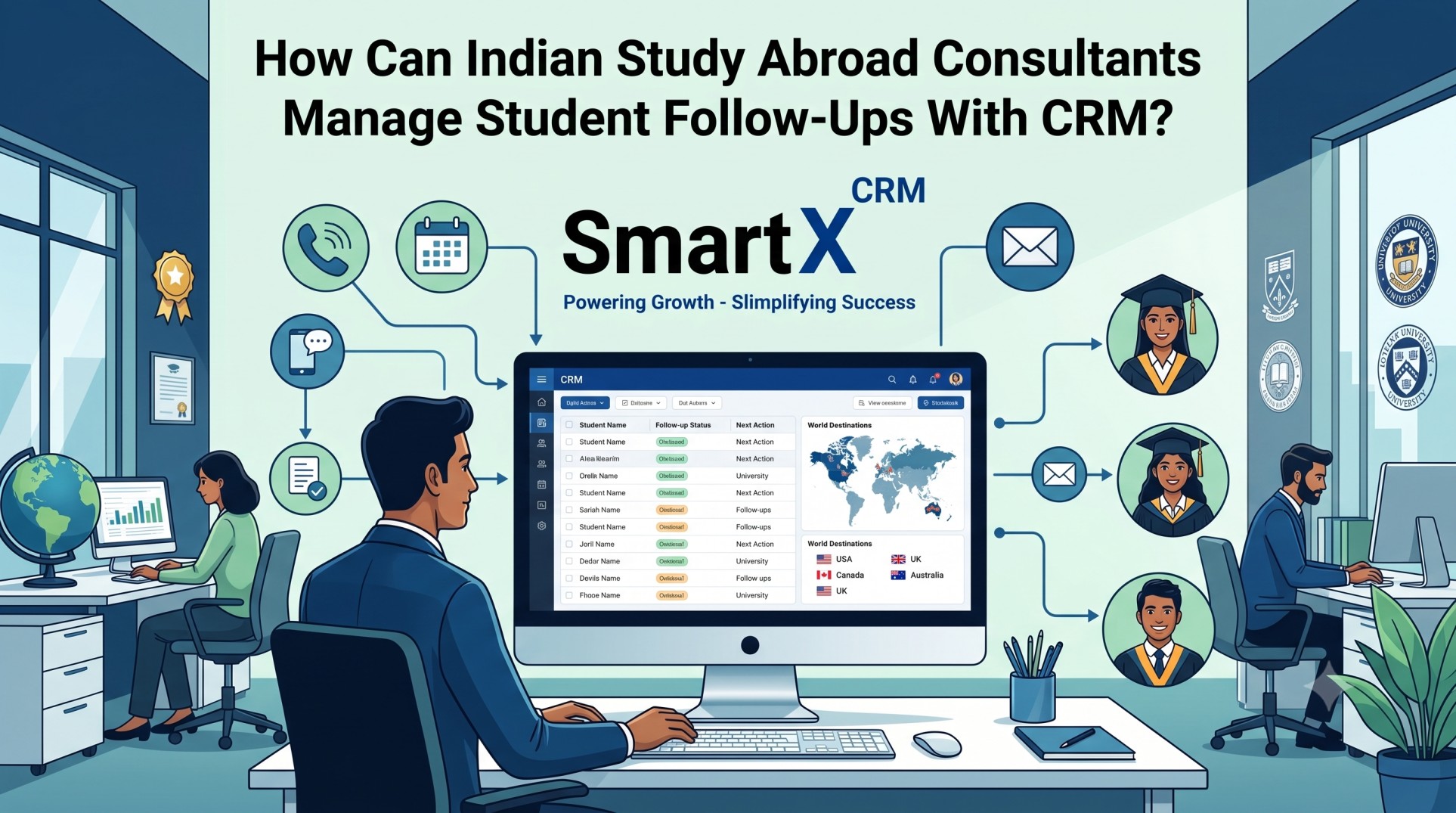
Every study abroad consultancy in India has the same quiet leak. A student enquires on Monday, has a pleasant first call on Tuesday, says “let me discuss with my parents,” and then the conversation simply stops. Nobody was rude and nobody said no. The follow-up just never happened, and three weeks later the student signs up with another consultancy down the road.
If you run an overseas education business in Surat, Ahmedabad, Vadodara, Rajkot, or anywhere else in India, you have probably lived this story many times. The good news is that it is fixable. When you manage student follow-ups with CRM, the follow-up stops depending on a counselor’s memory, mood, or workload and starts depending on a system that never forgets.
This guide explains exactly how Indian study abroad consultants can build a reliable student follow-up system inside a CRM. You will get a stage-wise follow-up cadence, a seven-step setup process, a WhatsApp, call, and email playbook, the KPIs worth tracking, and a 30-day rollout plan you can start this week.
Key Takeaways
- Most lost students are lost to silence, not to competitors. A lead follow-up process with clear rules fixes that.
- A CRM for study abroad consultants should tie every follow-up to a pipeline stage, an owner, a due date, and a channel.
- WhatsApp is the main channel in India, but it works best when it is logged inside the CRM and combined with calls and email.
- Parents, sub-agents, and document deadlines need their own follow-up tracks, not just the student.
- Measure overdue follow-ups, first response time, and stage-to-stage conversion every week.
Why Student Follow-Ups Break Down in Study Abroad Consultancies
Before fixing the problem, it helps to understand why it keeps happening. Follow-up failure in a study abroad consultancy is rarely about lazy counselors. It is almost always a structural problem.
Spreadsheets and WhatsApp chats are not a follow-up system
Many consultancies still run on Excel sheets, personal phone contacts, and scattered WhatsApp chats. A counselor remembers that a student wanted to “call after IELTS results,” but that note lives in a chat that only one person can see. If that counselor is on leave or leaves the company, the context leaves with them. We explain this gap in more detail in our comparison of CRM vs Excel.
Intake seasons create sudden surges
Study abroad enquiries are not evenly spread. They spike before the major intakes for the UK, Canada, Australia, the USA, and Germany. During a surge, a single counselor may handle dozens of active students at once. Without automated reminders, the students who are not shouting for attention are the ones who get forgotten, and those are often the students who were quietly ready to convert.
Parents are part of the decision
In India, a student rarely decides alone. Parents influence the country, the budget, the university, and the final yes. A follow-up that only reaches the student misses half the audience. A CRM that stores parent contacts and parent concerns on the same record lets you follow up with the right person at the right time.
Counselor turnover erases history
Overseas education teams see frequent staff changes. When a counselor leaves, hundreds of half-finished conversations go with them. A shared CRM keeps the full conversation history, so the next counselor can pick up exactly where the last one stopped.
What a CRM Follow-Up System Actually Does
A CRM does not make follow-ups happen by magic. It removes the four excuses that cause them to be skipped: forgetting, not knowing what to say, not knowing who owns the student, and not being able to see what happened last time.
A well-configured system does the following:
- Creates a follow-up task automatically whenever a lead enters a stage or a call ends.
- Assigns an owner so there is never a student without a responsible counselor.
- Sends reminders to the counselor before a follow-up is due and escalates it to a manager once it is overdue.
- Logs every touchpoint across calls, WhatsApp, email, and walk-ins on one timeline.
- Shows managers the real picture through reports on overdue tasks, response times, and conversion by stage.
This is the foundation of good lead management. If you are still deciding which platform fits your team, our guide on how to choose the right CRM walks through the evaluation criteria in detail, and the breakdown of CRM features that matter most shows which capabilities directly affect follow-up quality.
Build a Stage-Wise Follow-Up Cadence
The biggest mistake consultancies make is using one follow-up rule for every student. A new enquiry and a student waiting for a visa decision need completely different conversations. The fix is a cadence built around your pipeline stages.
Here is a practical starting framework for study abroad consultants in India. Adjust the timing to match your own volume and team size.
| Pipeline stage | Follow-up goal | Suggested timing | Best channel | What the CRM should do |
|---|---|---|---|---|
| New enquiry | Make first contact and qualify | Within minutes to a few hours | Call, then WhatsApp | Auto-assign owner, create call task |
| First counseling done | Confirm interest and next step | Same day summary, then 2 days | WhatsApp, call | Log notes, schedule next task |
| Profile evaluation and shortlist | Share country and university options | 2 to 3 days | Email, WhatsApp | Attach shortlist, set decision date |
| Documents and application | Collect missing documents | Every 2 to 3 days | WhatsApp, call | Track checklist, flag gaps |
| Offer received | Push toward acceptance and deposit | 24 to 48 hours | Call, parent call | Alert manager if no response |
| Visa filing | Keep the file on schedule | Weekly or at each milestone | WhatsApp, email | Update status, set deadlines |
| Pre-departure | Prepare and collect referrals | 1 to 2 weeks before travel | WhatsApp, call | Send checklist, request review |
The “cold lead” rule
Not every enquiry converts quickly, and that is fine. Decide in advance how many attempts you will make before moving a student to a nurture list. A common approach is several attempts over two to three weeks across different channels, then a move to a slower monthly nurture track. The CRM should do this move automatically so no counselor has to remember to do it.
Reason-based follow-ups beat generic check-ins
A message that says “Just checking in” gives the student nothing to respond to. Every follow-up should carry a reason: a new intake deadline, a scholarship update, a missing document, a university response, or a visa slot. Good CRM notes make this possible because the counselor can read the last conversation in ten seconds and write something specific.
Step-by-Step: How to Set Up Student Follow-Ups in Your CRM
Here is a seven-step process any consultancy can follow, whether you have three counselors or thirty.
Step 1: Map your real pipeline
Write down the actual stages a student passes through in your business, from enquiry to departure. Keep it between six and ten stages. Too few and you lose visibility, too many and counselors stop updating them.
Step 2: Define the follow-up rule for each stage
For every stage, decide the goal, the maximum gap between touches, the channel, and the owner. The table above is a good starting point. Put these rules in writing so everyone follows the same standard.
Step 3: Capture every lead in one place
Follow-ups only work if every lead is inside the system. Connect your website forms, social media ads, walk-ins, and referral sources so enquiries land in the CRM automatically. Our guide on how to manage student enquiries covers capture and assignment in more depth.
Step 4: Automate task creation and reminders
Set the CRM to create a follow-up task each time a stage changes or a call outcome is saved. Add reminders for the counselor and a second reminder for the manager when a task is overdue. This is where you can use automated follow-ups to remove manual tracking entirely.
Step 5: Create message templates
Write short, human templates for each stage in English, Hindi, and Gujarati if your students need them. Templates save time, keep quality consistent, and let new counselors sound experienced from day one. Personalize the name, country, and intake before sending.
Step 6: Make every call outcome mandatory
At the end of each call, the counselor must record an outcome and the next follow-up date. This single habit is what turns a CRM from a database into a follow-up engine. If a call has no next step, the lead is effectively dead.
Step 7: Review overdue tasks daily
Managers should start each day with a list of overdue follow-ups per counselor. A five-minute review prevents most lost students and creates healthy accountability without micromanagement.
Using WhatsApp, Calls, and Email Together
Indian students and parents live on WhatsApp. Ignoring that is a mistake, but relying on WhatsApp alone is also a mistake. The strongest follow-up systems combine channels on purpose.
When to call
Use calls for high-stakes moments: the first contact, post-counseling decisions, offer acceptance, and visa preparation. A call builds trust and lets you hear hesitation that a text message hides.
When to use WhatsApp
Use WhatsApp for quick updates, document requests, reminders, and sharing brochures or checklists. It is fast, familiar, and usually gets a quicker reply than email. To see how this works in practice, read our guide on WhatsApp automation for study abroad agents and learn how to turn WhatsApp conversations into enrollments.
When to use email
Email is best for formal material such as university shortlists, offer letters, fee structures, and visa checklists. Parents and older decision makers often prefer it for documents they want to review and save.
Keep consent and records clean
Only message students and parents who have agreed to be contacted, and follow WhatsApp Business messaging rules for outbound templates. Keep a record of consent inside the CRM. This protects your reputation and supports your wider approach to student data security.
Following Up With Parents and Sub-Agents
A follow-up system that only tracks students is incomplete.
Parent follow-ups
Add parents as linked contacts on the student record. Track their main concerns, usually budget, safety, ROI, and job prospects. Schedule a short parent call after the shortlist and again after the offer. Concerns that are answered early rarely become objections later.
Sub-agent and partner follow-ups
If you work with sub-agents or referral partners, each lead they send needs the same discipline. Delays damage trust and cost you future referrals. A dedicated sub-agent management module lets partners see status updates without calling your team for every query.
Following Up on Documents, Deadlines, and Visas
Late-stage follow-ups are where consultancies often become careless, because the student has already paid or committed. Yet this is where errors are the most expensive.
- Documents: Use a per-student checklist with a due date for each item, and automate reminders for anything pending. A good document management setup shows at a glance what is missing.
- Applications: Track each university application separately, with its own deadline and status. Strong application management prevents duplicated work and missed intake windows.
- Visas: Create dated milestones for financial documents, biometrics, interview preparation, and decision tracking. Dedicated visa tracking keeps the whole team aligned on where each file stands.
For a deeper look at deadline-driven reminders, see our guide to visa and university deadlines.
KPIs to Track Your Follow-Up Performance
You cannot improve what you do not measure. These metrics tell you quickly whether your follow-up system is working.
| KPI | What it tells you | How to use it |
|---|---|---|
| First response time | How fast new enquiries get contacted | Set a target and review it weekly |
| Overdue follow-ups | How many tasks counselors missed | Review daily, escalate repeat cases |
| Contact rate | Share of leads actually reached | Test better call times and channels |
| Stage-to-stage conversion | Where students drop off | Fix the weakest stage first |
| Lead-to-enrollment rate | Overall funnel health | Compare by counselor and source |
| Reactivation rate | Cold leads that restart | Judge whether your nurture track works |
Dashboards and CRM reports make these numbers visible without anyone building spreadsheets. Review them in a short weekly meeting and pick one metric to improve each month.
Common Follow-Up Mistakes to Avoid
Even with a CRM, some habits quietly undermine results.
- Too many stages. If updating the pipeline feels like paperwork, counselors will skip it.
- No next step after calls. A call without a scheduled follow-up leaves the lead floating.
- Over-automation. Automated messages should support personal contact, not replace it. Students can tell the difference.
- Ignoring cold leads. Many students return months later when their plans become firm. Keep nurturing them gently.
- No manager visibility. If nobody reviews overdue tasks, reminders become background noise.
- Following up only when convenient. Contact students when they are available, which is often evenings and weekends.
How SmartX CRM Helps You Manage Student Follow-Ups
SmartX CRM is built for overseas education consultants in India, so its follow-up tools are designed around real counseling workflows rather than generic sales pipelines. Through Educa CRM, consultancies can run their entire student journey in one place.
In practical terms, that means:
- A visual pipeline that shows where every student stands.
- Automated task reminders so no follow-up is missed.
- WhatsApp integration with conversations logged against the student record.
- Document, application, and visa tracking linked to the same profile.
- Reports that show overdue follow-ups, counselor activity, and conversion.
If you want to compare options before deciding, our guide to the best study abroad CRM software explains what to look for, and you can review SmartX CRM pricing to see how plans fit different team sizes. For a broader view of the problem this solves, read why abroad education consultants need CRM software.
A 30-Day Rollout Plan
You do not need a long implementation project to start. Here is a simple plan.
Week 1: Foundation. Map your pipeline, define follow-up rules per stage, and import existing leads. Assign an owner to every student.
Week 2: Automation. Turn on task creation, reminders, and manager escalation. Load your message templates and connect lead sources.
Week 3: Habit. Train counselors to record call outcomes and next dates every time. Start the daily overdue review.
Week 4: Measure. Look at your first KPI report, find the weakest stage, and refine your cadence for it.
Within a month, most teams see fewer forgotten students and much clearer accountability, which is exactly what protects revenue during the next intake rush.
Frequently Asked Questions
How often should a counselor follow up with a student?
It depends on the stage. New enquiries need contact within hours, active applicants may need contact every two to three days, and cold leads can move to a monthly nurture track. The right rhythm is the one your CRM enforces consistently.
Can a CRM automate follow-ups without sounding robotic?
Yes. Automate the reminders and task creation, but let counselors personalize the message. Templates should give a starting point that the counselor edits with the student’s name, country, intake, and last conversation.
Is it safe to use WhatsApp for student follow-ups?
It is effective when you contact only students and parents who have agreed to be messaged and follow WhatsApp Business rules for outbound templates. Logging conversations in your CRM also keeps records organized.
How do I make counselors actually use the follow-up reminders?
Make call outcomes and next follow-up dates mandatory, review overdue tasks every morning, and show counselors their own numbers. Habits form when the system is simple and managers visibly check it.
How long does it take to set up a follow-up system in a CRM?
A focused team can map its pipeline, define rules, and start using reminders within a few days. A thirty-day plan is enough to build the habit, measure results, and refine your cadence.
Does a CRM help with parent follow-ups?
Yes. You can store parent contacts on the student record, log their concerns, and schedule parent calls at key moments such as after the shortlist and after the offer, so no decision maker is left out.
Conclusion: Make Follow-Up a System, Not a Habit
Students rarely leave because your counseling was poor. They leave because someone else called back sooner, answered their parent’s question, or reminded them about a deadline. When you manage student follow-ups with CRM, you turn those small moments into a repeatable process that works through busy intakes and staff changes alike.
Start with a clear pipeline, write a stage-wise cadence, automate the reminders, and review overdue tasks every day. Then watch your enquiries convert more steadily.
Ready to see it in action? Start a free demo and see how SmartX CRM helps your team follow up with every student, on time, every time.

Leave a comment: