

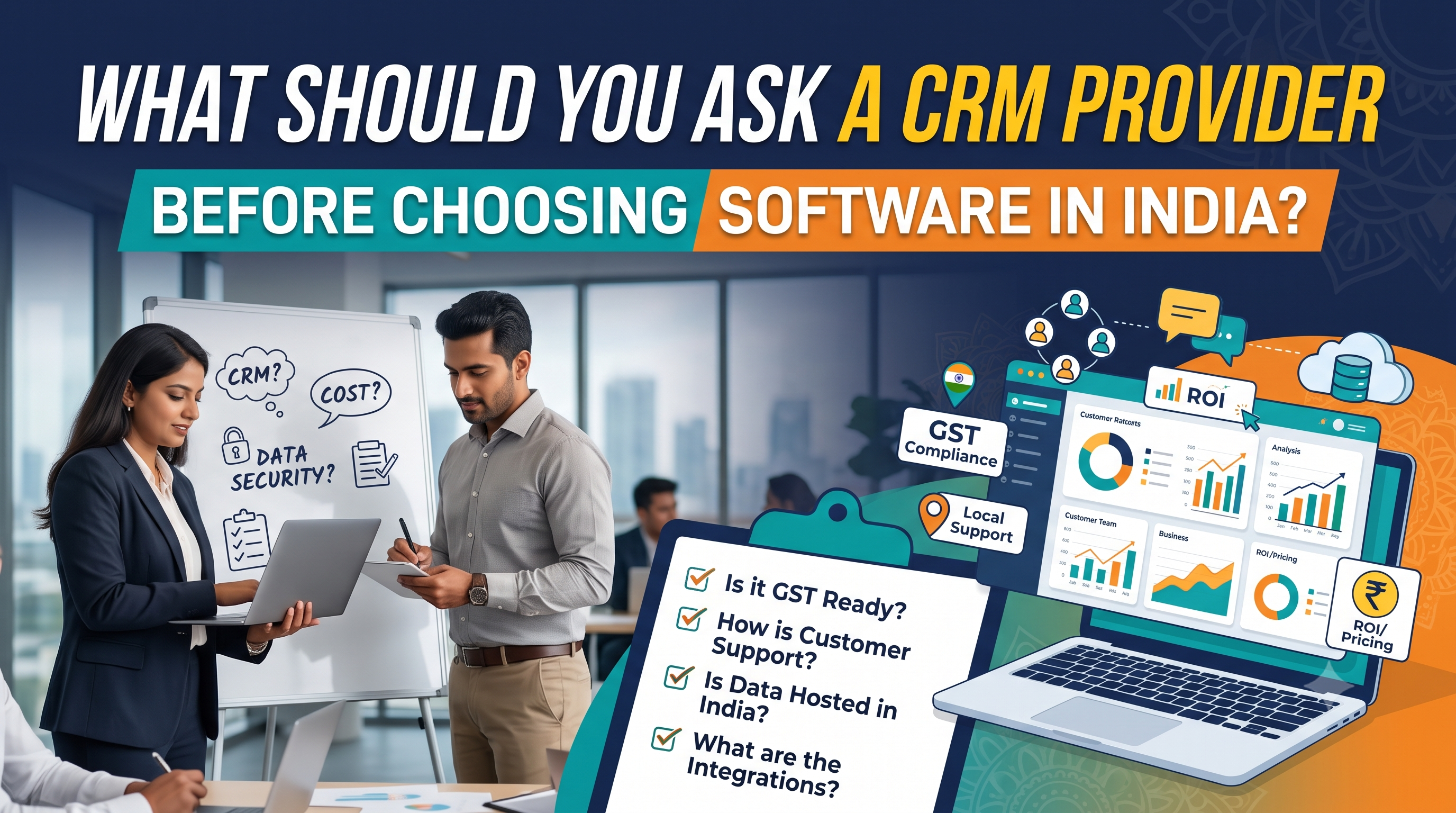
The best CRM for abroad education consultancy in India is the one built around how Indian counsellors actually work: WhatsApp-first communication, one student applying to eight universities at once, sub-agents in Tier 2 cities, and a visa file that can’t afford to go missing. This guide compares SmartX CRM against Meritto, LeadSquared, telecrm, and Kondesk on the criteria that actually decide whether a CRM survives past month three — not just feature counts.
Quick answer: SmartX CRM is built specifically for overseas education consultancies and includes native WhatsApp automation, multi-country application tracking, visa workflow management, and B2B sub-agent management in one platform. Meritto suits large, well-funded institutions on per-application pricing; LeadSquared suits teams that want marketing automation and don’t mind customizing a generic CRM; telecrm suits small teams whose main bottleneck is call and WhatsApp follow-up speed; Kondesk suits immigration-heavy consultancies that want an industry-specific tool without deep university-database features.
Why Generic CRMs Fail Overseas Education Consultancies (And Why It Changes What “Best” Means)
A generic sales CRM tracks one lead through one deal. An overseas education consultancy tracks one student through eight to ten simultaneous university applications, each with its own document checklist, deadline, and decision timeline — spread across a 6–18 month sales cycle that also involves parents as co-decision-makers and, eventually, a visa process with its own compliance requirements.
That mismatch matters more in 2026 than it did a few years ago. According to Ministry of External Affairs data presented in India’s Parliament, roughly 1.25 million Indian students were enrolled in higher education abroad in 2025 — a 5.7% decline from 1.33 million in 2024, the first drop after three straight years of growth, driven largely by tighter visa policies in the US and Canada. The same data shows Indian students now studying across 153 countries, with Canada, the US, and the UK still the largest destinations even as their intake tightens. For a consultancy, a shrinking, more visa-sensitive market means fewer, higher-stakes leads: missing a document deadline or losing a WhatsApp thread now costs proportionally more than it did during the boom years, because there are fewer replacement leads coming in behind it.
A CRM’s job in this market isn’t just to store contacts — it’s to stop deals from dying in the gap between “counsellor meant to follow up” and “counsellor actually did.” That gap is where most consultancies actually lose students, not in the counselling quality itself.
What Makes an Abroad Education Consultancy’s Workflow Different From Ordinary Sales
It’s worth being specific about why this isn’t just “sales with extra steps,” because that’s exactly the assumption that leads consultancies to buy a generic CRM and regret it six months later.
- One lead becomes many parallel opportunities. A single student inquiry typically becomes 5–10 separate university applications, each progressing independently, each with its own outcome. A generic CRM’s one-lead-to-one-deal model forces you to either duplicate the student record per application (fragmenting communication history) or track applications as unstructured notes (losing visibility entirely).
- The sales cycle spans two very different phases. Counselling and application submission is phase one; visa processing, interview prep, and pre-departure support is phase two. Many CRMs are built for phase one and simply stop there, leaving visa tracking to a spreadsheet or WhatsApp group that nobody owns.
- Documentation volume is enormous and time-sensitive. Twenty to fifty documents per student, several of which expire (police clearance certificates, medical certificates) and need re-collection if a visa process drags on.
- Multiple decision-makers, asynchronously. Parents are frequently the ones asking follow-up questions, reviewing costs, and making the final call — sometimes without the student on the thread at all. A CRM that logs communication only against “the lead” and not against a household misses this.
- Compliance sits on top of everything. GDPR for EU-bound applications, ICEF and British Council membership standards, and increasingly formal data-protection expectations from partner universities.
None of this is exotic — it’s simply a different shape of business than the linear sales funnels most CRMs are designed around. Generic platforms (Salesforce, HubSpot, Zoho, and similar) can be configured to approximate it, but every one of the points above has to be custom-built, which is where the real cost of a “cheap” generic CRM shows up months later.
Common Mistakes to Avoid When Choosing a CRM for Abroad Education Consultancy in India
Before the feature comparison, it’s worth naming the buying mistakes that show up repeatedly across consultancies that end up switching CRMs within a year — because avoiding these matters more than any single feature on a checklist.
Buying on price before checking fit. A ₹5,000/month CRM your team actually uses every day is cheaper, in real terms, than a ₹500/month tool that sits unused after week three. The right comparison isn’t monthly cost — it’s cost per counsellor-hour saved and cost per additional enrolled student, and those numbers only show up after a real trial, not a demo.
Testing only with the vendor’s sample data. Every CRM looks clean in a demo built around a tidy, linear student journey. The real test is your messiest active case: a student applying to nine universities in three countries, with two document resubmissions and a parent who emails instead of using WhatsApp. If the CRM can’t visibly handle that case during the trial, it won’t handle it in production either.
Underestimating mobile usage. Counsellors spend real time outside the office — education fairs, home visits, university roadshows — and a CRM that’s usable only at a desk quietly becomes a CRM that’s only half-used. Confirm the mobile app supports full lead review, document upload, and WhatsApp messaging, not just read-only dashboards.
Treating WhatsApp as optional. In the Indian market specifically, WhatsApp is frequently the default channel students and parents use to reach a consultancy, and a CRM that bolts it on via a third-party plugin usually means no saved chat history, no automated triggers, and an extra login for counsellors to manage. This is one of the most common reasons a CRM gets abandoned — not because the core CRM was bad, but because the WhatsApp workaround was worse than what the team was doing before.
Ignoring sub-agent and partner logic if you use one. Consultancies that route leads through partners in Tier 2 or 3 cities and choose a CRM without dedicated partner management tend to discover the gap only once duplicate student records and commission disputes start piling up — by which point migrating to a better system is a much bigger job than it would have been at the start.
Skipping compliance and security questions. Passport copies, financial statements, and academic records sit in these systems by default. Not asking where data is hosted, who can access which records, and whether the vendor can support GDPR requirements for EU-bound applicants is a risk that’s invisible until something goes wrong.
Not involving the counsellors who’ll actually use it. A CRM chosen entirely by a founder or director, without input from the people doing daily follow-ups, is one of the strongest predictors of low adoption. Counsellors know the specific pain points a demo won’t surface — get two or three of them into the trial before signing anything.
SmartX CRM vs. Meritto vs. LeadSquared vs. telecrm vs. Kondesk: Which Is the Best CRM for Abroad Education Consultancy in India?
Here’s how the five most commonly evaluated options in India compare on the dimensions that matter specifically for study-abroad workflows.
| SmartX CRM | Meritto | LeadSquared | telecrm | Kondesk | |
|---|---|---|---|---|---|
| Built specifically for study-abroad workflows | Yes | Partly — built for education broadly, not consultancy-specific | No — generic sales CRM extended into education | No — generic calling/WhatsApp CRM used across industries | Yes — education & immigration focus |
| WhatsApp Business API | Native, two-way, with document requests | Available, multi-channel | Third-party dependent | Core strength — call + WhatsApp sync is the product’s focus | Available, secondary to core workflow |
| Multi-university application tracking | Native, per-application status | Yes, admissions-focused | Requires custom build | Basic — custom fields, not native stages | Yes |
| Visa document & stage tracking | Native, country-specific workflows | Limited | Not built in | Custom fields only | Yes, immigration-focused |
| Sub-agent / B2B partner management | Native, with commission tracking | Not built in | Not built in | Not built in | Limited |
| University & course database | 10,000+ institutions built in | Not a core feature | Not built in | Not built in | Not a core feature |
| Counsellor performance reporting | 40+ pre-built dashboards | Available | Strong, marketing-focused | Call reports & leaderboards | Available, less education-specific |
| Mobile app | Full-featured iOS/Android | Available | Available | Full-featured, ~95% of desktop functionality | Available |
| Pricing model | Flat per-user, INR | Per-application — can scale expensive at volume | Per-user, often requires paid customization | Flat per-user, INR (from ₹799–₹1,099/user/month) | Per-user, INR |
| Best fit | Consultancies wanting one platform for the full study-abroad + visa + partner workflow | Large, well-resourced institutions with dedicated IT support | Teams prioritizing marketing automation who’ll invest in customization | Small teams whose main pain point is call/WhatsApp follow-up discipline | Immigration-heavy consultancies wanting an industry-specific tool |
None of these is a bad choice for every consultancy — the right one depends on which single bottleneck is costing you the most students right now.
If your main problem is missed follow-ups on calls and WhatsApp, telecrm’s narrower, calling-first focus is worth a look — it’s built around call recording, dialer integration, and follow-up reminders more than around application or visa tracking, so it fits smaller teams whose core issue is discipline rather than workflow complexity.
If your main problem is coordinating ten simultaneous university applications and a visa file per student without losing anything, that’s the specific problem SmartX CRM and Meritto are both built to solve. The difference between them is largely pricing model — Meritto’s per-application pricing can become expensive as volume grows, where SmartX’s flat per-user pricing doesn’t scale against application count — and depth of sub-agent/partner tooling, which Meritto doesn’t offer natively.
If your main problem is marketing automation and lead scoring across many channels, LeadSquared is a genuinely strong marketing platform, but you should budget for customization time and cost to bring it up to education-consultancy-specific functionality, since none of the study-abroad-specific modules exist out of the box.
If you run a combined education-and-immigration practice, Kondesk’s positioning toward both is worth evaluating, though its university database and multi-country application depth are lighter than SmartX’s or Meritto’s.
See a detailed breakdown of switching from Meritto or a feature-by-feature comparison against Kondesk.
Must-Have Features of the Best CRM for Abroad Education Consultancy in India
Before comparing vendors on price, check whether the CRM actually has these capabilities — most of the “CRM regret” consultancies report traces back to discovering one of these is missing after they’ve already signed a contract.
Lead Capture and WhatsApp-First Communication: The Foundation of Any Study-Abroad CRM
The CRM should auto-capture leads from Facebook and Instagram lead ads, website forms, and walk-ins, then route them to counsellors by specialization or workload — and it needs a genuine two-way WhatsApp Business API integration, not a bolt-on. WhatsApp is where most Indian students and parents actually expect to be reached, so a CRM that treats it as an afterthought will show up as a daily friction point for counsellors, not an occasional inconvenience.
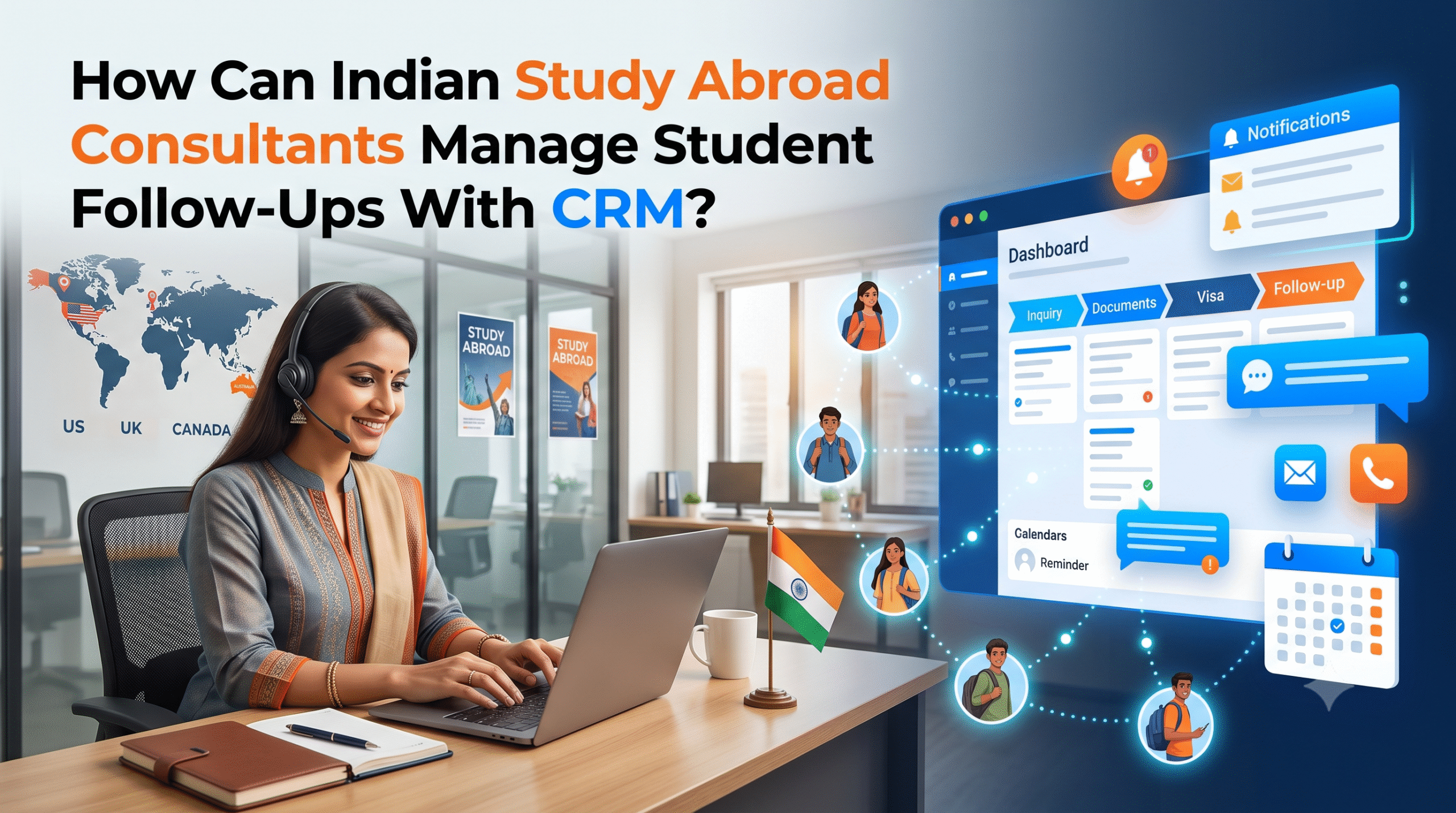
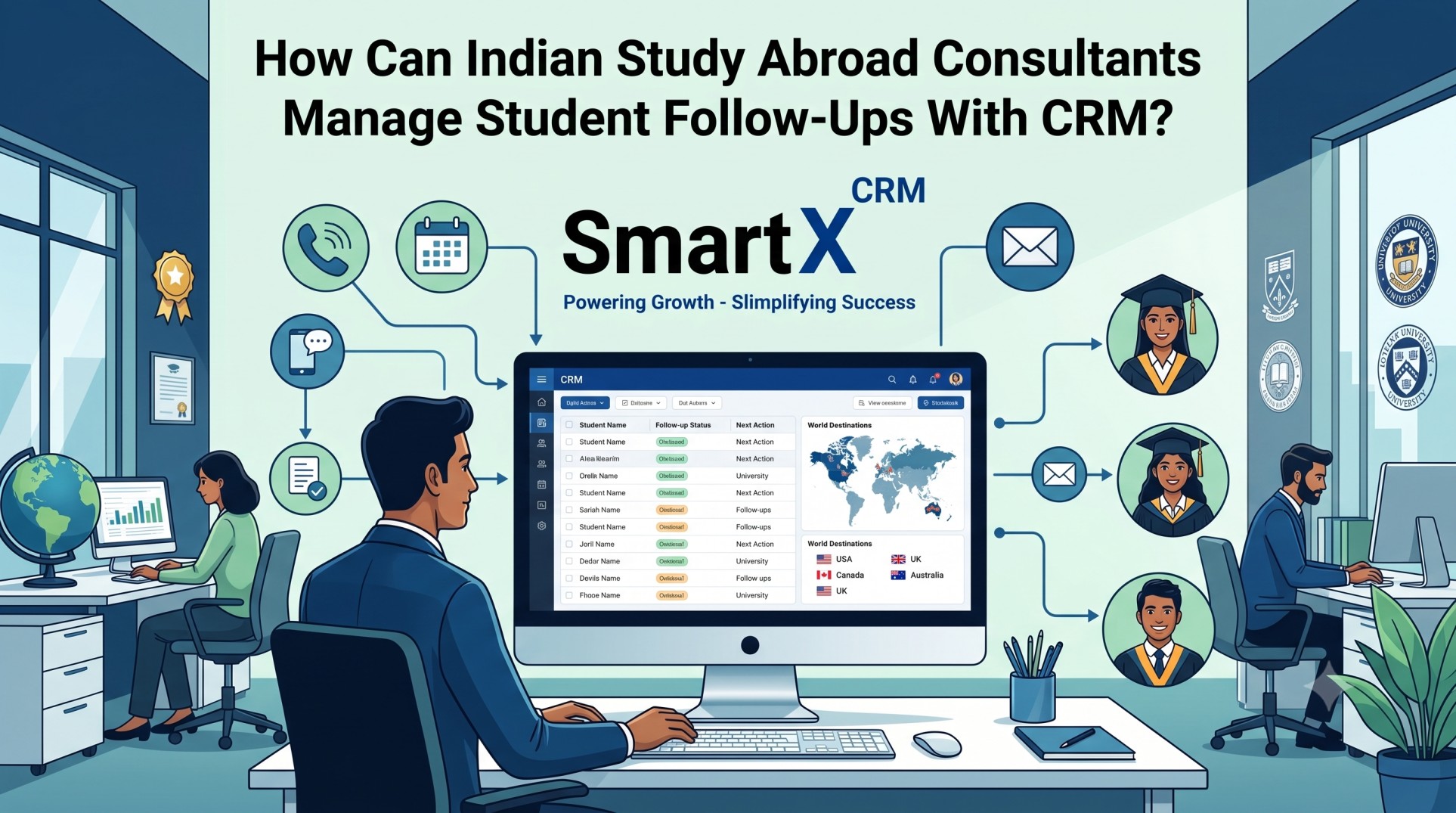
Beyond basic capture, look for lead scoring that reflects real signals — inquiry completeness, stated budget, academic eligibility for the courses being asked about, and how close the student is to an intake deadline — so counsellors spend their limited time on the leads most likely to convert rather than working the list in the order it arrived. SmartX’s lead management module and WhatsApp automation are built around WhatsApp as the primary channel, not a secondary one, including two-way chat history that stays attached to the student’s profile rather than living only inside a phone.
Multi-Country Application Tracking: Why It’s Non-Negotiable for Overseas Education Consultants
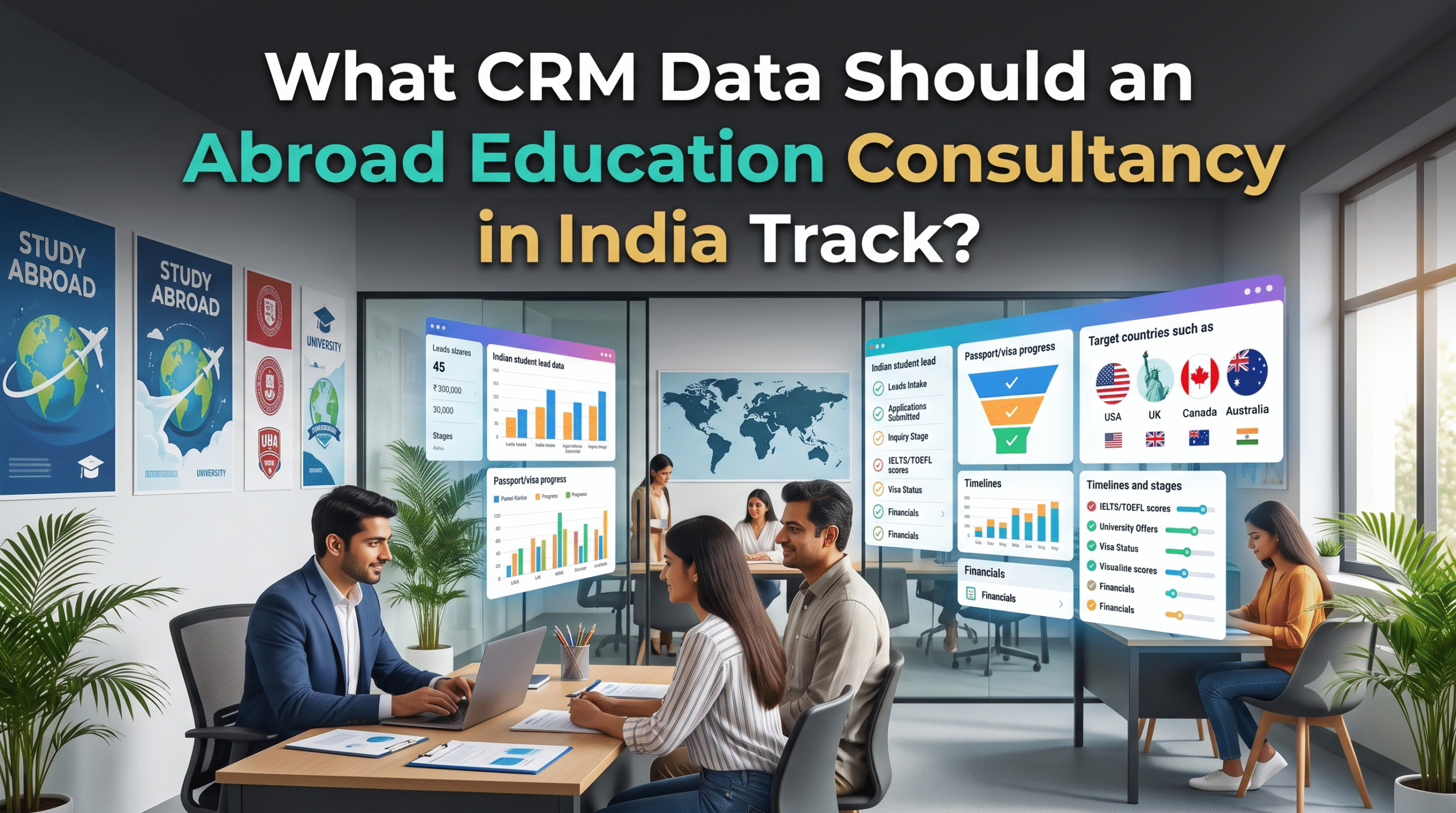
A single student applying to universities in the UK, Canada, and Australia simultaneously needs each application tracked as its own record — separate deadlines, separate document sets, separate decision status — without the student’s core profile getting duplicated three times. This is the single feature that most clearly separates study-abroad CRMs from generic sales tools, because it’s the one generic CRMs handle worst by default.
A well-built version of this also supports stage-specific workflows: each application stage (shortlisted, submitted, offer received, offer accepted) should trigger its own checklist, its own communication template, and its own escalation rule if it stalls too long. Application management built specifically for this pattern also gives you application-success-rate reporting by university — useful both for counselling future students realistically and for negotiating with partner universities.
Document Management With Verification Workflow: Where Most Consultancies Lose Time
Each student typically submits 20–50 documents across transcripts, letters of recommendation, statements of purpose, financial statements, and test scores. The CRM needs a document management system with per-country checklists, a student self-upload portal, and a clear verification status (submitted → under review → approved or rejected → sent to university) — not just a generic file-attachment field.
Two details matter more than they first appear: expiry-date tracking for documents like police clearance and medical certificates (which genuinely expire and need re-collection if a process drags past their validity window), and version control, so a counsellor can tell whether the SOP attached is the version the student revised last week or an earlier draft. Both are easy to overlook in a demo and expensive to discover missing during peak intake season.
Visa Workflow Management: The Feature That Separates a True Study-Abroad CRM From a Generic One
Visa handling deserves its own tracked pipeline: biometrics, interview scheduling, document adequacy checks, and outcome tracking, with country-specific templates for the US F-1, UK Student visa, Canada study permit, and Australia subclass 500 processes. Visa tracking built into the CRM avoids the common failure mode of visa status living in a separate spreadsheet that nobody updates in real time, which is often exactly where a consultancy’s most expensive mistakes happen — a missed biometrics slot or an interview date nobody flagged to the family.
Visa success-rate analytics, broken down by country, counsellor, and common rejection reason, are also worth asking about specifically. This is where a consultancy can actually learn something operationally — for instance, whether a particular counsellor’s financial-document preparation is producing a higher rejection rate than the team average, which is a coaching opportunity a spreadsheet will never surface on its own.
University and Course Database: Faster Counselling With Built-In Research
Counsellors shouldn’t have to leave the CRM to check a university’s tuition fees, entry requirements, or intake deadlines. A built-in university course finder with INR-converted fees and side-by-side comparison saves real research time per student, and it means a counsellor can answer a parent’s cost question on the spot during a call rather than promising to “check and get back to you” — a small thing that compounds into a real trust signal over a 6–18 month relationship.
Sub-Agent and Partner Management for Consultancies Working With Tier 2/3 City Agents
If you route leads through partners in Tier 2 or 3 cities, the CRM needs separate partner logins, automated commission calculations, and lead-source attribution — without this, commission disputes and duplicate student records are close to guaranteed at any scale. B2B sub-agent management purpose-built for this is genuinely rare outside education-specific CRMs, and it’s usually the feature generic CRMs handle worst, since partner ecosystems simply don’t map onto a standard sales hierarchy.
Counsellor-Wise Reporting and Performance Analytics: Turning Pipeline Data Into Coaching
Without visibility into individual counsellor performance, it’s hard to identify who needs coaching, whose pipeline is imbalanced, or which lead sources are actually converting. Useful reporting here goes beyond a basic leaderboard — look for lead-to-conversion rate by counsellor, average time to first contact, application submission rate, and revenue or enrollment attribution, ideally on a dashboard rather than a manually assembled spreadsheet each month. Reports and analytics that are pre-built for education-specific metrics (visa approval rate by country, intake-wise forecasting) save meaningful setup time compared with building equivalent reports from scratch in a generic CRM’s report builder.
Mobile Accessibility: Why an Education Consultancy CRM Has to Work Outside the Office
Full-featured mobile apps — not a scaled-down mobile website — matter because counsellors genuinely work outside the office: education fairs, university visits, home counselling sessions, and follow-ups that happen during a commute. Confirm the mobile app supports lead review, document upload, and WhatsApp messaging, not just read-only dashboards, before assuming “has a mobile app” checks this box.
Multi-Language Support for Indian Students and Parents
Parents in particular often prefer communicating in Hindi or a regional language, and template translation support for languages like Hindi, Tamil, Telugu, Marathi, Gujarati, and Bengali reduces the number of manual translations a counsellor has to do per family — a small operational detail that adds up across a large active pipeline.
Country-by-Country Visa Workflow Requirements Every Study-Abroad CRM Should Support
Short answer: each major destination country has a distinct visa process with its own document set and timeline, so a CRM’s visa tracking is only as useful as its country-specific templates — a generic “visa status” field isn’t enough to manage this reliably across a mixed pipeline of US, UK, Canada, and Australia applicants.
United States — F-1 Visa Workflow
The F-1 process centers on the I-20 issued by the admitting university, followed by SEVIS fee payment, the DS-160 form, and a consular interview. Financial documentation requirements are typically the strictest of the four major destinations, and interview outcomes vary meaningfully by consulate and by how well-prepared the student is for standard questions about intent to return. A CRM should track I-20 receipt, SEVIS payment, DS-160 submission, interview scheduling, and outcome as distinct stages, since a gap at any one of these can delay an entire intake.
United Kingdom — Student Visa Workflow (formerly Tier 4)
The UK process runs on the CAS (Confirmation of Acceptance for Studies) issued by the university, followed by the online visa application, biometric enrollment, and — for most applicants — a financial requirement showing funds held for a defined period before application. Because the financial-evidence window is time-bound, a CRM that tracks when funds need to be verified relative to the application date, not just whether the documents exist, prevents a common and entirely avoidable rejection reason.
Canada — Study Permit Workflow
Canada’s study permit process has tightened materially over the past two years, with acceptance rates for Indian applicants falling and processing times becoming less predictable. The process requires a Provincial Attestation Letter (PAL) in most provinces, proof of funds, and increasingly rigorous scrutiny of “genuine student” intent. Given how much this process has shifted recently, a CRM’s Canada workflow needs to be easy to update as requirements change — a static, hard-coded checklist becomes a liability if it goes stale.
Australia — Subclass 500 Student Visa Workflow
Australia’s student visa (subclass 500) is assessed partly through the Genuine Temporary Entrant (now Genuine Student) framework, alongside financial capacity and English-proficiency evidence. Processing times and scrutiny levels vary by the applicant’s country and the institution’s risk rating, so tracking which university/course combinations are producing smoother outcomes is a genuinely useful piece of institutional knowledge a CRM can help surface over time rather than losing it as each counsellor’s individual experience.
Why Country-Specific Visa Tracking Matters When Choosing a CRM
A CRM that only offers a single generic “visa applied → visa approved” pipeline forces counsellors to track the real, country-specific milestones somewhere else — usually back in a spreadsheet, which defeats the purpose of centralizing the workflow in the first place. When evaluating vendors, ask to see the actual visa workflow template for your top two or three destination countries during the trial, not just a description of “country-specific visa tracking” as a feature bullet.
Which Is the Best CRM for Your Type of Abroad Education Consultancy?
Team size and business model change which features matter most — a five-point checklist that’s right for a solo counsellor is often the wrong priority order for a 40-person, multi-branch operation.
Best CRM for a Solo Counsellor or 2-Person Education Consultancy
At this scale, the biggest risk is time lost to manual admin rather than team coordination. Prioritize fast setup, strong mobile usability, and WhatsApp automation over deep reporting or sub-agent management, which won’t be relevant yet. A flat, low-per-user-cost platform is usually the better economic fit than a per-application model, since application volume is naturally limited by team size at this stage.
Best CRM for a 5–15 Counsellor Education Consultancy Team
This is the range where multi-university application tracking, visa workflow management, and counsellor-wise reporting start to earn their keep — enough volume that a missed follow-up has real financial weight, and enough people that management needs visibility without personally checking each pipeline. This is also typically the point where document version control and expiry tracking stop being theoretical and start preventing real, recurring mistakes.
Best CRM for a Multi-Branch or Sub-Agent Education Consultancy Network
Once leads route through partner offices or sub-agents in other cities, B2B sub-agent management moves from nice-to-have to load-bearing — commission tracking, lead-source attribution, and controlled data access aren’t optional at this scale, and retrofitting them into a CRM that lacks them natively is a significant, disruptive project. This is also where compliance and access-control questions matter most, since more people across more locations have some level of access to student data.
Best CRM for a Combined Education-and-Immigration Consultancy
Where a single business handles both study-abroad counselling and separate immigration services (skilled visas, PR pathways), the visa and compliance workflow needs are broader than a study-abroad-only CRM typically covers, which is where Kondesk’s positioning becomes more directly relevant, alongside checking whether the study-abroad-focused platforms under consideration can be configured to handle non-student visa categories at all.
A Worked Example: Estimating ROI on a Study-Abroad CRM for a 10-Counsellor Team
To make the ROI discussion above more concrete, here’s a simplified illustration using round numbers a mid-sized consultancy could substitute its own figures into.
Assume a 10-counsellor team, each handling roughly 15 active student files at a time, at a fully-loaded cost of approximately ₹400/hour per counsellor (salary plus overhead). If a properly implemented CRM saves each counsellor 40 minutes a day in manual follow-up, document-chasing, and status-checking that a Kanban pipeline and WhatsApp automation would otherwise handle automatically, that’s roughly ₹267 per counsellor per working day, or close to ₹58,000 across the team per month, in time value alone — before counting a single additional enrolled student.
Against that, a flat-rate platform at, say, ₹2,500 per user per month for 10 users runs ₹25,000/month. On time savings alone, the platform would be paying for itself more than twice over. The larger financial impact in practice tends to come from conversion-rate improvement — fewer leads going cold from delayed follow-up — but that number is harder to estimate reliably in advance and varies significantly by how disciplined the team’s process was before switching, so it’s reasonable to treat it as additional upside rather than build it into the initial business case.
This kind of calculation is worth running with your own real numbers — counsellor headcount, loaded hourly cost, and a conservative estimate of daily time saved — before signing any contract, since it turns “the CRM costs ₹25,000 a month” into a comparison against a number that actually means something to the business.
Glossary: Study-Abroad and Visa Terms Every Education Consultancy Should Know
CAS (Confirmation of Acceptance for Studies) — the UK university document required before a student visa application can proceed.
I-20 — the US university-issued document required for F-1 visa applications and SEVIS registration.
PAL (Provincial Attestation Letter) — a Canadian provincial document now required for most study permit applications, introduced as part of Canada’s recent international-student intake caps.
SEVIS — the US government system tracking F-1 and other student/exchange visitors; SEVIS fee payment is a required step before the visa interview.
GTE / Genuine Student requirement — the Australian assessment of whether an applicant’s intent is genuinely to study, now central to subclass 500 visa decisions.
Sub-agent / B2B partner — a third-party recruiter or smaller consultancy that refers students to a larger consultancy in exchange for a commission, common in Tier 2/3 Indian cities.
Lead scoring — an automated ranking of inquiries by likelihood to convert, based on signals like inquiry completeness, budget, and academic eligibility.
WhatsApp Business API — the official, scalable version of WhatsApp integration (versus WhatsApp Web automation tools, which carry a higher risk of number bans and generally lack CRM-grade chat history and reporting).
Data Security, GDPR, and ICEF / British Council Compliance for Education Consultancy CRMs
Short answer: the best CRM for abroad education consultancy in India should offer end-to-end encryption, role-based access control, audit trails, and GDPR-compliant data handling, since consultancies routinely store passport copies, financial documents, and academic records for European-bound applicants.
This is one area where most buyer’s guides gloss over the actual requirement. If you place students with universities in the EU or UK, GDPR applies to how you store and transfer their data — not as an optional nice-to-have, but as a compliance obligation with real consequences for mishandling it. Separately, membership bodies like ICEF and the British Council increasingly expect member agencies to demonstrate basic data-handling discipline as part of their accreditation standards, and a poorly documented data-security posture can complicate that accreditation process.
Ask any vendor directly: where is data hosted, who can access a given student’s file, what’s the audit trail if a document goes missing, and how are backups handled. Role-based access control matters specifically in consultancies with sub-agents — a partner in another city should be able to see the leads assigned to them without having open access to your entire student database. SmartX CRM’s data security practices are built around these specific requirements rather than generic “bank-level encryption” marketing language that doesn’t actually answer any of the questions above.
Best CRM for Abroad Education Consultancy in India: What Should You Actually Pay in 2026?
Short answer: quality education-consultancy CRM software in India runs roughly ₹800–₹5,000 per user per month depending on features and scale, with per-application pricing models (like Meritto’s) becoming significantly more expensive than flat per-user pricing once volume grows.
| Pricing model | Typical range | Watch out for |
|---|---|---|
| Flat per-user (SmartX, telecrm) | ₹800 – ₹5,000/user/month | Confirm what’s excluded — document storage caps, WhatsApp message limits, sub-agent seats |
| Per-application (Meritto and similar) | Scales with volume — can exceed ₹5,00,000/year at 500+ applications | Attractive at low volume, expensive once you’re processing hundreds of applications annually |
| Generic CRM + customization (LeadSquared, Salesforce Education Cloud) | Base license + ₹50,000–₹5,00,000 one-time customization | The subscription price is rarely the real cost — factor in build time and ongoing developer dependency |
The cheapest sticker price isn’t the same as the lowest total cost. Beyond the subscription itself, factor in three hidden cost categories that show up after signing: integration costs (a proper WhatsApp Business API integration, if not native, can run ₹20,000 or more to set up separately; payment gateway integration another ₹15,000-plus), training costs (generic CRMs typically require significantly more onboarding time before counsellors are comfortable, which is time not spent with students), and opportunity costs (every week spent fighting an ill-fitting system is a week of follow-ups that slip).
A Rough Way to Think About CRM ROI
Rather than comparing sticker prices directly, it’s more useful to estimate what a CRM needs to deliver to justify its cost. A simple version of that math: if a CRM saves each counsellor even 30–45 minutes a day in manual follow-up and document-chasing, and a counsellor’s time is worth even a modest hourly rate, a mid-tier plan typically pays for itself within the first month for most 5–10 counsellor teams — before accounting for any improvement in conversion rate at all. Conversion-rate improvement from better, more consistent follow-up is usually the larger effect in practice, but it’s harder to estimate precisely in advance, so it’s worth treating as upside rather than the basis for the decision.
Check SmartX CRM pricing for current plan details, or start a free trial with your own student data before committing either way — the numbers above are a starting point for negotiation, not a substitute for testing against your actual pipeline.
How to Evaluate the Best CRM for Abroad Education Consultancy in India Before You Buy
Evaluating the best CRM for abroad education consultancy in India comes down to a practical checklist covering what actually predicts whether a CRM sticks or gets abandoned within a few months, rather than a 90-point scoring sheet that’s more thorough than useful:
- Test with real student data, not the demo dataset. Import your actual pipeline — including your messiest, most document-heavy case — before signing anything. A demo environment is built to look clean; your real pipeline is the only honest test.
- Test on mobile, not just desktop. Counsellors work from education fairs, home, and coffee shops; a CRM that’s clunky on mobile won’t get used consistently, no matter how good it looks on a laptop during the sales call.
- Test WhatsApp end-to-end. Send a real message, request a real document, confirm the chat history actually saves to the student’s profile rather than disappearing once the conversation moves past the initial automated reply.
- Get 2–3 counsellors into the trial, not just the founder or director. Adoption resistance almost always shows up here first, and it’s far cheaper to find out during a trial than three months post-purchase when you’re explaining to the team why everyone’s back to Excel.
- Ask for a written migration plan if you’re moving off Excel or another CRM. Data loss during migration is one of the most common — and most avoidable — reasons a rollout stalls, and a vendor who can’t describe their migration process clearly is telling you something.
- Confirm what happens to sub-agent data and commissions during the trial period, if partner management matters to your business — this is often skipped during evaluation and discovered missing only once real commission calculations are due.
- Check response time and support channels before you need them, not after. Ask specifically whether support is available via WhatsApp, phone, and email, and what the actual response-time expectation is — not just “24/7 support” as a line item.
Implementing a Study-Abroad CRM: What the First Month Actually Looks Like
Even the right CRM needs a real rollout plan, and skipping this step is a common reason a good tool still fails to stick. A realistic sequence looks like:
Weeks 1–2 — Data migration and setup. Clean and import existing student data from Excel or a previous CRM, configure lead-source integrations (Facebook Lead Ads, website forms), and set up counsellor accounts and permission levels. This is also the point to configure sub-agent logins if partners are part of your model.
Week 2–3 — Team training. Run separate, focused training for counsellors (day-to-day lead and application workflow) and for management (reporting and pipeline oversight) rather than one generic session covering everything — the two groups use the system very differently.
Weeks 3–4 — Parallel running. Keep the old system available as a fallback while the team works fully inside the new CRM, so a gap in training or a missed edge case doesn’t mean a lost student. Most consultancies can fully retire the old system by the end of this period if training was genuinely completed in the prior weeks.
Ongoing — Review and optimize. After the first month, review actual usage data: which counsellors are logging in daily, which features are being used versus ignored, and where follow-ups are still slipping. This is the point to have an honest conversation about whether the rollout needs adjustment before assuming the CRM itself is the problem.
Flat-rate, education-specific platforms like SmartX or telecrm can typically compress this into a few days to two weeks given their pre-built education workflows. Generic CRMs requiring custom workflow-building for education use cases typically take one to three months, plus ongoing developer dependency for any future changes.
Frequently Asked Questions About the Best CRM for Abroad Education Consultancy in India
What is the best CRM for abroad education consultancy in India?
There’s no single universal answer — it depends on your consultancy’s specific bottleneck. SmartX CRM is purpose-built for the full study-abroad workflow (multi-university tracking, visa management, sub-agent support), which makes it the strongest fit for consultancies that need all of this in one platform rather than piecing it together from a generic CRM plus add-ons.
How much does education consultancy CRM software cost in India? Expect roughly ₹800–₹5,000 per user per month for flat-rate platforms like SmartX or telecrm. Per-application pricing (Meritto) or generic CRMs requiring custom development (LeadSquared, Salesforce Education Cloud) can cost significantly more at scale — see the pricing table above for specifics.
Is WhatsApp integration actually necessary for an education CRM in India? For most Indian consultancies, yes — WhatsApp is the primary channel students and parents expect to use, and CRMs without native, two-way WhatsApp Business API support typically require expensive third-party workarounds with no chat history saved to the student record.
Can a study-abroad CRM handle a student applying to multiple universities at once? This should be treated as a baseline requirement, not an advanced feature. Look specifically for per-university application status, separate document checklists per application, and unified student profiles — generic CRMs generally require creating duplicate “deal” records per university, which fragments both documents and communication history.
How long does CRM implementation typically take? Flat-rate, education-specific platforms like SmartX or telecrm can go live in a few days to about two weeks. Generic CRMs requiring custom workflow-building for education use cases typically take one to three months, plus ongoing developer dependency for changes — see the implementation timeline above for what each phase actually involves.
Can sub-agents in Tier 2/3 cities be managed inside the CRM? Only CRMs with dedicated B2B sub-agent management support this properly — separate partner logins, automated commission tracking, and lead-source attribution. Without this, expect duplicate student records and commission disputes as your partner network grows.
Is my students’ data secure and GDPR-compliant? Ask directly about encryption standards, role-based access control, audit trails, and data hosting location — and if you place students in EU or UK institutions, confirm the vendor’s GDPR-compliance posture specifically, since that’s a legal requirement rather than a marketing checkbox.
Can I migrate from Excel or another CRM without losing data? Yes, with proper planning — this is a routine migration, but it needs a written plan covering data cleanup, a phased import, and a parallel-running period before the old system is retired. Ask any vendor to describe their specific migration process rather than accepting a generic assurance that “migration is easy.”
Will my counsellors actually use a new CRM, or will they go back to Excel? Adoption depends more on the rollout than the software itself — involving 2–3 counsellors in the evaluation before purchase, running role-specific training rather than one generic session, and reviewing actual usage data in the first month are the three factors that most reliably predict whether a new CRM sticks.
What’s the difference between SmartX CRM and a generic CRM like Zoho or Salesforce for education consultancies? The core difference is that multi-university application tracking, visa workflow management, a university/course database, and sub-agent commission logic all come built in with an education-specific CRM, where a generic CRM requires custom-building each of these — which is usually where the real cost and delay of a “cheaper” generic option shows up.
Does the CRM need to support regional Indian languages? It’s a meaningful convenience rather than a strict requirement — parents in particular often prefer Hindi or a regional language, and template translation support reduces manual translation work per family, but it’s reasonable to weigh this against other features depending on your specific client base.
How do visa approval rates get tracked in a CRM, and why does that matter? A CRM with visa-specific analytics can break down approval rates by country, by counsellor, and by common rejection reason — which turns visa outcomes into a coaching and process-improvement tool rather than just a pass/fail record kept for compliance purposes.
Does the CRM need separate workflows for the US, UK, Canada, and Australia visa processes? Yes, ideally — each country’s process has distinct milestones (I-20 and SEVIS for the US, CAS and financial-evidence timing for the UK, PAL requirements for Canada, GTE assessment for Australia), and a single generic “visa applied → approved” pipeline forces counsellors to track the real milestones somewhere else, usually a spreadsheet, which defeats the point of centralizing the workflow.
Is a CRM worth it for a solo counsellor or a very small consultancy? It can be, but the priority features are different from a larger team’s — fast setup, mobile usability, and WhatsApp automation matter more at this scale than deep reporting or sub-agent management, so it’s worth evaluating vendors specifically on those criteria rather than a full enterprise feature checklist.
What’s the difference between WhatsApp Business API and WhatsApp automation tools? The official WhatsApp Business API is the sanctioned, scalable integration path with proper chat history and reporting inside the CRM; unofficial WhatsApp Web automation tools carry a real risk of number bans and typically don’t offer CRM-grade history or analytics, so it’s worth confirming specifically which type of integration a vendor is offering rather than assuming “WhatsApp integration” means the same thing across vendors.
Read customer success stories and detailed case studies, or start a free trial with your own student data.
Leave a comment: