
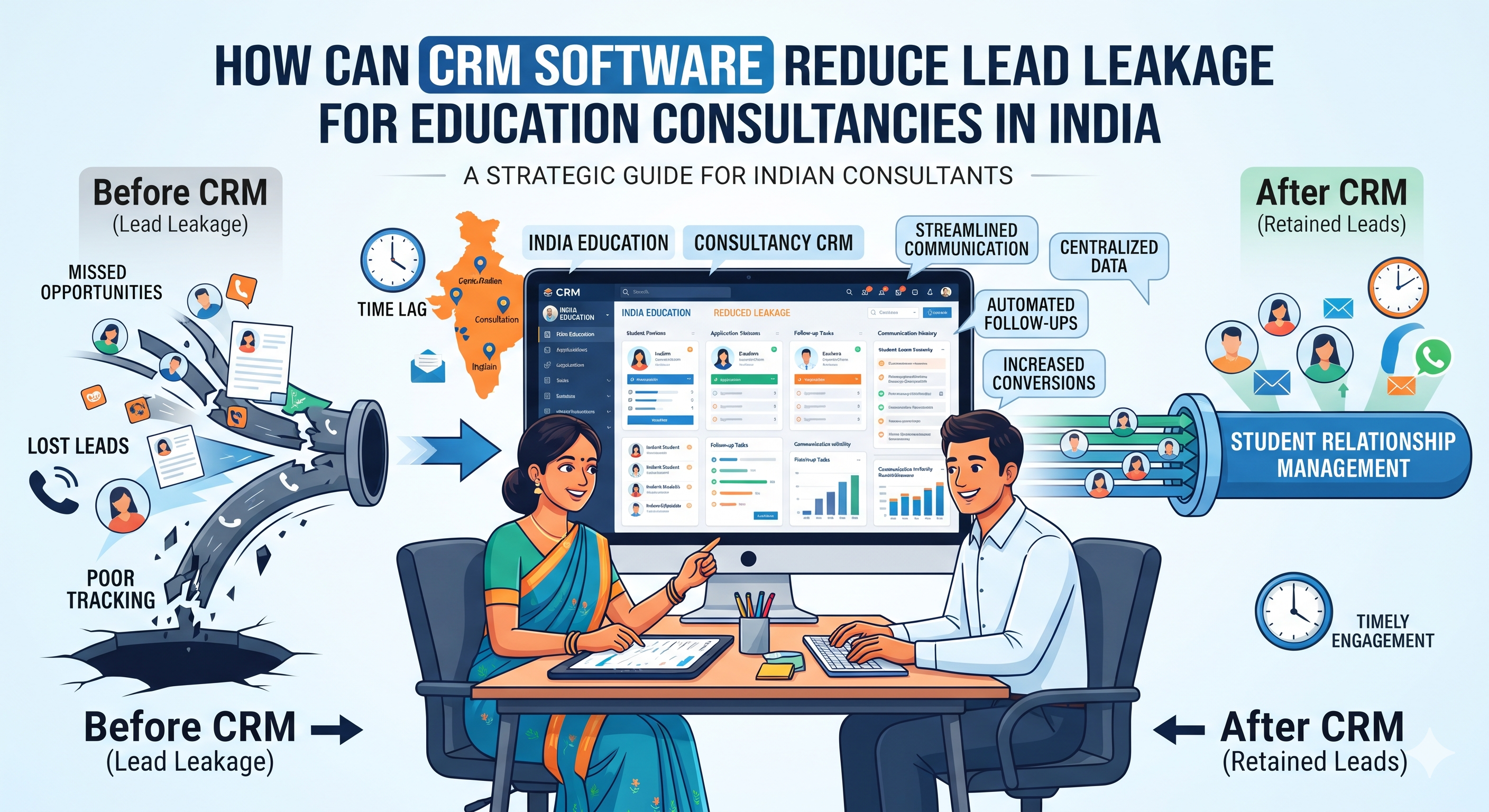
Quick Answer: How CRM Software Reduces Lead Leakage
CRM software reduces lead leakage for education consultancies in India by capturing every student enquiry in one place, assigning it to a counsellor within minutes, automating follow-ups on WhatsApp, call and email, and showing managers exactly where students drop out between enquiry and admission. When every lead has an owner, a next action and a deadline, enquiries stop disappearing between spreadsheets, phones and chat apps.
Key Takeaways
- Lead leakage is any qualified student enquiry that is lost, ignored or abandoned before it reaches a clear outcome (enrolled, not interested or not eligible).
- Most leakage in Indian consultancies happens at eight predictable points, from unrecorded walk-ins to stalled document collection.
- A study abroad CRM plugs these points through central capture, automatic assignment, follow-up automation, pipeline stages, reminders and reports.
- You can measure leakage with a simple formula and track it weekly.
- A focused 30-day plan is enough to close the biggest gaps before you invest in advanced automation.
What Is Lead Leakage in an Education Consultancy?
Lead leakage in an education consultancy is the loss of student enquiries that had a real chance of converting. The student did not say no. The consultancy simply failed to respond fast enough, follow up consistently, or keep the conversation moving.
This is different from a lead that is genuinely unqualified. A student with no budget, no eligibility or no intent to study abroad is a closed lead, and closing it is a healthy outcome. Leakage refers to the leads that went quiet because of process failure: a missed call, a forgotten WhatsApp reply, a counsellor who left the company, or a document checklist nobody chased.
For overseas education consultants, leakage matters more than in most industries for three reasons:
- Long decision cycles. A student may take weeks or months to choose a country, a course and a budget. Every week is a chance for a competitor to answer faster.
- Many touchpoints. Enquiries arrive from Instagram ads, Facebook lead forms, Google search, education fairs, walk-ins, referrals and sub-agents.
- High value per student. One enrolled student can represent service fees, partner university commissions and referrals. Losing even a small share of leads has a visible revenue impact.
If you want a deeper look at why enquiries slip through in the first place, read our guide on why education consultants in India lose track of student enquiries.
Why Lead Leakage Is So Costly for Indian Education Consultancies
Lead leakage is expensive because you have already paid to acquire the lead. Ad spend, fair stall costs, content production and counsellor salaries are sunk the moment an enquiry arrives. A leaked lead means that spend produced nothing.
Here are the hidden costs most consultancies underestimate:
- Wasted acquisition spend. If you pay for leads through Meta or Google ads, every unanswered enquiry is a direct loss of the cost per lead.
- Lower conversion rates. Your enquiry to admission ratio drops, even though marketing performance looks healthy on the surface.
- Counsellor burnout. Teams that chase unorganised lists work harder and convert less.
- Reputation damage. Students share experiences. A slow or careless response affects referrals, which are one of the strongest lead sources in this industry.
Indian consultancies also face a few local conditions that make leakage easy. Students and parents prefer WhatsApp over email. Many enquiries arrive outside office hours. Branch teams in different cities often keep their own sheets. Sub-agents may hold student data that never reaches the head office. A CRM built around these realities is far more useful than a generic sales tool.
Where Do Leads Leak? The 8 Leakage Points in Study Abroad Consultancies
Before you fix leakage, you need to see it. The table below maps the eight most common leak points, what causes them, and how a CRM closes each one.
| Leakage point | Typical cause | How CRM software fixes it |
|---|---|---|
| 1. Unrecorded enquiries | Walk-ins, calls and fair visitors noted on paper or in personal phones | Mobile and web forms that create a lead record instantly |
| 2. Slow first response | Leads wait for a counsellor to notice them | Automatic assignment and instant acknowledgement |
| 3. Wrong counsellor match | Leads go to whoever is free, not whoever fits | Rules by country, intake, branch or language |
| 4. Missed follow-ups | Reminders live in memory or personal notes | Task reminders and overdue alerts |
| 5. Channel switching | Conversation moves from call to WhatsApp to email with no record | One timeline per student across channels |
| 6. Stalled documents | Students go silent while collecting transcripts and tests | Document checklists with status and reminders |
| 7. Counsellor handover gaps | Staff leave and take lead knowledge with them | Full history stored in the CRM, easy reassignment |
| 8. Blind spots in reporting | Managers see totals but not drop-off stages | Funnel and source reports by stage |
Each of these points deserves its own fix, so let us look at them in more detail.
1. Unrecorded Enquiries
The first leak happens before a lead even exists in your system. A parent asks a question at a fair stall. A student calls the front desk and the call ends without a record. A counsellor takes a Facebook message on a personal phone. If the enquiry is not logged, it cannot be followed up.
2. Slow First Response
Students enquire with several consultancies at once. The first one to reply with a helpful answer usually earns the conversation. When responses depend on someone manually checking a sheet, delays of many hours or days become normal, especially on weekends and after campaign launches.
3. Wrong Counsellor Match
A student interested in Germany reaches a counsellor who mostly handles Canada. The counsellor responds, but with generic information, and the student loses interest. Poor matching is a quiet form of leakage because the lead technically received a reply.
4. Missed Follow-Ups
Most students need several touches before they decide. If follow-up depends on memory, the third and fourth touches rarely happen. This is the single largest source of leakage in many consultancies, and we cover it in detail in our post on how to prevent missed student follow-ups.
5. Channel Switching
A student starts with a call, continues on WhatsApp, and later sends documents by email. Without a single timeline, each counsellor sees only part of the story. Students then repeat themselves, and the experience feels disorganised.
6. Stalled Documents
After a student agrees to proceed, they must collect passports, transcripts, language scores, statements of purpose and financial documents. Many students stall here. Without structured reminders, these applications quietly die even though the student was a strong fit.
7. Counsellor Handover Gaps
Counsellor turnover is common in the consultancy business. When a team member leaves, their personal notes, chats and promises to students leave with them. A CRM keeps the record with the company, so reassignment is a few clicks, not a rescue operation.
8. Blind Spots in Reporting
If you cannot see how many leads reached each stage, you cannot see where they are leaking. Managers who only track total enquiries and total enrolments miss the middle of the funnel, where most losses occur.
How Does CRM Software Reduce Lead Leakage?
A CRM reduces lead leakage by giving every enquiry a single home, an owner, a next action and a visible status. The following seven mechanisms do most of the work.
Centralise Every Enquiry With Lead Capture and Integrations
The foundation of any leakage fix is central capture. A study abroad CRM connects your website forms, landing pages, ad lead forms, WhatsApp enquiries and manual entries into one database. Counsellors at a fair can add a lead from a phone in seconds, so nothing depends on a paper form.
Duplicate detection is part of this step. When the same student enquires through two channels, the CRM should merge or flag the records so two counsellors do not contact the same person with conflicting information. You can see how connections work on the SmartX CRM integrations page, and learn the basics in our guide to student enquiry management for abroad education consultants.
Assign Leads Automatically and Fairly
Automatic lead assignment removes the delay between enquiry and first contact. Rules can route leads by destination country, intake, branch, language or round robin. The result is a faster first response and a better match between student and counsellor.
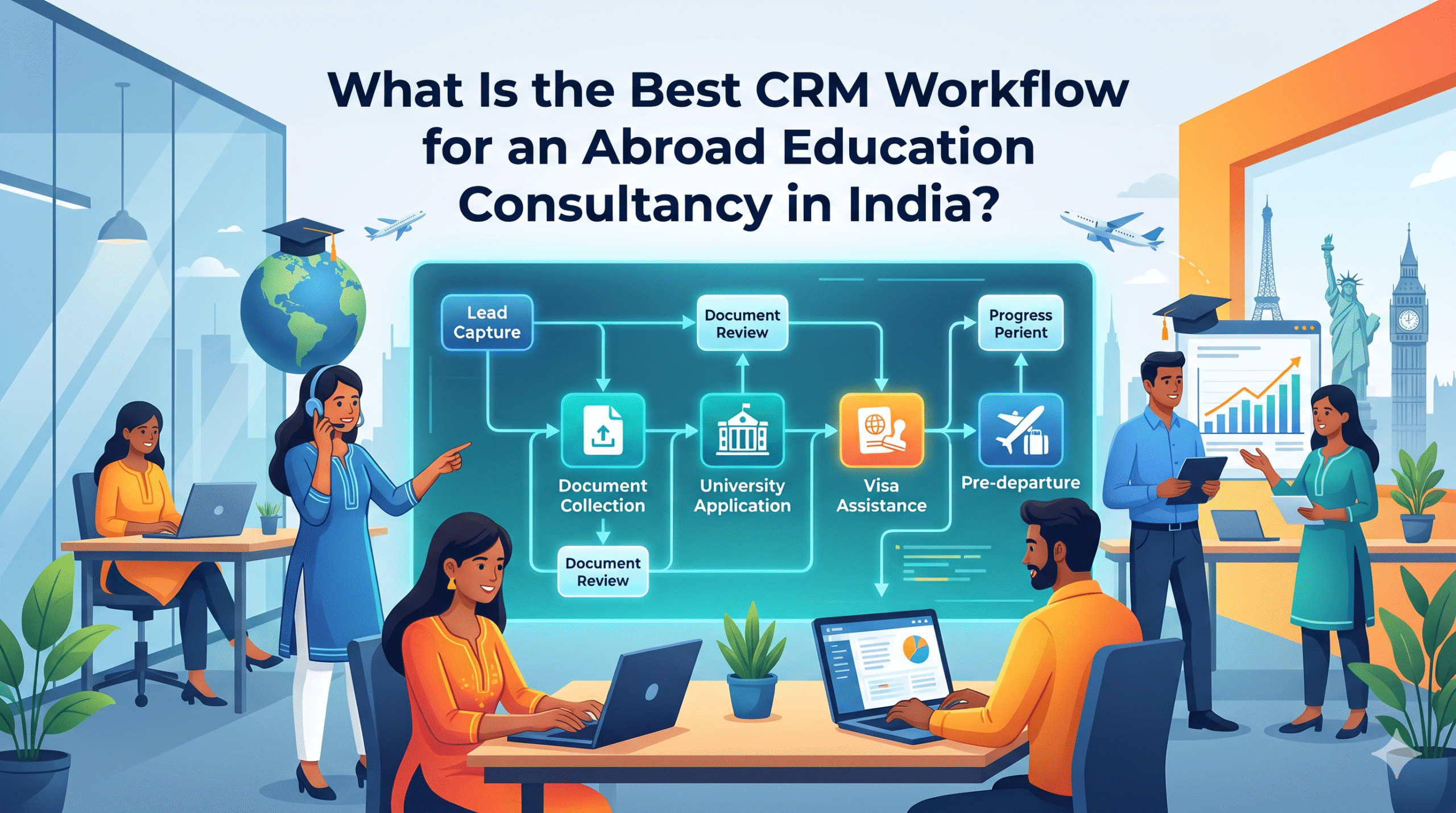
Assignment rules also create accountability. When a lead has one named owner, it is obvious who is responsible if it stalls. This is a core idea in the best CRM workflow for an abroad education consultancy in India.
Automate Follow-Ups on WhatsApp, Call and Email
Follow-up automation is where a CRM earns its cost. Instead of relying on memory, the system schedules tasks, sends reminders and can trigger templated messages at the right moment: an instant acknowledgement, a brochure after the first call, a gentle nudge after three quiet days.
In India, WhatsApp deserves special attention. Students and parents reply faster there than anywhere else. A CRM that supports approved WhatsApp templates, logs conversations against the student record and reminds counsellors to reply keeps this channel organised. Read more in our article on WhatsApp automation for education consultants and our overview of CRM software for study abroad agents with WhatsApp automation.
Note that automation should support human conversations, not replace them. Students choosing a university abroad want a counsellor they trust. Automation handles the reminders and routine updates so counsellors can spend their time on advice.
Build a Clear Pipeline With Defined Stages
A pipeline turns a messy list into a visible journey. A typical consultancy pipeline includes stages such as New Enquiry, Contacted, Counselled, Profile Evaluated, Documents Pending, Application Submitted, Offer Received, Visa Process and Enrolled. Each stage has an entry rule and an expected time limit.
When a lead sits in one stage longer than expected, the CRM can flag it. That flag is your early warning system for leakage. For a full walkthrough, see our guide on how to manage students from enquiry to admission in India.
Track Applications, Documents and Visas After the Sale
Leakage does not stop when a student signs up. Many consultancies lose students during the long middle phase of applications and visas. A CRM with application, document and visa tracking keeps this phase visible so no file is forgotten.
SmartX CRM includes dedicated modules for application management, document management and visa management. If you want to see how this looks in practice, read how to track student application progress with a CRM and how to never miss student visa or university deadlines.
Control Sub-Agent and Branch Leads
Many Indian consultancies work with sub-agents or multiple branches. Leads submitted by partners can leak when they sit in separate sheets or chat groups. A CRM with partner management lets sub-agents submit students into the same system with defined permissions, so the head office sees every lead and every commission trail. The B2B sub-agent management module is built for this scenario.
Use Reports to Find the Leak, Not Just Count Leads
Reports convert guesses into decisions. With stage-wise funnel reports, source reports and counsellor performance views, you can answer questions like these:
- Which lead source brings students who actually enrol, not just enquire?
- At which stage do we lose the most students?
- Which counsellors respond fastest, and which have overdue tasks?
- Are Instagram leads going cold faster than referral leads?
Our guide on what CRM data an abroad education consultancy in India should track lists the fields that make these reports reliable, and the SmartX CRM reports module shows how the views are presented.
How to Measure Lead Leakage in Your Consultancy
You cannot reduce what you do not measure. Use a simple formula and review it weekly.
Lead leakage rate = (Qualified leads with no recorded outcome after your response window / Total qualified leads) x 100
Define a “recorded outcome” as enrolled, closed with a reason, or actively in progress with a task due in the future. Any lead without one of these is leaking.
Here is an illustrative example (the numbers are for explanation only, not a benchmark):
| Metric | Value |
|---|---|
| Qualified leads this month | 400 |
| Leads with an enrolled, closed or active status | 310 |
| Leads with no outcome and no next task | 90 |
| Lead leakage rate | 22.5% |
In this example, nearly a quarter of qualified leads have no future. If your average enquiry to admission rate were 10 percent, those 90 leads represent roughly nine lost admissions per month. The point of the exercise is not the exact number but the direction: if you track the rate weekly, you can see whether your fixes work.
Track these supporting metrics alongside the main rate:
| Metric | What it tells you |
|---|---|
| First response time | Whether leads are contacted quickly |
| Overdue follow-up tasks | How well counsellors keep to their schedule |
| Leads with no next action | The most direct leakage signal |
| Stage-to-stage drop-off | Where in the funnel students disappear |
| Lead source conversion | Which channels deliver real admissions |
| Reactivation rate | How many cold leads you recover |
Step-by-Step: How to Plug Lead Leakage in 30 Days
You do not need a perfect system on day one. This plan focuses on the biggest gaps first.
- Week 1: Capture everything. List every channel that brings enquiries and connect each one to the CRM. Retire personal spreadsheets as official records. Import existing leads and tag their source.
- Week 1: Define your pipeline. Agree on six to nine stages with clear entry rules. Keep names simple so every counsellor uses them the same way.
- Week 2: Set assignment rules. Route leads by country, branch or round robin. Decide the maximum time allowed for first contact, such as 15 minutes during office hours.
- Week 2: Create follow-up cadences. Write a standard sequence for new, warm and cold leads. Include call, WhatsApp and email touchpoints with fixed gaps.
- Week 3: Add reminders and overdue alerts. Make sure every lead has a next action date. Send overdue lists to team leads each morning.
- Week 3: Build document and application checklists. For each destination, create a standard checklist so students know what is pending.
- Week 4: Turn on reporting. Set up the funnel, source and counsellor dashboards. Hold a short weekly review focused on leads with no next action.
- Week 4: Run a reactivation campaign. Contact leads that went cold in the past three to six months with a relevant update such as new intake dates or scholarship news.
For deeper planning on rollout and budget, see our guide to CRM implementation cost for counselling teams.
Which CRM Features Matter Most for Controlling Lead Leakage?
Not every feature contributes equally to leakage control. When you compare options, prioritise the ones that directly attack the eight leak points.
| Feature | Leak point it addresses | Priority |
|---|---|---|
| Multi-source lead capture and integrations | Unrecorded enquiries | Essential |
| Automatic lead assignment | Slow response, wrong match | Essential |
| Task reminders and overdue alerts | Missed follow-ups | Essential |
| WhatsApp and email logging | Channel switching | Essential |
| Pipeline stages with time limits | Blind spots, stalled leads | Essential |
| Document and application tracking | Stalled documents | High |
| Sub-agent and branch management | Partner and branch leaks | High for multi-branch teams |
| Reports by stage, source and counsellor | Reporting blind spots | High |
| AI calling or nudges | Fast re-engagement | Useful add-on |
If you are comparing vendors, our guides on CRM features that matter most for education consultants in India, how to choose the right CRM for an abroad education consultancy in India and what to ask a CRM provider before choosing software will help you build a fair checklist. Since student records include passports and financial documents, also review our education consultancy CRM data security guide.
Common Mistakes That Keep Lead Leakage High Even With a CRM
Buying software does not fix leakage on its own. These mistakes are common:
- Partial adoption. If half the team uses the CRM and half uses WhatsApp and notebooks, leakage continues in the half that is offline.
- Too many stages. A pipeline with fifteen stages confuses counsellors and produces dirty data. Start simple.
- No response time rule. Automatic assignment without a service-level expectation only moves the delay to a different place.
- Ignoring cold leads. Leads that go quiet often return when an intake date or scholarship changes. A reactivation process recovers value that is otherwise lost.
- No closure reasons. If counsellors can leave leads open forever, your leakage metric loses meaning. Require a reason when closing a lead.
How SmartX CRM Helps Education Consultancies Reduce Lead Leakage
SmartX CRM is built for study abroad and education consultancies, and its Educa CRM product focuses on the full journey from enquiry to enrolment. The platform brings together lead capture, assignment, follow-up reminders, WhatsApp-led communication, application and document tracking, visa management, sub-agent management and reporting in one workspace.
For consultancies that want to see the product itself, the Educa CRM page explains the core modules, the university course finder CRM helps counsellors match students to programmes faster, and the AI page describes how AI-assisted calling and nudges can support follow-ups.
Here is how SmartX CRM maps to the eight leak points:
- Capture: website, ad and manual entries flow into one lead list.
- Response: assignment rules and reminders shorten time to first contact.
- Follow-up: scheduled tasks and WhatsApp-friendly workflows keep conversations moving.
- Post-enrolment: application, document and visa modules reduce stalled files.
- Visibility: reports show where leads stop moving.
If you are still comparing platforms, our study abroad CRM comparison guide and the post on the best CRM for an abroad education consultancy in India give an honest view of what to look for. You can review plans on the pricing page or start a free demo to test the workflow with your own lead data.
Frequently Asked Questions About Lead Leakage and CRM in India
What is lead leakage in an education consultancy?
Lead leakage is the loss of qualified student enquiries because of process failures such as slow response, missed follow-ups, unrecorded enquiries or stalled documents. The student did not decline. The consultancy failed to keep the conversation alive.
How does a CRM prevent lead leakage?
A CRM prevents lead leakage by capturing every enquiry in one database, assigning an owner automatically, scheduling follow-ups and reminders, tracking each student through defined pipeline stages and reporting where students drop off. Every lead always has an owner and a next action.
How can I calculate my lead leakage rate?
Divide the number of qualified leads that have no recorded outcome or future task by the total number of qualified leads, then multiply by 100. Review the figure weekly and compare it after each process change.
Is WhatsApp automation useful for reducing lead leakage in India?
Yes. Many students and parents in India respond faster on WhatsApp than on email or calls. Using approved templates, logging chats in the CRM and reminding counsellors to reply keeps this channel organised and reduces missed replies.
How fast should a consultancy respond to a new student enquiry?
There is no single rule, but faster is better. Many teams set a target of minutes during working hours and a clear next-morning rule for after-hours enquiries. Automatic assignment and instant acknowledgement messages help you meet that target.
Can a small education consultancy benefit from a CRM?
Yes. Small teams often lose more leads proportionally because everything depends on one or two people. A simple CRM with capture, reminders and a basic pipeline can improve consistency without heavy setup.
How long does it take to see a reduction in lead leakage?
Teams often see fewer overdue follow-ups within the first few weeks of consistent use, because reminders and ownership rules take effect quickly. Conversion improvements usually take longer because student decisions span weeks or months.
Does a CRM help after the student signs up?
Yes. Application, document and visa tracking prevent leakage in the long middle stage of the journey, when students are most likely to stall or lose touch with the consultancy.
Conclusion: Make Every Student Enquiry Count
Lead leakage is rarely caused by bad counsellors or weak marketing. It is caused by missing structure: enquiries that are not recorded, follow-ups that depend on memory and funnels that nobody can see. CRM software gives education consultancies in India that structure by centralising capture, assigning ownership, automating reminders and exposing the stages where students drop out.
Start by measuring your current leakage rate, close the biggest gaps in 30 days, and then build from there. If you want to see how this works with your own enquiries, book a free SmartX CRM demo and turn your next campaign into admissions instead of lost leads.


Leave a comment: