How Can Indian Abroad Education Consultants Manage Students From Enquiry to Admission?
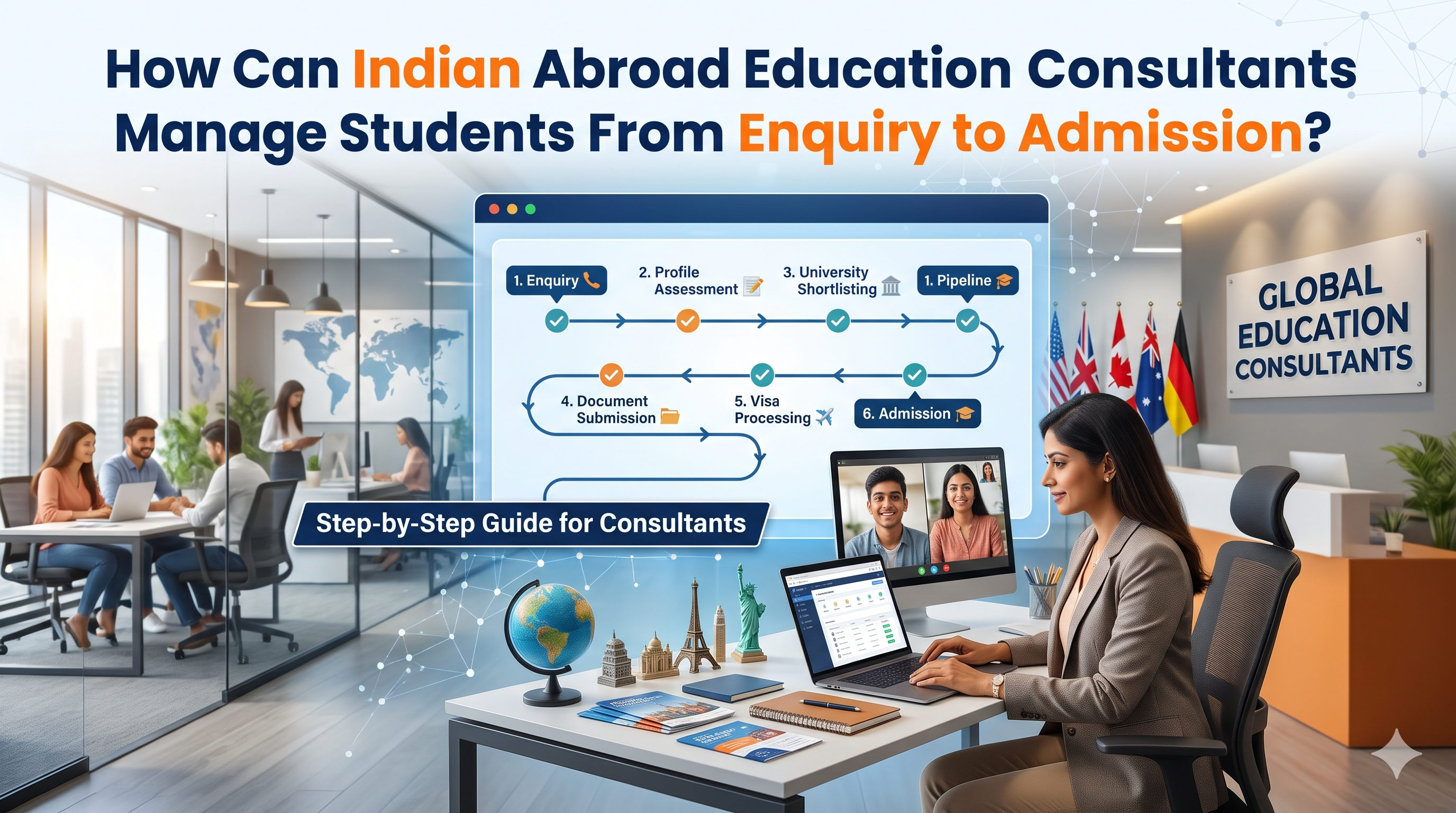
Quick answer: Indian abroad education consultants manage students from enquiry to admission by moving every student through one defined pipeline of seven stages: enquiry capture, counselling, shortlisting, documents and application, offer and acceptance, visa, and pre-departure. Each stage has a named owner, a response-time target and clear exit criteria, and the whole journey is tracked in a study abroad CRM instead of scattered WhatsApp chats and spreadsheets.
Most overseas education consultancies in India do not lose students because of weak counselling. They lose them in the gaps between stages. An enquiry waits a day for a callback. A document checklist is shared once and never chased. An offer letter arrives while the counsellor is busy with the next intake, and the student quietly accepts another consultant’s advice.
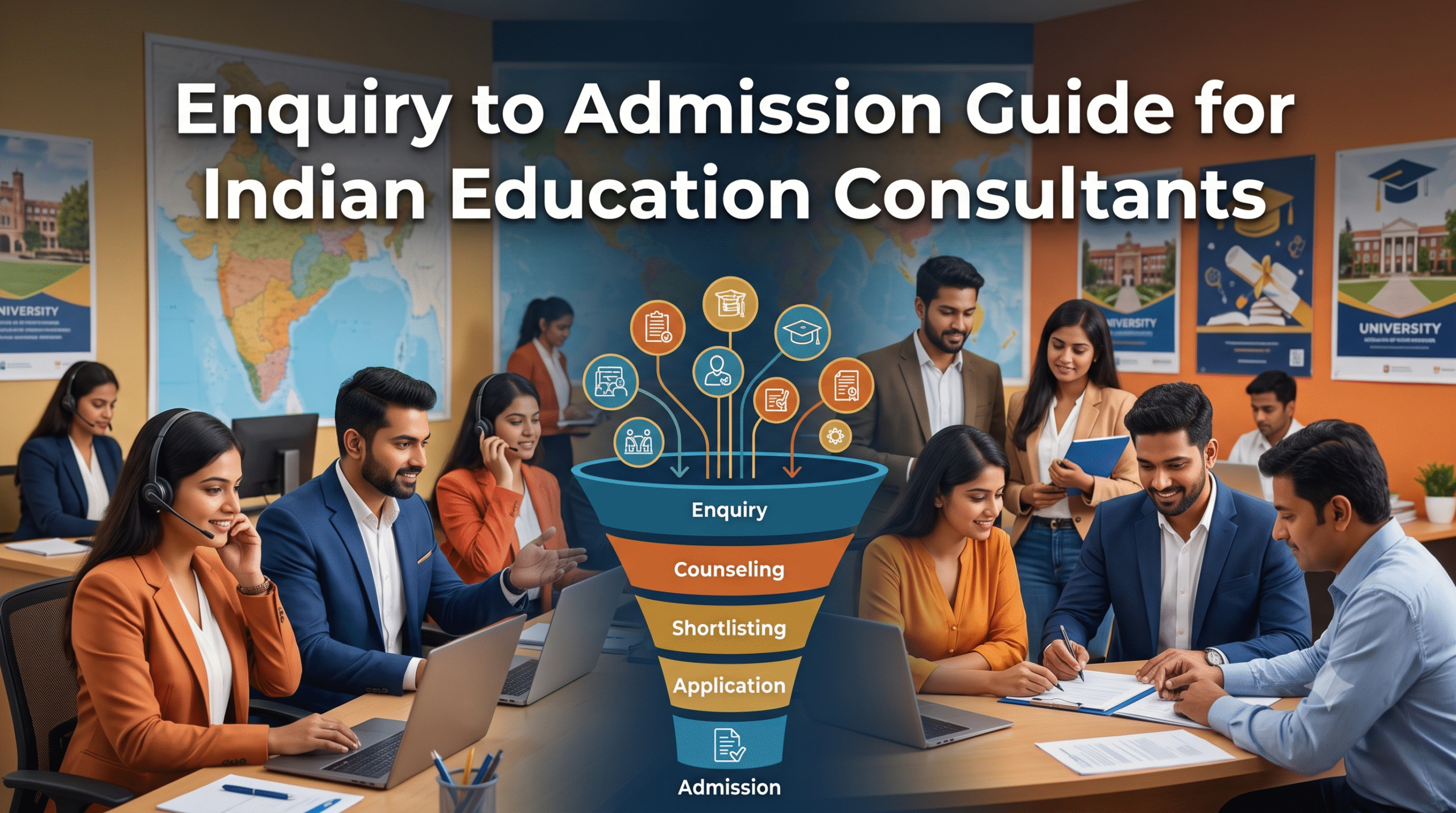
This guide gives you a practical operating model to manage students from enquiry to admission without those gaps. You will see each stage, who owns it, what “done” looks like, which metrics to watch and where a CRM such as SmartX CRM removes manual work. If you want the shorter checklist version first, read our enquiry to admission guide for Indian education consultants, then come back here for the full playbook.
Key Takeaways
- A consultancy that wants to manage students from enquiry to admission needs one pipeline, not one spreadsheet per counsellor.
- Seven stages cover the journey: capture, counselling, shortlisting, documents and application, offer and acceptance, visa, pre-departure.
- Every stage needs an owner, an exit rule and a time limit, otherwise students stall silently.
- Speed to first response, follow-up completion and offer-to-acceptance rate are the three numbers that predict revenue earliest.
- Automation should handle reminders, assignment and status updates so counsellors can spend their time advising students.
What Does It Mean to Manage Students From Enquiry to Admission?
To manage students from enquiry to admission means running a repeatable, tracked process that takes a prospective student from the first message or call to a confirmed offer and accepted seat at a foreign university. For an abroad education consultancy, the process normally continues past admission into visa filing and departure, because revenue and reputation depend on the student actually landing.
Three ideas sit inside this definition. First, the process is repeatable: two counsellors handling two students should follow the same steps. Second, it is tracked: every status, document and conversation lives in a shared record. Third, it is outcome-linked: each stage exists to move the student closer to a specific result such as a booked consultation, a submitted application or an accepted offer.
If your team is still deciding what a CRM does in this setting, our explainer on what CRM means in an overseas consultancy covers the basics in plain language.
Why Do Students Drop Off Between Enquiry and Admission?
Students drop off because the consultancy’s process depends on individual memory instead of a system. The same five leaks appear in most Indian abroad education consultancies, regardless of size.
- Slow first response. Students enquire with several consultants at once. The first useful reply usually sets the tone for the relationship.
- Follow-ups that live in one counsellor’s head. When that counsellor is on leave, the lead goes cold. Our guide to managing student follow-ups with CRM shows how to remove this single point of failure.
- Scattered documents. Passports, transcripts, IELTS scores and statements of purpose arrive through WhatsApp, email and walk-ins, then get lost or duplicated.
- Deadline blindness. Intake dates, scholarship cut-offs and visa appointment windows are tracked on personal calendars rather than against the student’s file.
- No manager visibility. The owner cannot see how many students are stuck at documents or waiting on offers without calling each counsellor.
These leaks are the practical reason Indian abroad education consultants need CRM software. The rest of this article shows how to close each one.
What Are the 7 Stages of a Study Abroad Admission Workflow?
The seven-stage enquiry to admission workflow is: (1) enquiry capture and qualification, (2) counselling and profile building, (3) shortlisting and course matching, (4) documents and application, (5) offer and acceptance, (6) visa and financial proof, (7) pre-departure and handover. The table below gives each stage an owner, an exit rule and a suggested time target.
| Stage | Typical owner | Exit criteria | Suggested target |
|---|---|---|---|
| 1. Enquiry capture and qualification | Front desk or tele-counsellor | Contact verified, country, course, intake and budget logged, consultation booked | First response within 15 minutes in working hours |
| 2. Counselling and profile building | Senior counsellor | Profile and goals recorded, expectations set, service agreement signed | Within 2 working days of first contact |
| 3. Shortlisting and course matching | Counsellor | Student approves 4 to 6 course and university options | Within 3 working days of counselling |
| 4. Documents and application | Application officer | All documents verified, applications submitted | 5 to 10 working days per country |
| 5. Offer and acceptance | Application officer and counsellor | Offer reviewed, accepted, deposit paid | Student contacted within 24 hours of each offer |
| 6. Visa and financial proof | Visa officer | Funds documents ready, visa filed, interview prepared | Filing planned against the embassy timeline |
| 7. Pre-departure and handover | Counsellor | Briefing, accommodation and travel confirmed, referral requested | Completed before departure date |
Treat these targets as starting points. Replace them with your own averages after two or three months of data. A pipeline that follows these stages is exactly what a purpose-built study abroad CRM is designed to hold.
Stage 1: How Should You Capture and Qualify Every Student Enquiry?
Capture every enquiry in one place the moment it arrives, assign it to a counsellor automatically, and qualify it with five questions: target country, course level, intake, budget range and current academic status. Enquiries reach Indian consultancies through website forms, Instagram and Facebook ads, WhatsApp, education fairs, walk-ins and sub-agents. If each channel feeds a different sheet, duplicates and delays are guaranteed.
A good capture routine looks like this:
- Route all sources into one lead list with the source tagged.
- Detect duplicates by phone number or email before assigning.
- Assign by rule, for example by destination country, language or counsellor workload.
- Send an instant acknowledgement on WhatsApp or email so the student knows a person will call.
- Book the counselling slot during the first call rather than promising a callback.
A CRM built for this job makes the process fast. See how teams manage student enquiries as abroad education consultants in India without losing track of source or owner.
Stage 2: What Should Happen in the First Counselling Session?
The first counselling session should end with a recorded student profile, a realistic destination plan and a signed service agreement. Counsellors often spend the session talking and then rely on memory. Instead, capture structured fields during the call: academic scores, backlogs, English test status, work experience, budget, family sponsor details and preferred intake.
Record the student’s concerns too. If a parent worries about visa refusal or part-time work rules, note it in the file so the next counsellor does not repeat the same discovery call. This is the point where the data you collect starts to matter, so decide early on what CRM data an abroad education consultancy in India should track.
Close the session with a clear next step and date, such as “shortlist shared by Thursday, documents due the following Wednesday.” Students stay engaged when they know what happens next.
Stage 3: How Do You Shortlist Courses and Universities Without Delays?
Shortlist four to six course and university options per student, balanced across ambitious, realistic and safe choices, and share them in one structured message the student can approve. Delays in this stage usually come from manual research, so keep a maintained database of programmes, intake dates, entry requirements and fees by country.
A CRM with a course search tool shortens this step considerably. SmartX CRM’s university course finder is built for this purpose, letting counsellors match a student’s profile to programmes and attach the options to the student record. Whatever tool you use, record the student’s decision on each option. A shortlist that is approved verbally but not logged becomes a dispute later.
If you work with sub-agents or partner counsellors, give them the same shortlist template so quality does not vary by branch. The B2B sub-agent management capability helps keep partner-sourced students inside the same pipeline.
Stage 4: How Do You Manage Documents and Applications for Many Students?
Give every student a country-specific document checklist, track each item as requested, received, verified or rejected, and submit the application only when the checklist is complete. Document collection is where most Indian consultancies burn time, because students send files in pieces and in poor quality.
Practical rules that work:
- Create one checklist template per destination, because Germany, Canada, the UK and Australia ask for different proofs.
- Collect documents in the student’s file, not in personal chats.
- Verify names, dates and scores against the passport before upload.
- Set automatic reminders for missing items at two, five and seven days.
- Lock the application only after a second person reviews it.
A dedicated document management module and application management workspace keeps this visible to the whole team. If you want a deeper look at keeping files organised, read how CRM software helps education consultants organise student applications.
Students applying to several countries need one master profile with separate application tracks. Our guide to managing multi-country applications explains how to avoid duplicate data entry.
Stage 5: How Do You Turn Offers Into Accepted Seats?
Contact the student within 24 hours of every offer, explain conditions in plain language, compare offers against the student’s budget and goals, and log the decision and deposit status. An offer is not a conversion until the student accepts and pays. This is the stage where competing consultants and direct university contact create the most risk.
Prepare a simple offer summary covering tuition, scholarship, intake, conditions and deadline for acceptance. Share it by WhatsApp and email, then set a reminder for the deadline minus three days. If the student hesitates, record the reason, since cost, location and family concerns each need a different response.
Managers should be able to see all pending offers in one view, sorted by acceptance deadline. This single report often recovers admissions that would otherwise expire.
Stage 6: How Do You Prepare Visa and Financial Proof on Time?
Build the visa file as soon as the student accepts an offer, using a country-wise checklist for financial documents, sponsor proofs, statements and appointment bookings, and track every date against the student’s record. Visa work has the strictest deadlines in the journey, and a missed appointment can push a student to the next intake.
Assign a visa officer who owns the file, and give counsellors read access so they can answer student questions. Track funds documents, medical and biometric appointments, interview preparation and decision status as separate steps. Our article on never missing student visa or university deadlines explains how automated reminders protect these dates.
Visa-specific tools such as visa management and visa tracking give the team one place to see which students are waiting on documents, appointments or decisions.
Stage 7: What Should You Do After Admission and Visa Approval?
Run a pre-departure briefing, confirm accommodation and travel, collect feedback and ask for referrals. Many consultancies treat visa approval as the finish line, but this stage creates future enquiries. A student who feels supported becomes the strongest source of new leads through family and friends.
Cover the following in the briefing: arrival checklist, banking and SIM setup, accommodation details, university orientation dates, emergency contacts and local rules. After arrival, schedule a check-in at two weeks and again at three months. Record any issues in the student file, because they inform how you counsel the next student heading to the same destination.
What Mistakes Slow Down Enquiry to Admission Management?
The most common mistakes are tracking students in personal spreadsheets, skipping exit rules, treating all enquiries as equal and measuring only final enrolments. Each one hides problems until a student has already left.
- Personal spreadsheets. When every counsellor keeps a private sheet, managers cannot see workload, and a resignation can wipe out weeks of relationship history.
- No exit rules. If “documents received” can mean one file or all twelve, stages lose meaning and reports become unreliable.
- Equal treatment of every enquiry. A student with a clear intake, budget and test score needs a faster call than a casual browser. Score or tag leads so the best opportunities are contacted first.
- Measuring only enrolments. By the time enrolment numbers fall, the damage happened weeks earlier at response time or documents. Watch the leading stages instead.
- Ignoring parents and sponsors. In India, the decision often belongs to the family. Record sponsor details and keep parents informed at offer and visa stages.
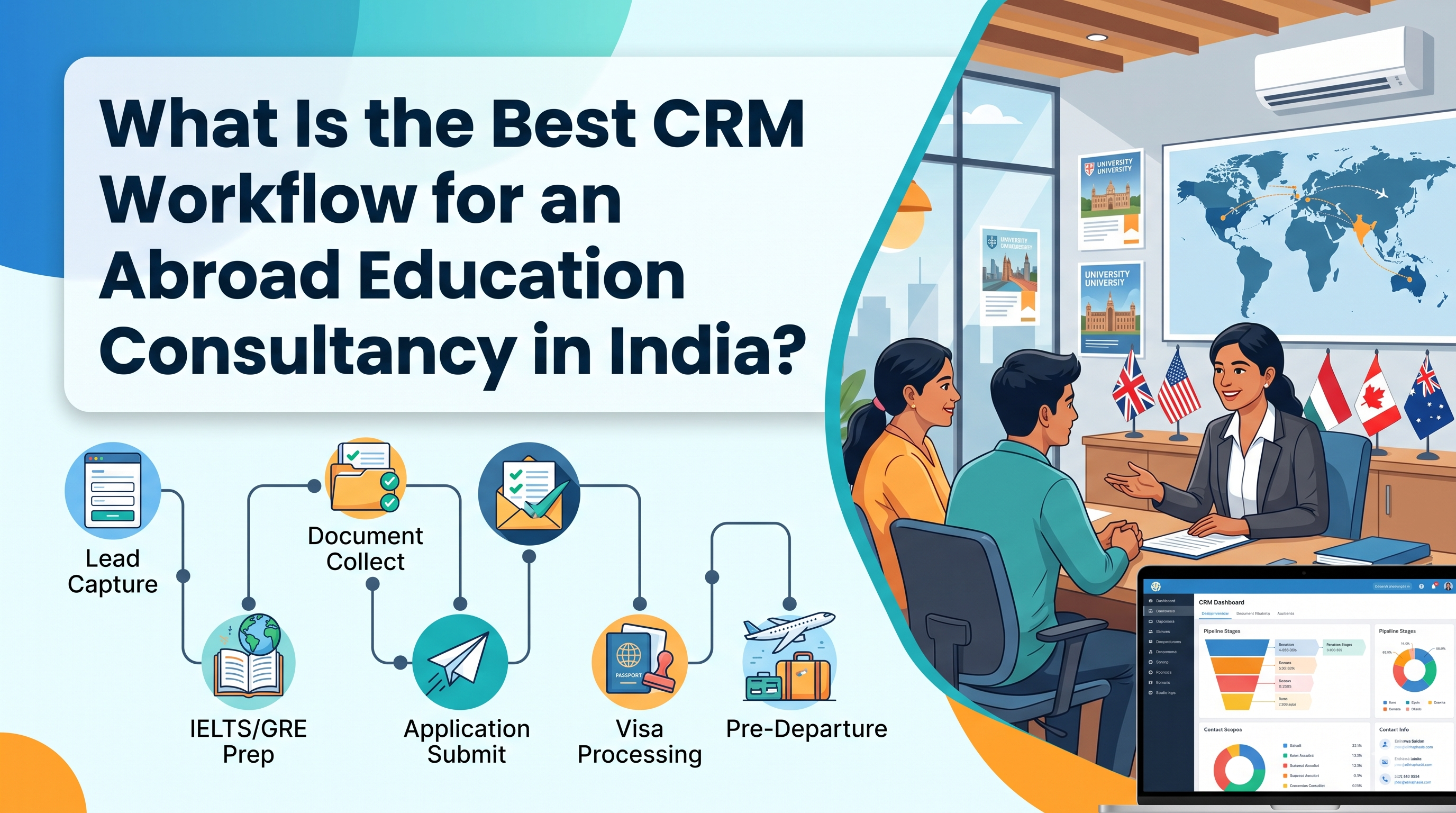
Fixing even two of these usually produces a visible improvement within one intake cycle. A consistent process, shared by the whole team, is also the strongest foundation for the best CRM workflow for an abroad education consultancy in India, where each stage, task and reminder is mapped before software is configured.
Which Metrics Should You Track From Enquiry to Admission?
Track speed to first response, stage-to-stage conversion, days spent in each stage, follow-up completion and source-wise conversion. These metrics show exactly where students leak out of your funnel.
| Metric | What it tells you |
|---|---|
| Speed to first response | Whether new enquiries get attention before competitors reach them |
| Enquiry to counselling rate | How well your first call converts curiosity into a booked session |
| Counselling to application rate | Whether counsellors are closing the loop after advising |
| Application to offer rate | The quality of applications and university matching |
| Offer to acceptance rate | The strength of your offer follow-up |
| Average days per stage | Which stage is slowing the pipeline |
| Follow-up completion rate | Whether reminders are actually being actioned |
| Source-wise conversion | Which channels bring students who actually enrol |
Review these weekly during peak intake periods and monthly otherwise. Reporting is easier when it is built in; SmartX CRM’s reports module is designed to give owners this view without manual spreadsheets.
How Does Automation Improve Student Management From Enquiry to Admission?
Automation improves the process by handling the repetitive tasks that cause delays: lead assignment, acknowledgements, document reminders, deadline alerts and status updates. It does not replace counsellors. It gives them back the hours they would otherwise spend chasing and copying data.
In practice, three kinds of automation matter most for Indian consultancies:
- WhatsApp automation. Students in India respond fastest on WhatsApp, so acknowledgements, document reminders and offer deadline nudges work best there. SmartX CRM’s WhatsApp tool, WA Daddy, is built for this. For a detailed look, read how WhatsApp automation turns conversations into enrolments and how CRM software for study abroad agents with WhatsApp automation fits into daily work.
- Rule-based assignment and reminders. Leads route to the right counsellor, and tasks appear automatically when a student enters a new stage.
- AI-assisted calling and follow-up. SmartX CRM’s AI capabilities can support first-touch conversations and routine follow-ups, which helps during admission-season spikes.
Automation also protects data. A consultancy holds passports, financial proofs and family details, so access control and secure storage are not optional. Review our education consultancy CRM data security guide before you move student files into any system.
How Can You Roll Out This Workflow in 30 Days?
You can roll out the workflow in four weeks by mapping stages in week one, building checklists in week two, training the team in week three and reviewing the first data in week four.
- Week 1: Map your stages. Agree the seven stages, owners and exit rules. Remove any stage names that overlap.
- Week 2: Build templates. Create country-wise document checklists, counselling forms, offer summaries and message templates.
- Week 3: Train and migrate. Import active students, assign owners and run a short training for every counsellor. Move live students first, archive old leads later.
- Week 4: Review and tune. Check response times, stuck students and follow-up completion. Adjust targets using your real numbers.
If you are still comparing systems, our guides on how to choose the right CRM for an abroad education consultancy in India and what to ask a CRM provider before choosing software will help you shortlist vendors. For a feature-led view, see the CRM features that matter most for education consultants in India.
Conclusion: Build the Pipeline Once, Then Let It Run
To manage students from enquiry to admission, build one visible pipeline, give every stage an owner and an exit rule, measure the handoffs and automate the routine work. Consultancies that do this stop depending on individual memory, respond faster, lose fewer offers and give students a calmer, clearer journey.
If you want to see this workflow in a live system, explore SmartX CRM pricing or start a free demo and walk through your own stages with the team.
Frequently Asked Questions
What is the enquiry to admission process for study abroad consultants?
It is the sequence of steps from a student’s first enquiry to a confirmed offer and accepted seat, usually covering capture, counselling, shortlisting, documents and application, and offer acceptance. Most consultancies extend it to visa and pre-departure support.
How many stages should an overseas education consultancy pipeline have?
Seven stages work for most Indian consultancies: enquiry capture, counselling, shortlisting, documents and application, offer and acceptance, visa, and pre-departure. Fewer stages hide delays, and many more make the pipeline hard to maintain.
How fast should a consultancy respond to a new student enquiry?
Aim to respond within 15 minutes during working hours, and send an automatic acknowledgement outside them. Speed matters because students often contact several consultants at the same time.
How do you track documents for many students at once?
Use a country-specific checklist for each student, mark every document as requested, received, verified or rejected, and set automatic reminders for missing items. A CRM with document management keeps all files in one student record.
Can one CRM manage applications to several countries for the same student?
Yes. A study abroad CRM should hold one master student profile with separate application tracks per country, so documents, offers and deadlines stay linked without duplicate data entry.
Which CRM helps Indian consultants manage students from enquiry to admission?
A CRM built for education consultancies, such as SmartX CRM, combines enquiry capture, counselling records, course search, application and document tracking, visa management, WhatsApp communication and reporting in one workspace.
Leave a comment: