How Can CRM Software Help Education Consultants in India Organise Student Applications?
CRM software helps education consultants in India organise student applications by keeping every student profile, shortlist, document, university application, deadline and visa stage in one shared system. Instead of hunting through Excel sheets, WhatsApp chats and email threads, your team sees a single record for each student, with a clear owner, checklist, status and due date for every application.
For a study abroad consultancy, this matters more than it first appears. One student may apply to five universities across three countries, each with a different intake, document list and deadline. Multiply that by hundreds of active students and a handful of counsellors, and small gaps turn into missed deadlines, duplicate follow-ups and lost trust. A well-configured education consultancy CRM removes those gaps by turning your application process into a repeatable workflow.
This guide explains exactly how that works. You will see the step-by-step flow from first enquiry to visa, the features that matter, the mistakes to avoid, and how to set the system up without disrupting your team.
Why Student Applications Get Messy in Study Abroad Consultancies
Most consultancies do not start with a bad process. They start with a manual one that works for twenty students and quietly breaks at two hundred. The usual pain points look familiar:
- Documents live everywhere. Passport scans arrive on WhatsApp, marksheets on email, and the SOP draft sits in a counsellor’s personal folder.
- Status is stored in people’s heads. Only the counsellor handling a student knows whether the application was submitted, whether the university asked for more papers, or whether an offer is pending.
- Deadlines differ by country and intake. UK, Canada, Australia, Germany and the US each follow their own cycles, and a single missed date can push a student back a full intake.
- Handovers fail. When a counsellor is on leave or leaves the company, the next person has to rebuild the story from scratch.
- Spreadsheets do not scale. Shared sheets get overwritten, versions multiply, and there is no automatic reminder when something is overdue.
These problems are exactly why more consultancies are moving to a dedicated system. If you are still weighing the decision, read why abroad education consultants in India need CRM software for the broader business case before going deep on applications.
What Is Student Application Management in a CRM?
Student application management is the part of a CRM that tracks each university application as its own record, linked to the student’s master profile. It records which course and intake the student chose, which documents are required, what has been submitted, what the university has replied, and what the next action is.
This is different from a generic sales pipeline. A standard CRM tracks a deal moving through stages. A study abroad CRM has to track many parallel applications for one person, plus documents, deadlines and visa steps that depend on each other. If the term is new to your team, what is CRM in overseas consultancy gives a plain-language introduction.
A dedicated application management module is built around this exact structure, which is why it works better than a repurposed sales tool.
How CRM Software Organises Student Applications, Step by Step
The easiest way to understand the value is to follow one student through the system. Here is the flow a good overseas education CRM supports.
Step 1: Capture Every Enquiry and Build One Student Profile
Applications can only be organised if the starting data is clean. Enquiries arrive from your website, Facebook and Instagram ads, walk-ins, education fairs, referrals and WhatsApp. The CRM pulls these into one place, removes duplicates, and creates a single student profile with contact details, academic background, test scores, budget, preferred countries and intake.
That profile becomes the source of truth. Every later application, document and message attaches to it. For a deeper look at the intake side, see how to manage student enquiries as an abroad education consultant in India.
Step 2: Shortlist Universities and Courses From the Same Screen
Once the profile is complete, counsellors shortlist programmes. Without a CRM, this means switching between university websites, personal notes and spreadsheets. With a connected university and course finder, the counsellor matches the student’s grades, budget and intake to real programmes and adds them directly to the student’s application list.
The shortlist is saved against the profile, so a colleague can open it later and see exactly why each course was chosen.
Step 3: Use a Document Checklist for Every Student
Documents cause more delays than any other part of the application. A CRM solves this with country-wise and university-wise document checklists. When a student is shortlisted for a Canadian college, the system generates the required list: passport, transcripts, language test score, SOP, recommendation letters, financial proof and so on.
Each item has a status such as requested, received, verified or rejected. Files are stored against the student profile through a central document management system, not on a counsellor’s phone. When a document is missing, the CRM flags it and can trigger a reminder to the student.
Step 4: Track Each University Application as Its Own Record
This is the heart of student application tracking. Each university application gets its own record with fields such as course, intake, application ID, submission date, portal login reference, fee status, university response and next step. A typical pipeline might run through these stages:
- Shortlisted
- Documents pending
- Ready to apply
- Applied
- Additional documents requested
- Offer received (conditional or unconditional)
- Offer accepted and deposit paid
- CAS, I-20 or visa file started
Because stages are standardised, a manager can open one board and see how many applications are stuck at “documents pending” across the whole team. That visibility is almost impossible to get from spreadsheets.
Step 5: Control Intakes and Deadlines With Automated Reminders
Deadline management is where a CRM pays for itself. You can attach a deadline to each application and set application deadline reminders for the counsellor, the student and the team lead at chosen intervals. Intake-wise views show which applications need to be submitted this week, which are at risk, and which have already slipped.
To see how this connects to visa and university timelines, read how CRM helps consultants never miss student visa or university deadlines.
Step 6: Manage SOP, LOR and Financial Papers as Tasks
SOPs, letters of recommendation, bank statements and sponsor letters are not simple uploads. They involve drafting, review, feedback and approval. A CRM turns each into a task with an owner and due date: the student drafts the SOP by Friday, the counsellor reviews by Monday, the final version is uploaded by Wednesday.
This task layer replaces the usual “did you send it?” messages and gives the student a clear to-do list instead of a vague reminder.
Step 7: Move From Offer Letter to Visa Without Losing Context
Organising applications does not stop at the offer. The same student record should carry on into the visa stage so that nobody re-enters data. Offer letters, deposit receipts, medical and biometric dates, and embassy appointments sit in the same file. Dedicated visa tracking and visa management tools let your team see in one glance which students are waiting on a decision and which need action.
Before and After: Spreadsheets Versus a Study Abroad CRM
| Task | With spreadsheets and chats | With a CRM |
|---|---|---|
| Student profile | Scattered across sheets and chats | One profile with full history |
| Document collection | Manual follow-up on WhatsApp | Checklist with status and automatic reminders |
| University application status | Known only to the counsellor | Shared pipeline visible to the team |
| Deadlines | Calendar notes and memory | Intake-wise views and reminders |
| Handover between counsellors | Slow, error-prone | Instant, full history on the record |
| Management reporting | Built by hand each month | Live dashboards |
Features to Look for in CRM Software for Application Management
Not every CRM is built for this job. When you evaluate options, look for features that match how consultancies actually work:
- Multiple applications per student, each with its own status, intake and deadline.
- Country and university specific document checklists that you can edit.
- Central document storage with version control and verification status.
- Task and reminder automation for counsellors and students.
- Pipeline views by stage, intake, country and counsellor.
- Fast global search so staff can find any student, application or file in seconds.
- Role-based permissions so counsellors, document officers and sub-agents see only what they should.
- WhatsApp and email integration so communication stays attached to the record.
- Reports on conversion, turnaround time and bottlenecks.
If you want a fuller checklist, the guide on CRM features that matter most for education consultants in India goes deeper, and how to choose the right CRM for an abroad education consultancy in India walks through a selection process.
Keeping Students Informed Without Chasing Them
Application delays are often communication delays. A student forgets to upload a bank statement, a parent does not reply, or a university query goes unnoticed. A CRM links messages to the application, so every update is logged where the team can see it.
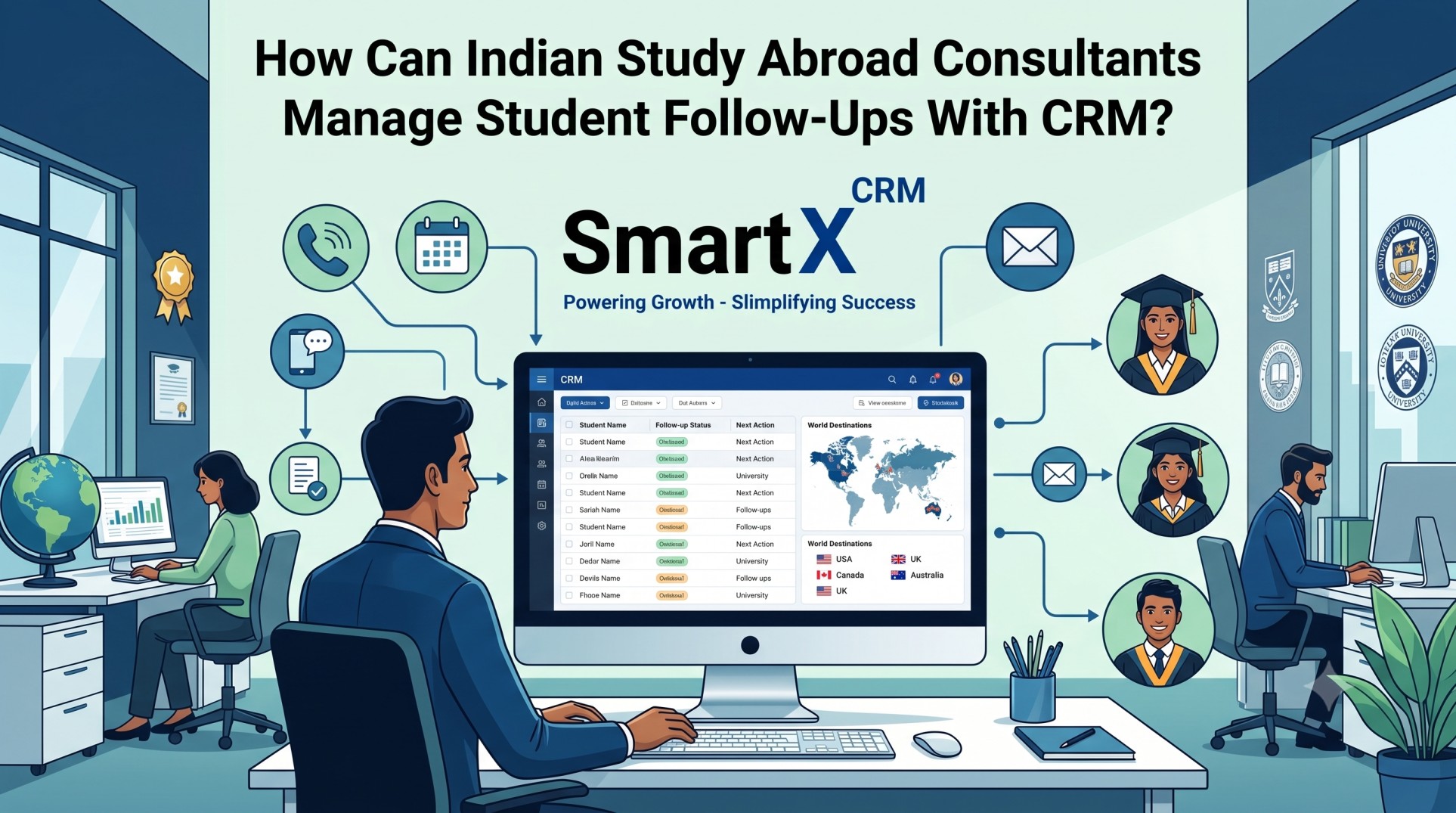
For Indian consultancies, WhatsApp is the main channel, so this matters. With WhatsApp automation for study abroad agents, you can send document requests, deadline alerts and status updates from the CRM, and every reply is stored on the student record. The same discipline applies after the first contact. Our guide on how Indian consultants can manage student follow-ups with CRM shows how to keep applicants moving between stages.
Handling Multi-Country Applications, Sub-Agents and Team Roles
Many consultancies work across several destinations and several branches. A CRM helps by letting you create separate workflows for each country while keeping one student profile. A student applying to Ireland and Australia can have two sets of checklists and deadlines without duplicating personal data.
If you recruit through partners, sub-agent management lets you give agents controlled access to submit leads and track their own students, while you keep control of final applications and commissions. For a closer look at complex cases, see the guide to the best education consultant CRM for managing multi-country applications.
Role-based access also protects your business. A document officer might see uploads and verification, a counsellor might see the full file, and a branch manager might see team-level numbers only.
Using Reports to Find Bottlenecks in Your Application Process
Once applications live in a CRM, your data becomes useful. Instead of guessing why students drop off, you can see where the process slows. Useful questions include:
- How many applications are stuck at “documents pending,” and for how long?
- Which counsellor has the longest average time from shortlist to submission?
- Which country or university has the highest rate of additional document requests?
- What percentage of offers convert to deposits and visas?
Live reports and dashboards answer these without manual exports. To decide which fields to capture so those reports are meaningful, read what CRM data an abroad education consultancy in India should track.
Protecting Student Data and Documents
Student applications involve passports, financial statements and academic records. Moving these into a CRM should improve security, not weaken it. Look for encrypted storage, access logs, permission controls and clear data retention practices. India’s data protection rules make careful handling of personal data more important for consultancies, so it is worth reviewing the education consultancy CRM data security guide before you migrate files.
How to Set Up Student Application Management in Your CRM
A good rollout is short and structured. Most consultancies can get a working setup running in a few weeks by following this order.
- Map your current process. List every stage a student passes through, from enquiry to visa, and note where delays usually happen.
- Define your pipeline stages and fields. Keep stages simple and agree on what each one means so every counsellor uses them the same way.
- Build document checklists. Start with your top three countries and top universities, then expand.
- Import existing data. Clean your spreadsheets, remove duplicates and import active students first.
- Train the team and set rules. Decide who updates what and by when, then review the dashboards in a weekly meeting.
Budget and timeline planning matter too. This breakdown of how much CRM implementation actually costs for a counselling team helps you plan realistically, and the platform’s integration options show how it connects with the tools you already use.
Common Mistakes to Avoid
- Copying a messy spreadsheet into the CRM. Clean the data first, or the CRM will simply hold the same mess in a new place.
- Too many pipeline stages. Fifteen stages confuse counsellors and lead to skipped updates. Start lean.
- Skipping checklists. Without standard checklists, document quality stays dependent on individual memory.
- No ownership rules. If nobody is responsible for updating a status, the board becomes unreliable within weeks.
- Ignoring the student side. If students are not reminded and guided, your team still ends up chasing them by hand.
How SmartX CRM Helps Consultancies Organise Student Applications
SmartX CRM is built for study abroad and education consultancies, so the application workflow is part of the core design rather than an add-on. Teams can manage student profiles, shortlist programmes, collect documents, track each university application, monitor deadlines and carry the file into visa processing from a single platform. Consultancies that want a purpose-built setup can look at Educa CRM, and anyone comparing options can review the pricing plans.
The best way to judge fit is to see your own workflow inside the product. You can book a free demo to walk through application tracking with your real use cases, or contact the SmartX team with questions about migration and setup. If you are still comparing options at a broader level, the article on best education consultancy CRM for managing student admissions is a good companion read.
Frequently Asked Questions
How does CRM software help education consultants organise student applications?
A CRM stores each student’s profile, shortlisted programmes, documents, deadlines and visa stage in one shared system. Each university application becomes its own record with a status, owner and due date, so the whole team can see progress and act on delays.
Can a CRM track multiple university applications for the same student?
Yes. A study abroad CRM links several application records to one student profile. Each record holds its own course, intake, deadline, documents and university response, which makes comparing and managing parallel applications simple.
What is the best way to manage student documents in a CRM?
Use country and university specific checklists, store every file against the student profile, and mark each item as requested, received or verified. Automated reminders help reduce manual follow-up with students and parents.
Does a CRM help prevent missed application deadlines?
It does. You can attach deadlines to each application and set reminders for counsellors, students and team leads. Intake-wise views also show which submissions are due soon or already overdue.
Is CRM software useful for small education consultancies?
Yes. Smaller teams often feel the pain of manual tracking early because one counsellor may handle many students. A CRM adds structure from the start and makes it easier to grow without losing track of applications.
Can application tracking continue into the visa stage?
A good CRM carries the same student record from application to offer, deposit and visa. That way, offer letters, appointment dates and visa status stay linked to the original profile with no duplicate data entry.
Conclusion
Organised applications are the backbone of a reliable study abroad business. When every document, deadline and university response is tracked in one place, students get faster answers, counsellors waste less time, and managers can finally see where the process slows down. CRM software gives education consultants in India a practical way to reach that level of control without adding more staff or more spreadsheets.
Start small: define your stages, build a few strong checklists, and train your team to update records daily. Then refine as the data shows you where to improve. If you want to see how this looks in practice, book a free SmartX CRM demo and explore the application workflow with your own scenarios.

Leave a comment: