
Quick answer: A DPDP consent manager is a company registered with the Data Protection Board of India that lets people give, review and withdraw consent across many businesses from one platform. Registration opened on 13 November 2026. Small businesses do not need one, but they must meet their own consent and security duties by 13 May 2027.
Last updated: 29 November 2026 · By SmartX CRM Product Team
The DPDP consent manager framework is the newest part of India’s data protection law to come into force. On 14 November 2026, the Ministry of Electronics and IT announced that the consent manager registration framework had taken effect on 13 November 2026, and opened an online portal at dpbi.gov.in for companies that want to apply.
If you run a study abroad consultancy or a clinic, two questions follow. Do you need a DPDP consent manager? And what must change before May 2027? This guide answers both, using the official PIB releases linked below.
What is a DPDP consent manager?

A DPDP consent manager is a company registered with the Data Protection Board of India that gives individuals one place to give, manage, review and withdraw their consent. It works for the person whose data it is, called the Data Principal, and is accountable to that person.
Think of a DPDP consent manager as a consent dashboard. For example, a student could see, in one app, which businesses hold her consent, and withdraw any of them with a tap.
In addition, three points define the role:
- Section 2(g) of the Digital Personal Data Protection Act, 2023 defines the role, and the company must register with the Data Protection Board of India.
- Its platform must not be able to read the personal data that passes through it. Instead, it handles consent instructions only.
- It must act in a fiduciary capacity towards the individual and avoid conflicts of interest with the businesses it connects to.
The model is similar to the RBI Account Aggregator system for financial data. Taxmann’s analysis of the consent manager rules compares the two in detail.
What changed on 13 November 2026?

From 13 November 2026, companies can formally apply to become a DPDP consent manager. Rule 4 of the DPDP Rules, 2025 came into force on that date, and the Data Protection Board of India started accepting applications through its portal.
According to the PIB release, eligible companies apply online, the Board assesses each application, and the Board will publish the list of registered consent managers on its website. Inc42 reported that MeitY Secretary S. Krishnan launched the portal.
The government is bringing in the DPDP Rules over 18 months, in three phases:
| Date | What takes effect | Who it affects most |
|---|---|---|
| 13 November 2025 | DPDP Rules, 2025 notified; definitions and setting up of the Data Protection Board | Government and the Board |
| 13 November 2026 | Consent manager registration and obligations (Rule 4) | Companies that want to become consent managers |
| 13 May 2027 | Data Principal rights, Data Fiduciary obligations, Board inquiry and penalty process | Every business that handles personal data, including consultancies and clinics |
Who can register as a consent manager?
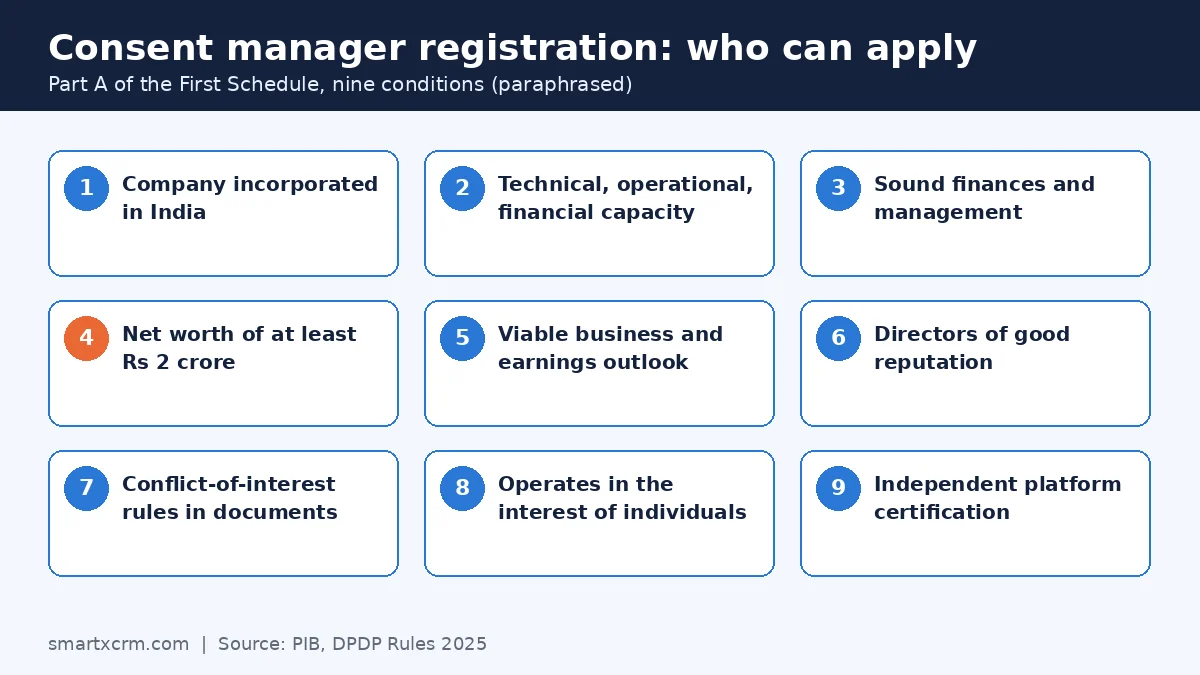
Only a company incorporated in India with a net worth of at least Rs 2 crore can apply for consent manager registration. It must also show adequate technical, operational and financial capacity, as the PIB release states.
Part A of the First Schedule to the DPDP Rules lists nine conditions in all. In plain terms, the applicant must:
- Be a company incorporated in India.
- Have enough technical, operational and financial capacity to run the platform.
- Be in sound financial condition with sound management.
- Have a net worth of not less than Rs 2 crore.
- Show a viable business volume, capital structure and earnings outlook.
- Have directors and senior managers of good reputation and integrity.
- Include conflict-of-interest rules in its company documents, changeable only with the Board’s approval.
- Run its operations in the interest of Data Principals.
- Get independent certification that its platform meets the Board’s standards.
After registration, a DPDP consent manager must keep consent records for at least seven years, must not sub-contract its duties, and must publish details of its promoters and directors (Part B of the same schedule).
Does a small business need a DPDP consent manager?

No. A small business does not need to sign up with or become a DPDP consent manager. Using one is a choice for individuals, and businesses can continue to collect consent directly from their own clients.
However, your own role does not change. Any business that decides why and how it uses personal data is a Data Fiduciary under the Act. A consultancy in Ahmedabad that collects passport copies, or a dental clinic in Kochi that stores patient histories, is a Data Fiduciary whether or not a consent manager is ever involved.
So the real work is your own consent notice, consent records and security, all due by 13 May 2027. If a client later uses a DPDP consent manager, you must still act on withdrawals that reach you that way.
Consent manager vs consent management platform vs data fiduciary

A consent manager is a regulated intermediary that serves individuals, a consent management platform is software a business buys, and a Data Fiduciary is the business itself.
| Point | DPDP consent manager | Consent management platform (CMP) | Data Fiduciary (your business) |
|---|---|---|---|
| What it is | Registered intermediary | Software tool, such as a cookie or preference banner | The business that decides how data is used |
| Works for | The individual | The business that buys it | Itself, within the law |
| Registration with the Board | Required | Not required | Not required (special rules for Significant Data Fiduciaries) |
| Can it read personal data? | No, it must be data-blind | May store consent and preference data | Yes, for the stated purpose |
| Scope | Consent across many businesses | One business’s website or app | Its own clients and staff |
| Example | A consent dashboard app listed by the Board | A cookie banner on your website | A Pune study abroad consultancy |
What must data fiduciaries do by 13 May 2027?

By 13 May 2027, every Data Fiduciary must give a clear consent notice, let people withdraw consent, answer data requests within 90 days, protect data with reasonable safeguards and report breaches. These duties apply to businesses of all sizes.
The PIB explainer on the DPDP Rules lists the main data fiduciary obligations:
- Issue a separate consent notice that is clear and easy to understand, stating the specific purpose for collecting the data.
- Let people withdraw consent at any time.
- Let people ask what data you hold, why, and how you use it, and ask for correction, updating or erasure.
- Respond to these requests within a maximum of 90 days.
- Provide a contact person for data questions, either a designated officer or a Data Protection Officer.
- Inform affected people without delay if there is a breach, explaining what happened, the likely impact, the steps taken and whom to contact.
- Get verifiable consent from a parent or guardian before processing a child’s data, subject to the exemptions listed in the Rules.
The last point matters for consultancies, because many school-leavers are under 18 when they first enquire. Check the exact exemptions in the Rules before relying on them.
| Failure | Maximum penalty |
|---|---|
| Not keeping reasonable security safeguards | Rs 250 crore |
| Not notifying the Board or affected people of a breach | Rs 200 crore |
| Breaking obligations related to children | Rs 200 crore |
| Any other breach of the Act or Rules | Rs 50 crore |
What the DPDP rules mean for study abroad consultants
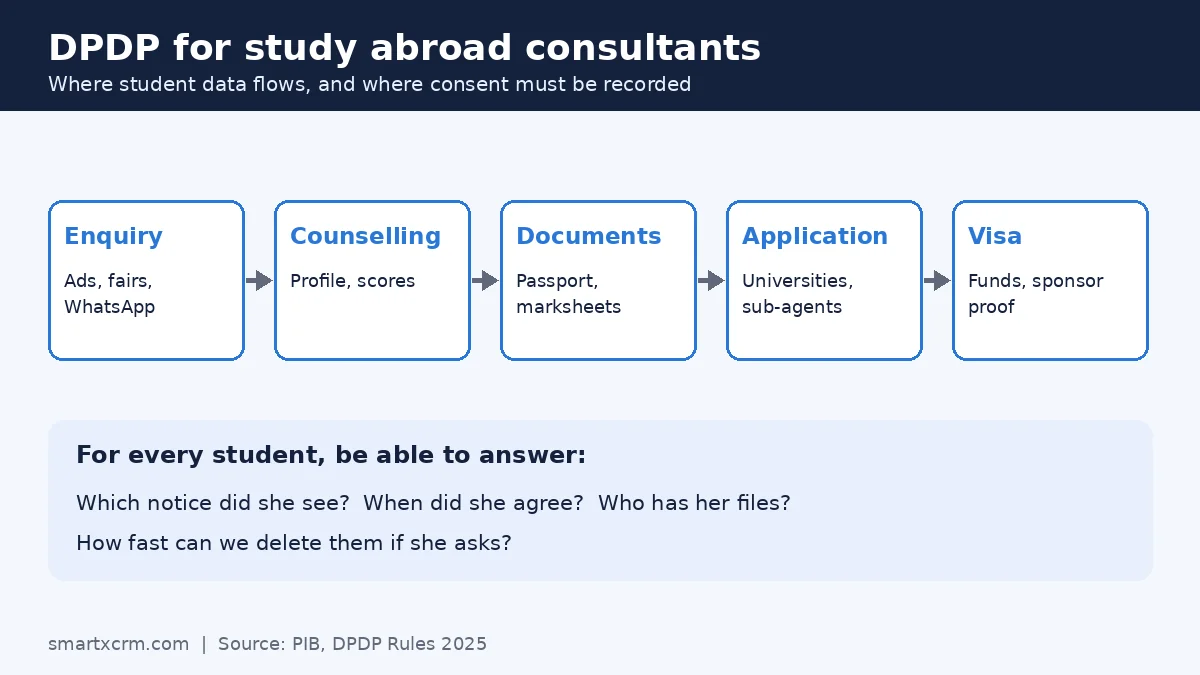
For study abroad consultants, the DPDP Rules mean that every student file, from the first enquiry to the visa decision, needs a clear purpose, a consent record and controlled access. Consultancies hold more sensitive documents than most small businesses.
A typical student file holds the passport, marksheets, IELTS or PTE scores, bank statements and sponsor income proof. Also, much of it goes on to universities, sub-agents and loan partners.
For example, a six-counsellor consultancy in Pune gets 300 enquiries a month from Instagram ads and education fairs. Leads sit in Excel, and counsellors forward passport scans on personal WhatsApp. As a result of the DPDP rules, the owner should know for any student: which notice she saw, when she agreed, who has her documents, and how fast the team can delete them.
That is much easier when every lead, document and message sits on one student record with access limits. If you are choosing a study abroad consultant CRM in India, add consent records and access control to your checklist. Our guide on CRM data security for education consultancies covers the security side in more depth.
What the DPDP rules mean for clinics and doctors
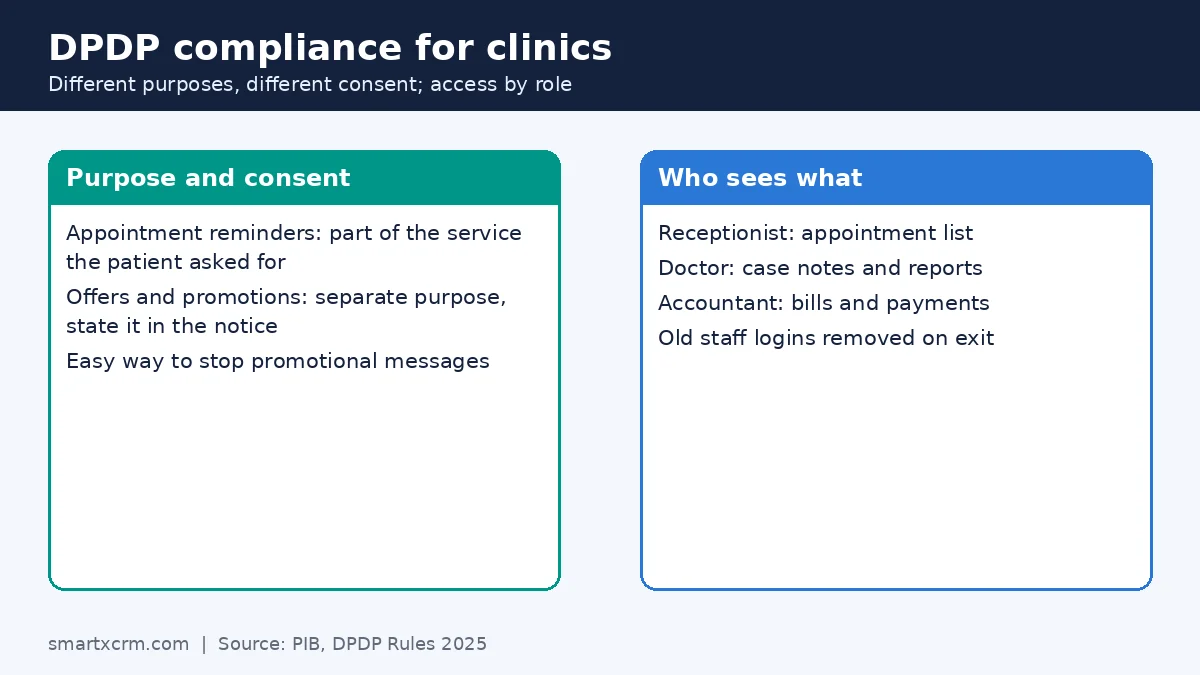
For clinics, DPDP compliance means treating patient contact details, case notes, reports and images as personal data that needs a stated purpose, consent where required, and tight access. Health data is among the most sensitive data a small business holds.
For instance, consider a skin clinic in Jaipur that sends appointment reminders and offers on WhatsApp. Reminders for a booked visit serve the patient’s request. Offers are a different purpose, so the notice should say so and patients should be able to stop them easily.
Clinics should also limit who sees what, because not every staff member needs every file: the receptionist needs the appointment list, the doctor the case notes. A healthcare CRM for clinics with role-based access for doctor, receptionist and accountant makes that split simple.
How to get DPDP ready: an 8-step plan before May 2027
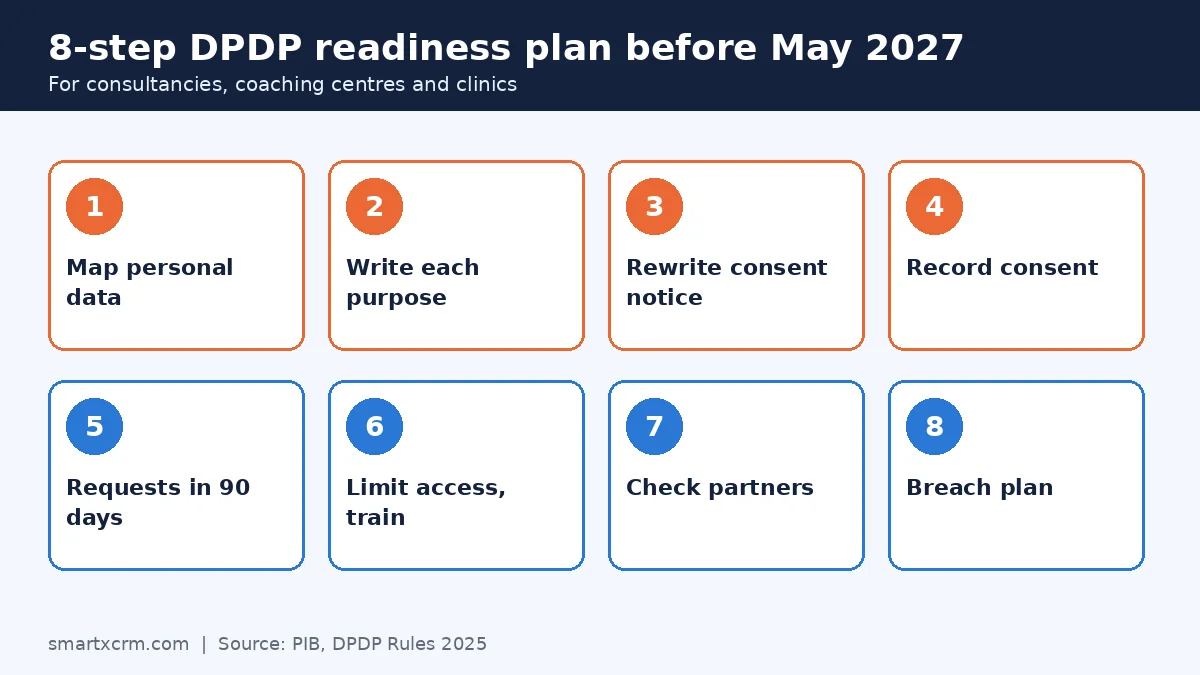
To get DPDP ready, map your data, state each purpose, rewrite your consent notice, record consent, set up requests and withdrawals, limit access, check partners and plan for breaches. With about five months to the 13 May 2027 deadline, here is a plan a small team can follow.
Steps 1 to 4: data, purpose and consent
- Map the personal data you hold. List every place personal data enters your business: website forms, Meta lead ads, WhatsApp chats, walk-in registers, passport and transcript scans, or patient files. Note who can see each one.
- Write down the purpose for each data type. Next, for each item, write one line on why you collect it, for example “passport copy to file the student visa application”. The DPDP Rules expect the notice to state the specific purpose.
- Rewrite your consent notice. Make it a separate notice in plain English (and Hindi or a local language if clients prefer). Explain what you collect, why, and how to withdraw consent at any time.
- Record consent against every contact. Store the date, the channel (form, WhatsApp, in person) and the version of the notice the person saw. Keep it on the student or patient record, not in a separate notebook.
Steps 5 to 8: requests, access, partners and breaches
- Set up a process for withdrawal and requests. First, give people one email or form to ask what you hold, correct it or delete it. Name a contact person and plan to close every request well within the 90-day limit.
- Limit access and train staff. Give counsellors, front desk staff and accountants only the access they need. Also, remove old staff logins on their last day and stop sharing files through personal WhatsApp accounts.
- Check every partner who receives data. Universities, sub-agents, labs, loan partners and courier firms may receive personal data from you. Agree in writing how they protect it and when they delete it.
- Prepare a breach response plan. Decide who does what if a laptop is lost or an account is hacked. Then follow the PIB explainer: tell affected people without delay, in plain language, with the steps taken and a contact for help.
A sensible schedule: steps 1 to 3 in December 2026, steps 4 to 6 by February 2027, steps 7 and 8 by March 2027, and April for a final check before the DPDP compliance deadline.
How can a CRM help with consent records?

A CRM keeps each person’s details, documents, messages and consent history on one record, with access limited by role. It does not make you compliant alone. Still, it makes records easy to show and update.
EduCa CRM by SmartX CRM, CRM software for education and study-abroad consultants in India, includes user roles and permissions, so you can control who can view, edit or delete student and visa data. Its student document management with access controls adds encrypted storage, audit trails and alerts for expiring documents.
So, when you compare tools, ask any vendor, including us, these questions:
- Can I record the date, channel and notice version of consent on each lead or patient?
- Can I restrict access by role and see who viewed or changed a file?
- Can I export or delete one person’s data quickly when they ask?
If you want to see how this works for a consultancy, explore our CRM software for overseas education consultants or book a free CRM demo and bring your own consent notice to review with the team.
Frequently asked questions about the DPDP consent manager

Is a consent manager mandatory under the DPDP Act?
No. A DPDP consent manager is an option for individuals, not a legal requirement for businesses. You can keep collecting consent directly through your own forms, as long as your notice and records meet the DPDP Rules.
When do the DPDP Rules apply to small businesses?
The main duties for Data Fiduciaries, including consent notices, rights requests and penalties, take effect on 13 May 2027. The rules therefore cover small consultancies and clinics like any other business that handles personal data.
What is the net worth requirement to register as a consent manager?
Only an Indian company with a net worth of not less than Rs 2 crore and adequate technical, operational and financial capacity can apply, according to the PIB release of 14 November 2026.
Can my CRM provider act as my DPDP consent manager?
Only if the Data Protection Board of India has registered it as a consent manager. A normal CRM is a tool your business uses as the Data Fiduciary; it helps you store consent records, but it does not replace your own duties.
How long must a consent manager keep consent records?
Under the First Schedule to the DPDP Rules, a registered consent manager must keep records of consents, notices and data sharing for at least seven years and give individuals access to them.
What is the penalty for a data breach under the DPDP Act?
Failing to keep reasonable security safeguards can attract a penalty of up to Rs 250 crore. Not informing the Board or affected people about a breach can attract up to Rs 200 crore.


Leave a comment: