

Quick answer: The UK student visa refusal rate reached 6.4% in the year to September 2026, the highest level since 2015 and more than double the 3.1% of a year earlier. Withdrawals also jumped. Universities now must keep refusals below 5% under the Basic Compliance Assessment, so Indian applicants face stricter checks on funds, course choice and credibility.
Last updated: 28 November 2026 · By SmartX CRM Product Team
The UK student visa refusal rate is now the number Indian study abroad consultants need to watch most closely. On 26 November 2026, The PIE News reported that the rolling 12-month refusal rate for sponsored study visas hit 6.4%, its highest point in more than a decade. On the same day, the Home Office published new figures showing that visas granted to Indian students fell by 29%.
This guide explains what the new numbers say, why refusals are rising, how the 5% university limit changes admissions, and what you can do this week to protect your January and September 2027 files. Every figure below comes from a source we read and link to.
What is the UK student visa refusal rate in 2026?
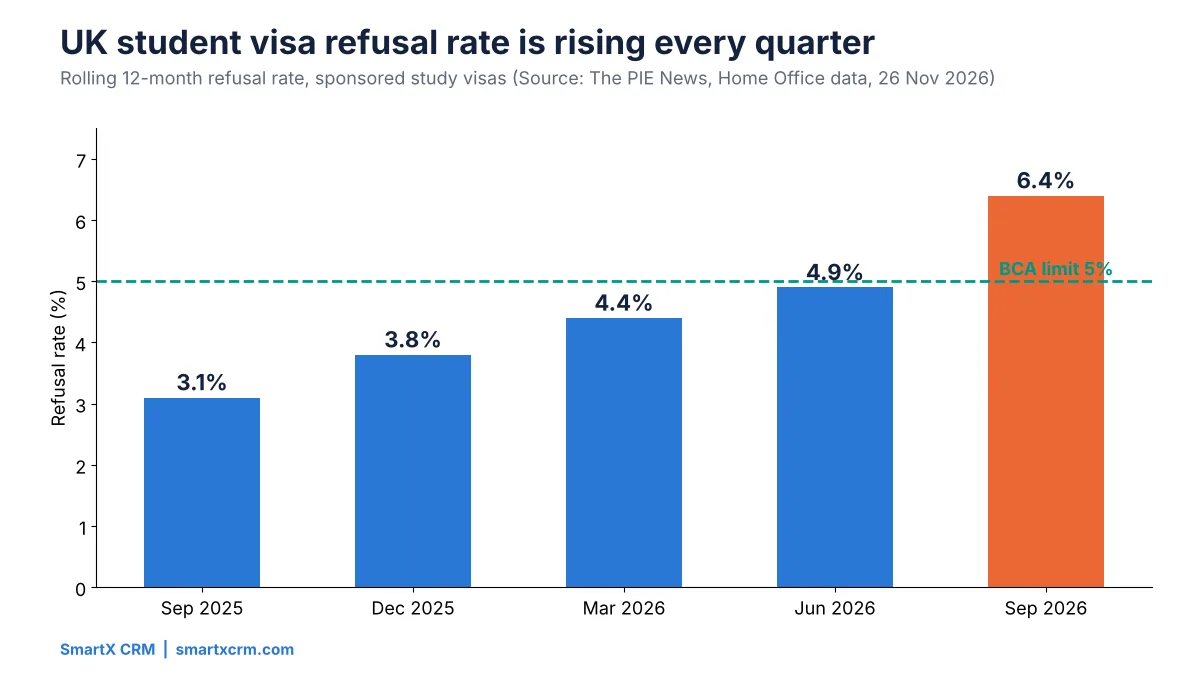
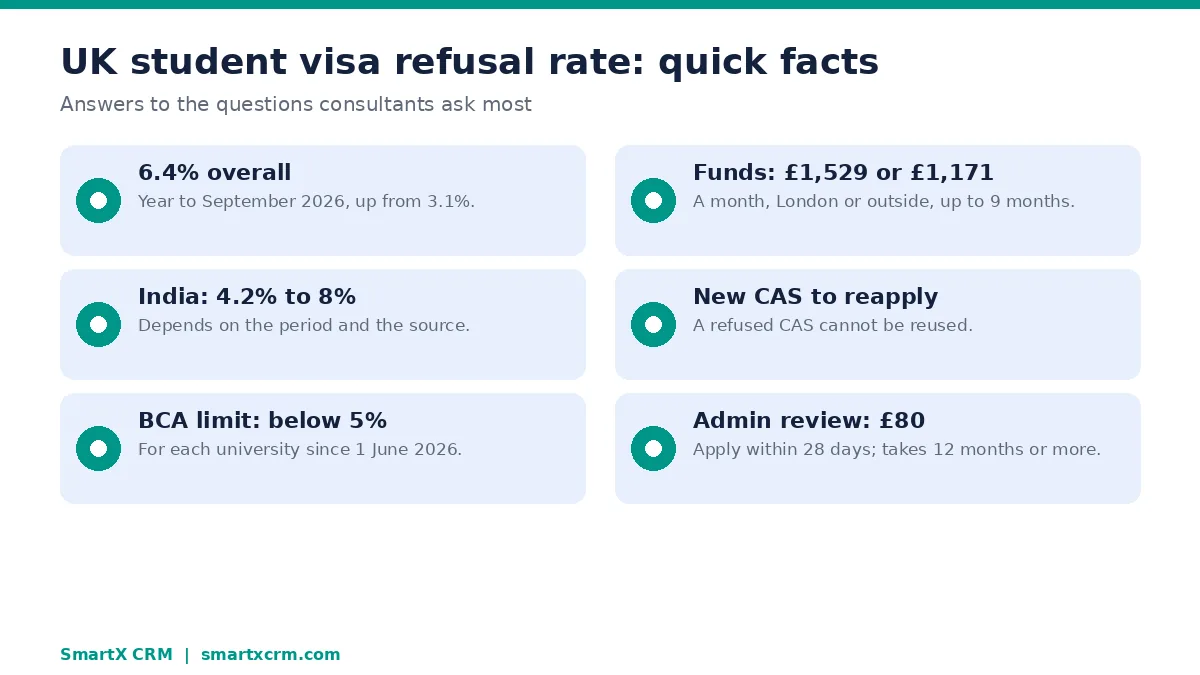
The UK student visa refusal rate was 6.4% for sponsored study visas in the 12 months to September 2026. A year earlier it was 3.1%, so the rate has more than doubled.
The figure comes from an analysis of Home Office immigration statistics, published by The PIE News. The rolling rate has gone up every quarter this year. Outside China, which has a very low refusal rate, the rate is 8.2%.
| Period (rolling 12 months to) | Refusal rate |
|---|---|
| September 2025 | 3.1% |
| December 2025 | 3.8% |
| March 2026 | 4.4% |
| June 2026 | 4.9% |
| September 2026 | 6.4% |
Two more numbers matter for planning. First, 230,300 main applicants applied in July to September 2026, which is 16% fewer than a year earlier. Second, the refusal rate for that quarter alone was 3.4%, double the 1.7% seen in the same quarter of 2025.
Why are UK student visa refusals rising so fast?
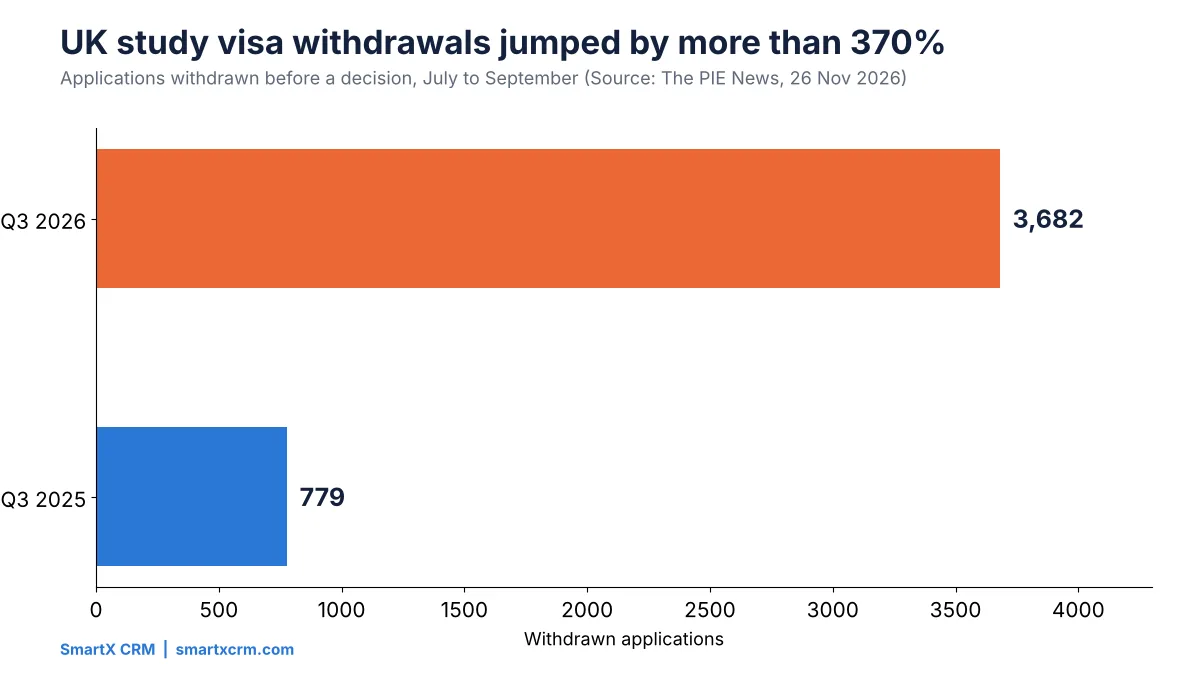
UK student visa refusals are rising because UKVI is checking applicants more closely and universities are under pressure to keep their own refusal numbers low. As a result, UKVI now refuses more weak files, and students withdraw others before a decision.
Withdrawals tell the same story. In July to September 2026, 3,682 study visa applications were withdrawn before a decision, against 779 in the same period of 2025. That is a rise of more than 370%. A withdrawal does not count as a refusal, so some of the real pressure is hidden in this number.
Credibility interviews are a second reason. The PIE reported that 79% of the 11,415 applicants called to a credibility interview between May and October were judged not credible. The Russell Group said it is watching the sudden rise in refusals closely and asked for fair and transparent decisions.
A third reason is wider policy. The Office for National Statistics says UK net migration fell to 77,000 in the year to June 2026, and the government has kept the focus on lower arrivals. Students are part of that picture.
What is the BCA 5% refusal limit for UK universities?
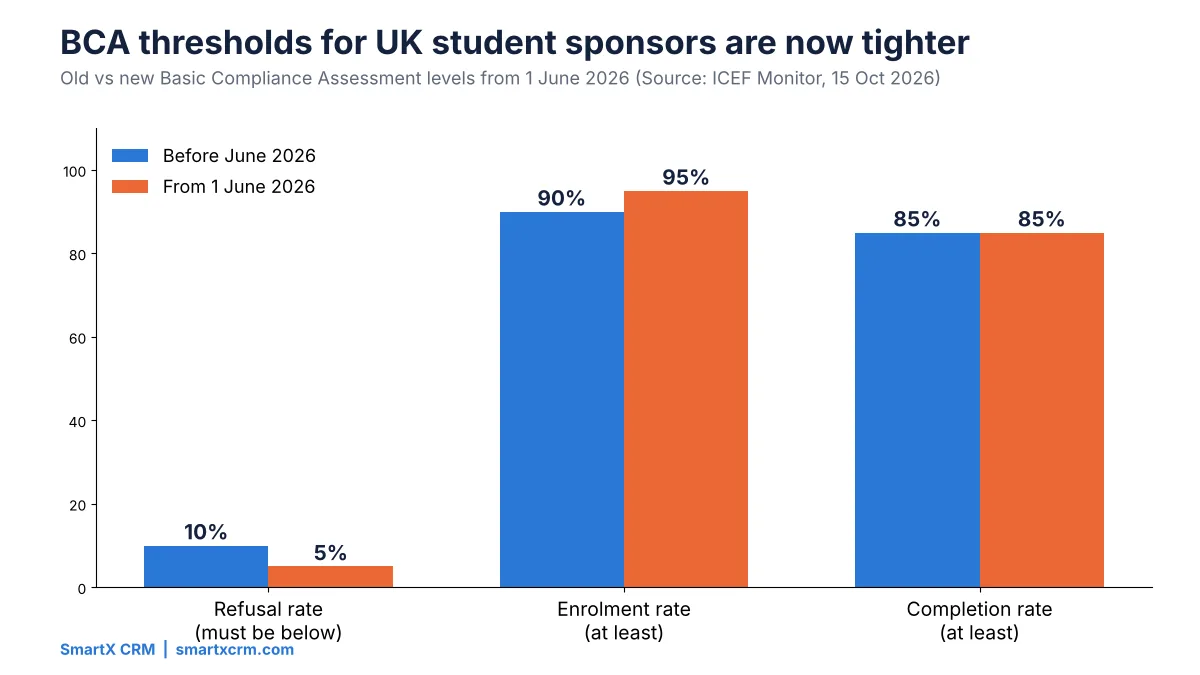
The Basic Compliance Assessment (BCA) is the yearly check UKVI uses to decide whether a university can keep its student sponsor licence. Since 1 June 2026, a sponsor must keep its study visa refusal rate below 5%, down from 10%.
According to ICEF Monitor, the other two tests also became tighter. UKVI rates each sponsor red, amber or green, and missing the green level on any one test can lead to penalties.
| BCA test | Old threshold | From 1 June 2026 |
|---|---|---|
| Visa refusal rate | Below 10% | Below 5% |
| Enrolment rate | At least 90% | At least 95% |
| Course completion rate | At least 85% | At least 85% (90% from June 2027) |
For Indian consultants, the effect is direct. A university that is close to 5% will be careful with any profile it sees as risky. Expect more pre-CAS interviews, more requests for bank evidence, higher deposits and some offers withdrawn before CAS. Times Higher Education reported in May 2026 that some universities had already paused recruitment from high-refusal countries.
How does the rising refusal rate affect Indian students?
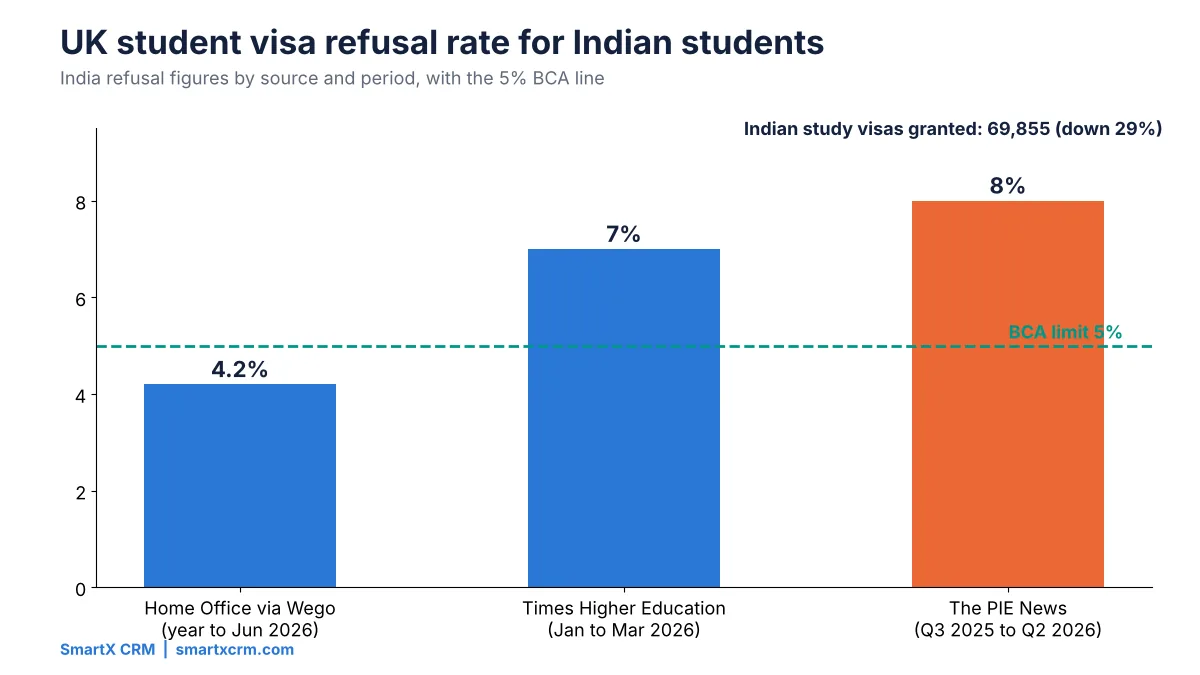
Indian students are getting fewer UK visas, and the refusal rate for Indian applicants is now above the 5% university limit on some measures. The Home Office statistics show 69,855 sponsored study visas granted to Indian main applicants in the year to September 2026, down 29%.
India is still the second largest source country after China, with 22% of all study visas granted. Different reports give different India refusal figures because they measure different periods:
| Source | Period | India refusal rate |
|---|---|---|
| Home Office data, reported by Wego | Year to June 2026 | 4.2% |
| Times Higher Education | January to March 2026 | About 7% |
| The PIE News | Q3 2025 to Q2 2026 (three quarters) | About 8% |
However, the trend is clear even if the exact number varies: refusals for Indian applicants are rising, and on the PIE measure they are above the 5% BCA line. That makes Indian files a compliance concern for some universities. If you also send students to Australia, read our note on Australia student visa processing priority for 2027, where provider choice now affects how fast a file is opened.
What are the common UK student visa refusal reasons?
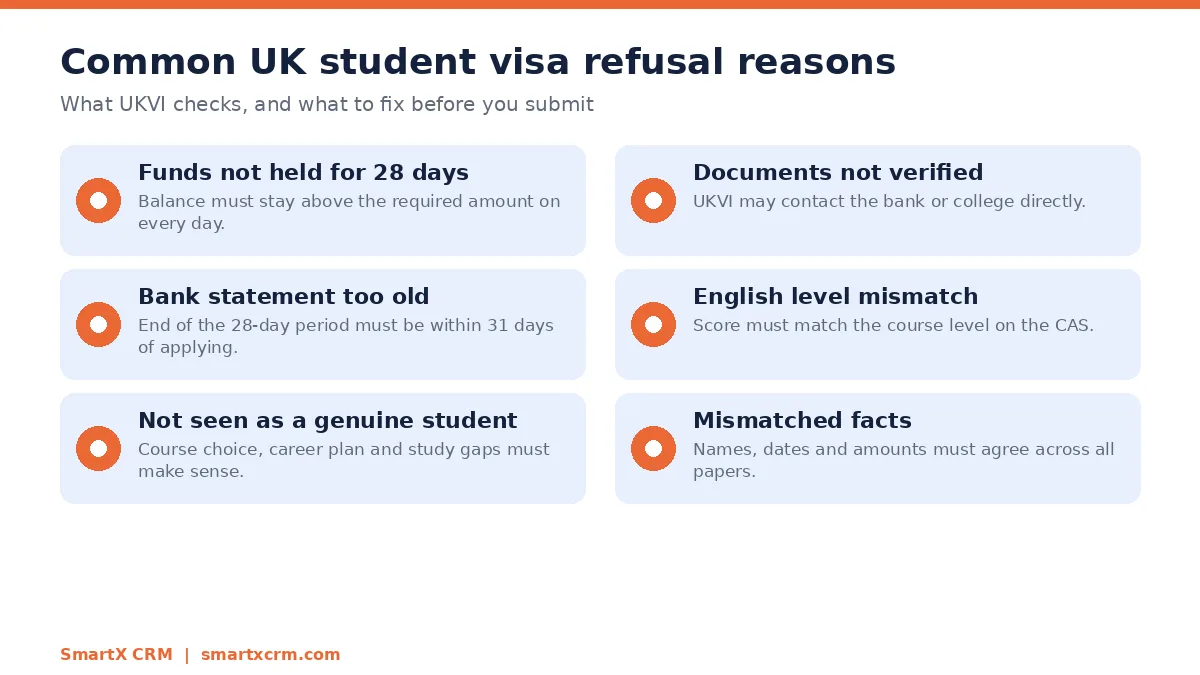
The most common UK student visa refusal reasons are weak financial evidence, doubts about whether the applicant is a genuine student, and documents that UKVI cannot verify. Consultants can catch most of these before submission.
Money is the easiest to get wrong. GOV.UK says a student must show the course fee for the first year plus living costs of £1,529 a month in London or £1,171 a month outside London, for up to 9 months. The money must be held for at least 28 days in a row, and the end of that 28-day period must fall within 31 days of the application date.
| Refusal reason | What UKVI looks at | How the consultant prevents it |
|---|---|---|
| Funds not held for 28 days | Bank balance on every day of the 28-day period | Check daily balance on the statement, not just the closing balance |
| Statement too old | End date within 31 days of applying | Track the statement date and file before it expires |
| Not a genuine student | Course choice, career plan, gaps, cost logic | Run a mock interview and a written course-fit note |
| Documents cannot be verified | Bank or college confirms the document | Ask the bank if it answers UKVI checks before you use the statement |
| English level | Test score or university assessment | Match the score to the course level on the CAS |
| Deception or false facts | Any mismatch across forms and documents | Cross-check names, dates and amounts in one file before submission |
A small mismatch can be enough. A loan sanction letter with a different amount from the bank statement, or a gap year not explained, often leads to a refusal or a credibility interview.
How do you prepare a student for a UKVI credibility interview?
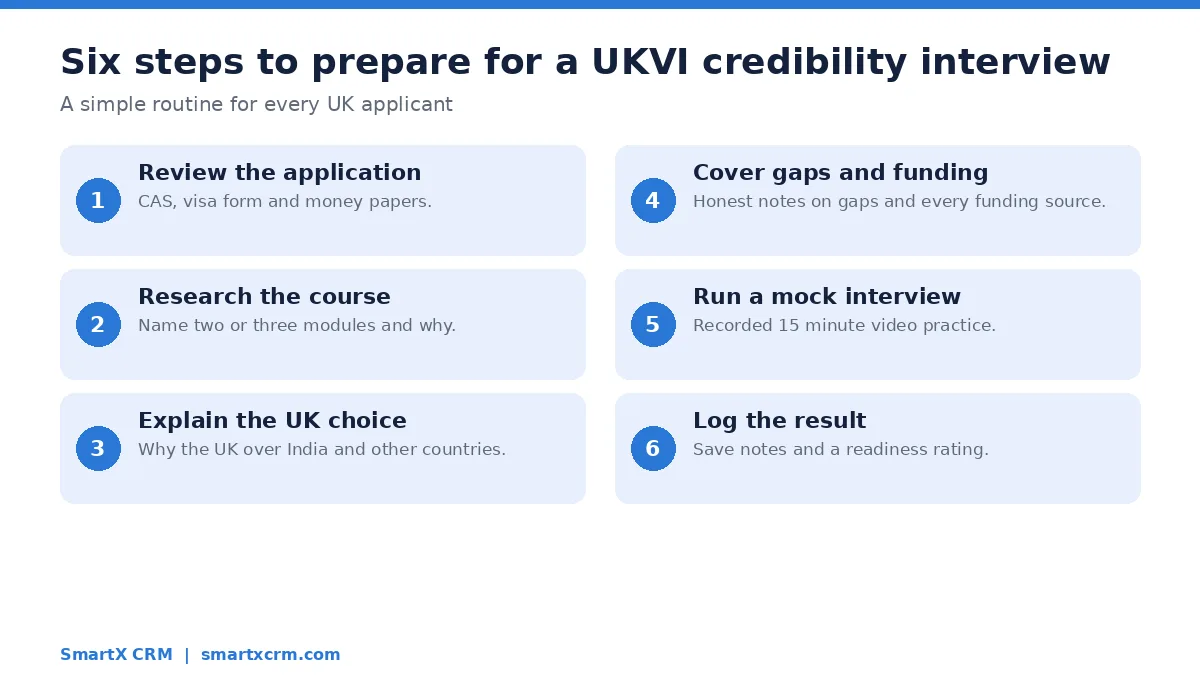
Prepare a student for a UKVI credibility interview by making sure they can explain, in their own words, why this course, why this university, why the UK and how they will pay. The interview is usually a short video call with UKVI staff.
University guidance, such as the University of Bristol credibility page, lists the usual topics: course modules, career plans, other countries considered, funding, study gaps and where the student will live. Use these steps with every UK applicant:
- Review the application: Go through the CAS, the visa form and the financial documents with the student so every date and amount is familiar.
- Research the course: Ask the student to name two or three modules and explain why they matter for their career.
- Explain the UK choice: Prepare a clear reason for choosing the UK over India and other countries, including cost.
- Cover gaps and funding: Write down an honest explanation for any study or work gap and the source of every rupee of funding.
- Run a mock interview: Hold a recorded 15 minute video practice and give feedback on short, direct answers.
- Log the result: Save notes and the readiness rating in the student record before the real interview date.
Students should never memorise a script. UKVI officers are trained to spot copied answers, and a natural, specific answer is more convincing.
What can a student do after a UK student visa refusal?
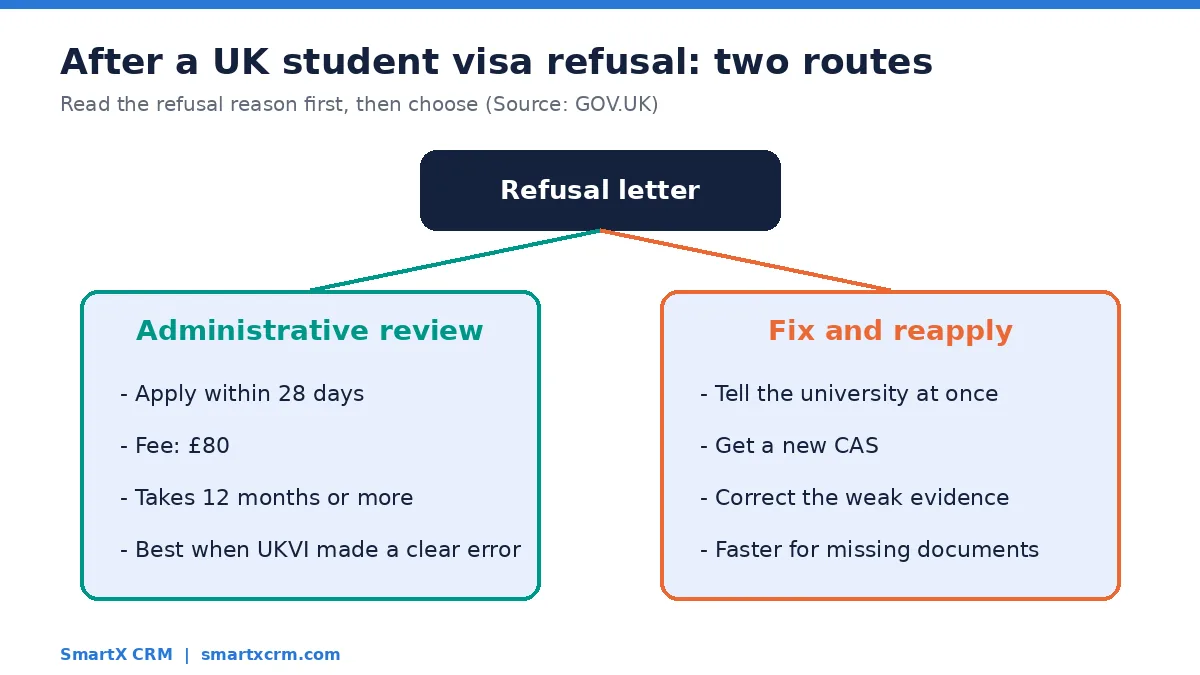
After a UK student visa refusal from outside the UK, a student can ask for an administrative review within 28 days of the decision, or fix the problem and reapply with a new CAS. The right choice depends on the reason in the refusal letter.
GOV.UK guidance on administrative review says the fee is £80 and that reviews currently take 12 months or more. That is too slow for most intakes, so a review mainly makes sense when UKVI made a clear mistake. If the problem was missing or weak evidence, a fresh application is usually faster.
- Read the refusal notice and note the exact paragraph used.
- Send the notice to the university at once; a refused CAS cannot be reused.
- Ask the university if it will issue a new CAS and for which intake.
- Check the deposit refund policy and its deadline.
- Fix the evidence, then reapply only when the file is complete.
Keep a record of every refusal reason. Over a season, this record shows which counsellors, banks or universities lead to problems.
How can consultants lower UK student visa refusal risk with a CRM?
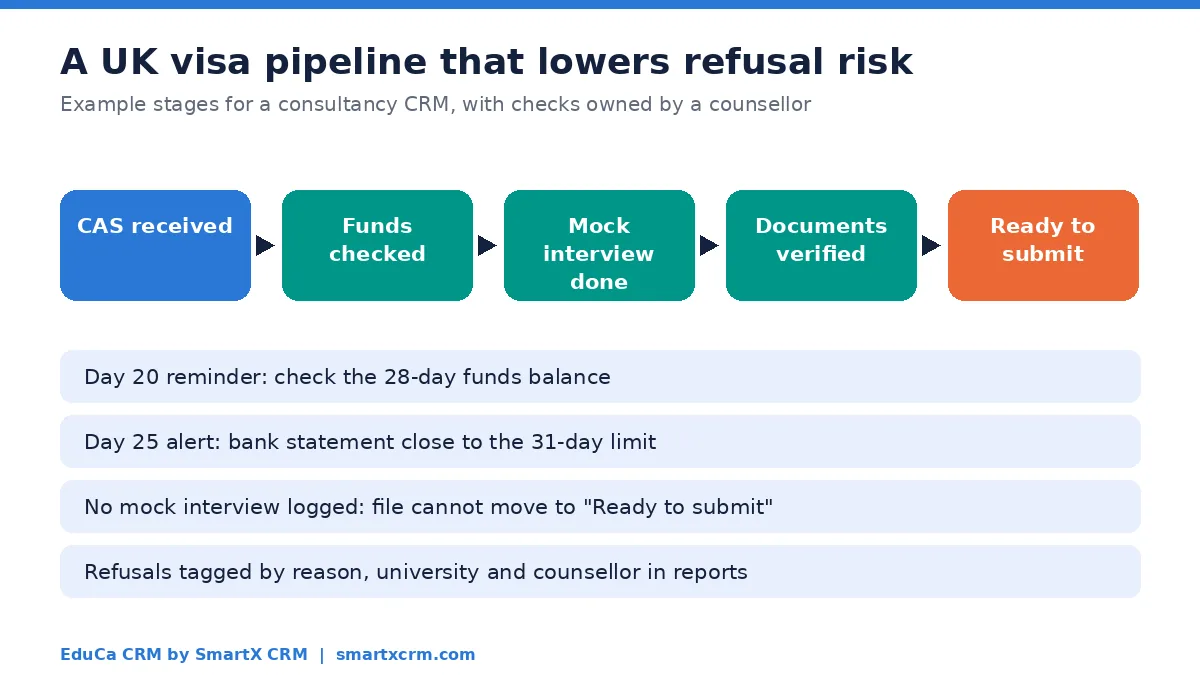
A CRM lowers UK student visa refusal risk by turning every check above into a tracked step, so nobody submits a file with an old bank statement, a missing document or an untrained student. It also gives you refusal data by university and counsellor.
EduCa CRM by SmartX CRM is CRM software for education and study-abroad consultants in India. It brings application management, document management, visa tracking software and reports into one place. For a consultancy that also handles PR and work visas, a CRM for study abroad and immigration consultancy keeps student and immigration cases in the same pipeline.
A worked example from Pune
Take an example consultancy in Pune with 60 students holding UK offers for the January 2027 intake. The team adds three stages to its UK pipeline: “funds checked”, “mock interview done” and “documents verified”. Each stage has a checklist and an owner.
- A reminder fires on day 20 of each student’s 28-day funds period, so the counsellor checks the balance before the statement is printed.
- A second reminder warns when a statement is 25 days old, before it passes the 31-day limit.
- Students without a logged mock interview cannot move to “ready to submit”.
- Refusals are tagged by reason, so the owner sees in one report which universities and banks cause trouble.
This is the kind of workflow a study abroad consultant CRM in India should support out of the box. If you want to set it up, see how EduCa works as CRM software for overseas education consultants or book a free demo with the SmartX CRM team.
Next steps for this week
- List every UK file for January 2027 and mark its funds start date and statement date.
- Ask each partner university about new pre-CAS checks and deposit rules.
- Book mock credibility interviews for all students with study gaps or loans.
- Start a simple refusal log with the reason paragraph from each letter.
Frequently asked questions about the UK student visa refusal rate
What is the UK student visa refusal rate in 2026?
It was 6.4% for sponsored study visas in the 12 months to September 2026, according to The PIE News analysis of Home Office data. A year earlier it was 3.1%.
What is the UK student visa refusal rate for Indian students?
Figures vary by period: 4.2% for the year to June 2026 in Home Office data reported by Wego, about 7% in January to March 2026 per Times Higher Education, and about 8% over three quarters per The PIE News.
What is the BCA 5% rule?
Since 1 June 2026, UK universities must keep their study visa refusal rate below 5% to pass the Basic Compliance Assessment. Enrolment must be at least 95% and completion at least 85%.
How much money do I need for a UK student visa?
You need the first year of course fees plus £1,529 a month in London or £1,171 a month outside London, for up to 9 months, held for 28 days in a row.
Can I reapply after a UK student visa refusal?
Yes. You need a new CAS from the university, because a CAS used in a refused application cannot be reused. Fix the refusal reason before you reapply.
How long does a UK visa administrative review take?
GOV.UK says administrative reviews for applications made outside the UK currently take 12 months or more. You must apply within 28 days of the decision, and the fee is £80.


Leave a comment: