

How Can Indian Abroad Education Consultants Manage Students From Enquiry to Admission?
Every abroad education consultancy in India knows the feeling. Enquiries arrive from WhatsApp, Instagram ads, walk-ins, education fairs and sub-agents. A counsellor speaks to the student, then to the parents, then the file goes quiet for three weeks. Someone collects the documents, someone else files the applications, and by the time the offer letter lands, nobody is sure who promised the student what.
The consultancies that grow steadily are not the ones with the most leads. They are the ones that manage students from enquiry to admission as one connected process, with clear stages, clear owners and no blind spots between teams.
This guide breaks that journey into ten practical stages, explains what should happen at each one, who should own it, and how a study abroad CRM keeps the whole pipeline visible. It is written for owners, branch managers and senior counsellors at Indian overseas education consultancies who want fewer lost students and more confirmed admissions.
Why the Enquiry-to-Admission Journey Breaks Down in Indian Consultancies
Before fixing the process, it helps to be honest about where it leaks. Most problems in student enquiry management come from a handful of patterns that repeat across consultancies of every size.
Enquiries arrive from too many places. A single intake season can bring leads from Meta ads, Google forms, website chat, Justdial-style listings, walk-ins, seminars, school tie-ups and B2B sub-agents. When each channel lands in a different inbox or phone, some students simply never get a call back.
The decision-maker is often not the student. In India, parents usually fund the education and frequently make the final call. A process that only tracks the student misses half the conversation, including budget limits, loan plans and family concerns.
The cycle is long. From first enquiry to visa approval can take six to twelve months, often spanning multiple intakes (September, January and May for the UK; Fall and Spring for the USA; February and July for Australia). Students who are “not ready yet” are easily forgotten.
Work moves between teams. Counsellors, documentation executives, application officers and visa officers each hold a piece of the file. Every handover is a chance for something to slip.
Data lives in Excel, notebooks and WhatsApp chats. When the counsellor who handled a student leaves, the history often leaves with them.
A strong admission management process solves each of these problems deliberately rather than hoping hard work will cover the gaps.
The 10-Stage Student Journey at a Glance
Here is the full student lifecycle management framework this guide follows. Use it as a starting point and adapt the stage names to match how your consultancy already talks.
| # | Stage | Main goal | Typical owner | Move to next stage when… |
|---|---|---|---|---|
| 1 | Enquiry capture | Record every lead in one place | Front desk / tele-caller | Lead is logged with source and contact |
| 2 | Qualification | Check fit, intent and timeline | Tele-caller / junior counsellor | Student is genuinely interested and eligible |
| 3 | Counselling | Build trust with student and parents | Senior counsellor | Family agrees on country and budget range |
| 4 | Shortlisting | Choose universities and courses | Counsellor | Final shortlist is approved by student |
| 5 | Documentation | Collect and verify every document | Documentation executive | Checklist is 100% complete and verified |
| 6 | Applications | File and track applications | Application officer | All applications submitted |
| 7 | Offers | Manage offer letters and decisions | Counsellor | Student accepts one offer |
| 8 | Deposit & CAS/I-20/CoE | Secure seat and confirmation document | Application officer | Confirmation document received |
| 9 | Visa | File, track and prepare for interview | Visa officer | Visa granted |
| 10 | Pre-departure & enrolment | Prepare student and confirm arrival | Counsellor / student success | Student is enrolled at university |
The rest of this guide walks through each stage in detail.
Stage-by-Stage: How to Manage Students From Enquiry to Admission
1. Capture Every Student Enquiry in One System
The first rule of student enquiry management is simple: no lead should exist only in someone’s phone. Every enquiry, whatever its source, should land in a single database within minutes.
At this stage, record the basics: student name, mobile number, email, city, source (ad campaign, walk-in, referral, sub-agent, fair), the course or country they mentioned, and the intended intake. The source field matters more than most consultancies realise, because it later tells you which marketing spend actually produces admissions rather than just enquiries.
Connect your website forms, ad lead forms and WhatsApp number directly to your CRM so that leads appear automatically. Then assign each new lead to a counsellor using a fixed rule, such as round-robin, by country specialisation or by branch. Our detailed guide on how to manage student enquiries with a CRM covers capture and assignment rules in more depth.
Target: first response within the same working hour. Students contact several consultancies at once, and the first useful conversation often wins.
2. Qualify Leads Before Investing Counselling Time
Not every enquiry deserves an hour with your best counsellor. Qualification is a short, structured call that separates serious students from casual browsers.
A good qualification script checks:
- Highest qualification and percentage or CGPA
- English test status (IELTS, PTE, TOEFL, Duolingo) or planned test date
- Preferred country and intake
- Approximate budget and whether an education loan is planned
- Who is involved in the decision (student alone, parents, relatives)
- Any past visa refusals or gaps in education
Based on the answers, tag each lead as hot (ready for this intake), warm (next intake or still testing), or cold (exploring, no clear timeline). Hot leads go straight to counselling. Warm leads enter a nurture sequence. Cold leads still stay in the system, because many will return a year later.
3. Run Structured Counselling With Student and Parents
Counselling is where trust is built, and in India, that means including the family. Schedule at least one session where parents are present, either in the office or on a video call.
Keep a standard counselling note template so that every session captures the same information: academic profile, career goal, countries discussed, budget agreed, concerns raised by parents, and next steps promised. When a different team member picks up the file later, they can see exactly what was discussed without calling the student again to ask.
Be transparent about costs, timelines and realistic outcomes. Ethical counselling, including saying no to unsuitable options, protects your reputation far more than an over-promised admission ever will.
4. Shortlist Countries, Universities and Courses
Once the family has agreed on direction, the counsellor builds a shortlist. A balanced shortlist usually mixes ambitious, matching and safe options across one or two countries.
Searching university websites one at a time wastes hours. A university course finder inside your CRM lets counsellors filter by country, course level, fees, intake and entry requirements, then save the shortlist straight to the student’s profile.
Record why each option was chosen. If a student later asks why a particular university was not included, the reasoning is already documented.
5. Collect and Verify Documents Without Chasing Manually
Documentation is where many files stall. Students forget, parents are busy, and executives spend whole days sending reminder messages.
Create a country-specific document checklist that typically covers passport, mark sheets and transcripts, degree certificates, English test score report, statement of purpose, letters of recommendation, CV, work experience letters, and financial documents such as bank statements, ITRs and loan sanction letters.
Use a central document management system so that every file is uploaded once, tagged by type, and visible to the application and visa teams. Mark each document as pending, received or verified. Only move the student forward when the checklist shows complete and verified.
6. File Applications and Track Every Status
With documents ready, the application officer submits to each shortlisted university, either directly or through aggregator portals. The challenge is tracking: a single student might have five applications, each with its own portal login, status and deadline.
Log every application against the student record with university, course, intake, application ID, submission date and current status (submitted, under review, additional documents requested, offer, rejected). Dedicated application management turns this into a simple board where your team can see every pending decision at once.
For consultancies handling several destinations, managing multi-country applications from one dashboard prevents deadlines in one country being missed while the team focuses on another.
7. Manage Offer Letters and Help the Family Decide
When offers start arriving, students need help comparing them. Lay out the options side by side: tuition fee, scholarship, total cost, course duration, location, part-time work options and post-study work rights.
Conditional offers need special attention. Note every condition (final marks, English score, document) and set a task to follow up before the deadline. An unconditional offer that lapses because nobody chased a mark sheet is one of the most avoidable losses in this business.
Once the student accepts one offer, politely decline the others through the proper channel. This keeps your relationship with universities healthy.
8. Handle Deposits and Confirmation Documents
Accepting an offer usually requires a tuition deposit, followed by the confirmation document the visa depends on, such as a CAS for the UK, an I-20 for the USA or a CoE for Australia.
Track payment status, receipt uploads and confirmation document dates against the student record. Families often need guidance on remittance limits and loan disbursement timing, so build those checkpoints into your workflow rather than handling them ad hoc.
9. File the Visa and Track It to a Decision
The visa stage is high-stakes for the student and for your success rate. Assign a visa officer, build a visa-specific checklist, and schedule mock interviews where the destination requires them.
Record every milestone: financial documents ready, application lodged, biometrics booked and attended, interview date, and the final decision. With visa tracking built into your CRM, managers can see at a glance which students are waiting on biometrics and which decisions are overdue.
If a visa is refused, log the reason carefully. Refusal patterns across students often reveal a documentation or preparation gap your team can fix.
10. Prepare the Student for Departure and Confirm Enrolment
Admission is not complete until the student is actually enrolled. Run a pre-departure session covering accommodation, travel, forex, insurance, local rules and what to expect in the first weeks.
Then confirm arrival and enrolment with the university. This matters commercially too: many universities pay commission only after enrolment is confirmed. A happy, well-prepared student also becomes your best source of referrals, so mark them as an alumni contact rather than closing the file.
Follow-Up Rules That Keep Students Moving
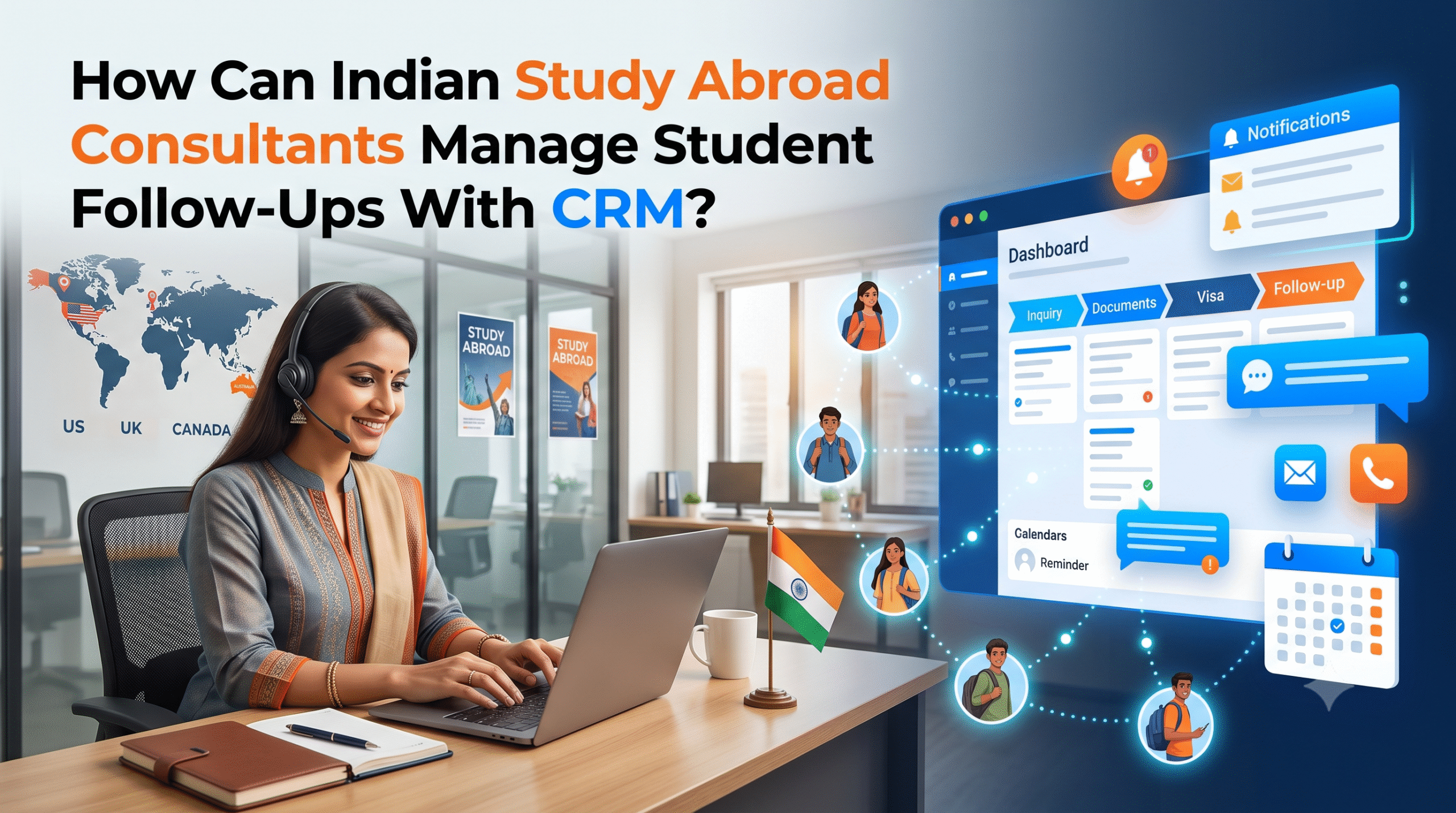
Most lost students are not rejected; they are forgotten. A written follow-up policy removes guesswork. Our post on how to manage student follow-ups explores this topic further, but here is a practical starting cadence:
| Lead status | Follow-up frequency | Best channel |
|---|---|---|
| New enquiry | Within 1 hour, then day 1 and day 3 | Call + WhatsApp |
| Hot lead (this intake) | Every 2–3 days | Call, WhatsApp |
| Warm lead (next intake) | Weekly, then fortnightly | WhatsApp, email |
| Cold lead | Monthly updates | Email, WhatsApp broadcast |
| Documents pending | Every 2 days until complete | WhatsApp with checklist |
| Application submitted | Weekly status update | WhatsApp, email |
Automation does the heavy lifting here. Scheduled reminders, templated messages and WhatsApp automation let a small team keep hundreds of students informed without anyone spending the day copying and pasting messages.
Managing Sub-Agents and Multiple Branches
Many Indian consultancies grow through branches in tier-2 cities and through B2B sub-agents who refer students. Both add volume, and both add risk if the data stays outside your system.
Give sub-agents a controlled way to submit students and see status updates, without exposing your full database. Track commissions per agent and per admission. With sub-agent management inside the same CRM, head office sees every student regardless of who sourced them, and disputes over who referred which student become rare.
For branches, keep one shared database with branch-level permissions, so each branch works its own pipeline while management sees the full picture.
KPIs Every Consultancy Should Track From Enquiry to Admission
You cannot improve what you do not measure. These metrics show where your process is strong and where it leaks:
| KPI | What it tells you |
|---|---|
| First response time | How quickly new enquiries are contacted |
| Enquiry-to-counselling rate | Quality of leads and qualification calls |
| Counselling-to-application rate | Counsellor effectiveness and trust building |
| Average days in documentation | Where files are stalling |
| Offer rate per application | Quality of shortlisting |
| Visa success rate | Strength of documentation and interview prep |
| Enquiry-to-enrolment rate by source | Which marketing channels truly pay off |
| Counsellor-wise conversions | Training needs and incentive planning |
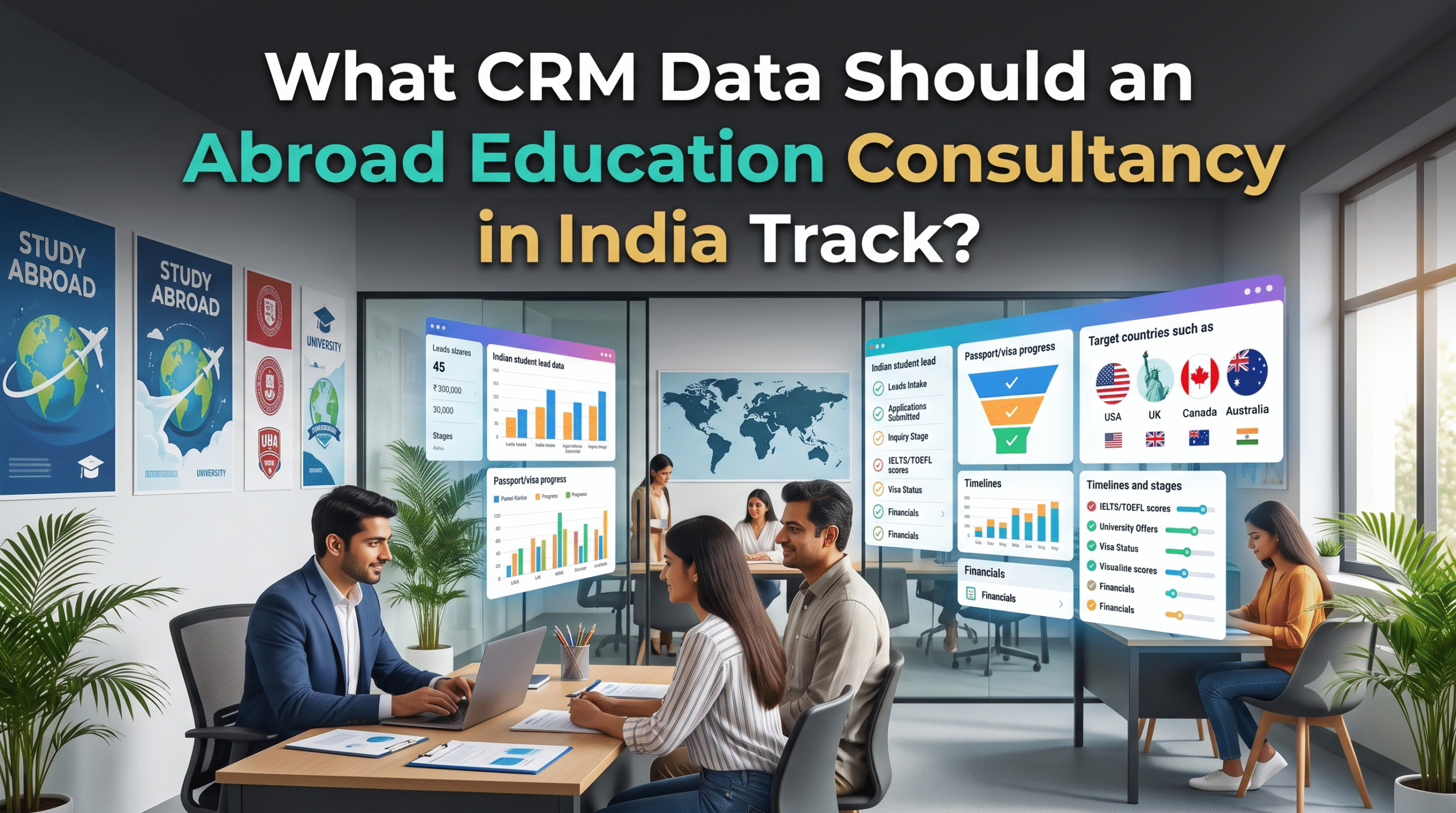
Review these monthly and before every intake. Built-in CRM reports save the hours otherwise spent assembling spreadsheets. If you are unsure which fields to capture in the first place, our guide on what CRM data an education consultancy should track is a useful companion.
Excel vs a Study Abroad CRM: When Should You Switch?
Spreadsheets work when a consultancy handles a few dozen students a season with one or two counsellors. They start failing quietly once you see signs like these:
- Two counsellors call the same student without knowing it
- Follow-up dates are missed because nobody opened the sheet
- Documents are scattered across email, WhatsApp and laptops
- You cannot say which ad campaign produced last intake’s enrolments
- A counsellor leaves and their students go cold
At that point, a purpose-built education consultancy CRM is no longer a luxury. It holds the full student timeline, automates reminders, controls who sees what, and keeps student data secure. Data protection deserves attention in its own right, since you handle passports and financial records; see our education consultancy CRM data security guide for what to check.
How SmartX CRM Helps You Manage Students From Enquiry to Admission
SmartX CRM was built for overseas education businesses, so the ten stages above map directly onto its modules rather than being forced into a generic sales pipeline.
- Enquiry capture and assignment from website, ads, WhatsApp and walk-ins into one education consultancy CRM
- Course finder for faster, better-documented shortlisting
- Document, application and visa modules that share one student record across teams
- WhatsApp automation for reminders, updates and broadcasts
- Sub-agent and branch management with permission controls
- Reports and dashboards for conversions, counsellor performance and source ROI
- Integrations with the tools your team already uses
The result is a single view of every student, from first enquiry to confirmed enrolment, that does not depend on any one person’s memory.
Common Mistakes to Avoid
- Treating enquiries and admissions as separate systems. One student record should travel through every stage.
- Ignoring parents in the process. Log parent contacts and concerns alongside the student’s.
- Moving files forward with incomplete documents. It creates rework and delays later.
- Letting warm leads go silent. Next intake’s admissions are sitting in this intake’s warm list.
- Measuring enquiries instead of enrolments. Lead volume means little if conversion is poor.
- Skipping post-enrolment contact. Alumni referrals are the cheapest leads you will ever get.
Frequently Asked Questions
What is the enquiry-to-admission process for abroad education consultants?
It is the full journey a student takes with your consultancy, from the first enquiry through qualification, counselling, shortlisting, documentation, applications, offers, deposit, visa and finally enrolment at the university. Managing it well means every stage has a clear owner and exit criteria.
How quickly should a consultancy respond to a new student enquiry?
Aim to respond within the same working hour. Students often contact several consultancies at the same time, so a fast, helpful first conversation gives you a real advantage.
How do consultants track multiple university applications for one student?
The most reliable method is logging each application against the student’s record in a CRM, with university, course, intake, application ID, deadline and status. An application board then shows every pending decision across all students.
Should parents be included in the counselling process?
Yes. In most Indian families, parents fund the education and influence the final decision. Including them early reduces drop-offs later and helps you understand budget and loan plans.
When does an education consultancy need a CRM instead of Excel?
Usually once you have more than one or two counsellors, multiple lead sources, or students spanning several intakes. Duplicate calls, missed follow-ups and scattered documents are clear signals it is time to switch.
Conclusion
Managing students from enquiry to admission is less about working harder and more about working in a defined sequence. Capture every enquiry, qualify before counselling, involve the family, document every decision, track every application and visa, and keep in touch after enrolment. Do that consistently and your consultancy loses fewer students, wins more referrals and grows without chaos.
If you want to see how this ten-stage workflow looks inside a real system, book a free SmartX CRM demo or compare plans on our pricing page.
Leave a comment: