
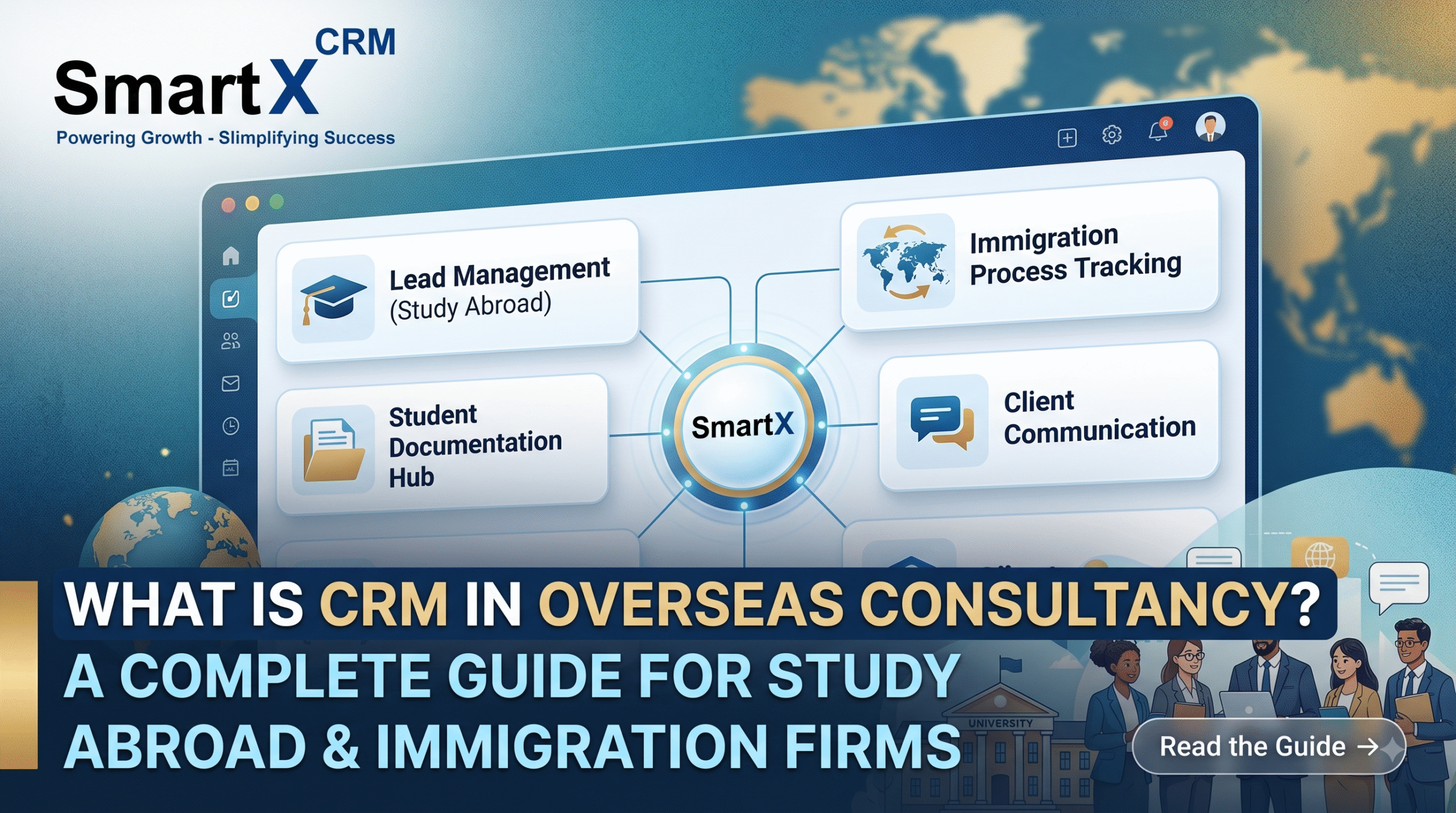
Running an overseas education or immigration consultancy involves more moving pieces than most outsiders realize. A single student file might touch a counsellor, a document verification team, a university liaison, a visa officer, and an accounts department before an offer letter is even issued. When that file lives across WhatsApp chats, spreadsheets, and someone’s personal notebook, mistakes creep in — a missed deadline, a duplicate call to the same lead, an application submitted with the wrong transcript. This is the exact gap that CRM in overseas consultancy is built to close.
This guide walks through what the term actually means, why generic sales software rarely fits this industry, and what a purpose-built CRM for study abroad and immigration consultancy should include. Along the way, we’ll look at how Smartx CRM approaches these problems for consultancies operating across Australia, India, and Malaysia.
What Does CRM in Overseas Consultancy Actually Mean?
CRM stands for Customer Relationship Management, but in the context of overseas consultancy, the “customer” is a student or visa applicant, and the “relationship” spans months or even years — from the first enquiry through counselling, university or program selection, document collection, visa filing, and eventually pre-departure support. CRM in overseas consultancy refers to the software and processes a firm uses to capture every one of those touchpoints in one place, rather than scattering them across email inboxes, phone logs, and paper files.
Unlike a retail or B2B sales CRM, which is mostly concerned with closing a single transaction, a CRM for study abroad and immigration consultancy has to track a layered pipeline: enquiry, counselling session, shortlisted institutions or visa categories, document checklist, application submission, offer or approval, fee payment, and visa outcome. Each stage has its own required documents, deadlines, and stakeholders. A counsellor working ten active files needs to know, at a glance, which student is waiting on a bank statement and which one has an interview scheduled next week.
This is why treating CRM in overseas consultancy as “just another sales tool” tends to backfire. Firms that try to force-fit a generic CRM often end up building workarounds in spreadsheets anyway, because the software wasn’t designed around visa categories, university intake cycles, or document workflows in the first place — a gap covered in more depth in this guide to CRM software for study abroad.
Why Overseas Consultancies Can’t Rely on Spreadsheets and WhatsApp Alone
Most consultancies don’t start with a CRM. They start with a phone, a WhatsApp Business account, and an Excel sheet — and for the first few dozen students, that setup works well enough. The trouble starts once lead volume grows past what one or two people can hold in their heads.
A few patterns show up again and again in firms that haven’t yet adopted a CRM for study abroad and immigration consultancy:
- Leads arriving from Facebook ads, a website form, walk-ins, and referrals end up in different places, so nobody has a single view of total pipeline volume.
- Two counsellors unknowingly call the same prospect, which looks unprofessional and wastes staff time.
- A visa deadline gets missed because the reminder lived in someone’s personal calendar, not a shared system.
- Management has no reliable way to see conversion rates by source, by counsellor, or by destination country, so budget decisions are guesswork.
- When a staff member leaves, their conversation history and follow-up notes often leave with them.
None of these problems are about effort — the teams involved are usually working hard. They’re about the absence of a shared system that survives staff turnover and scales past a founder’s personal memory. CRM in overseas consultancy exists specifically to fix that gap, a point explored further in why education institutions need a CRM.
Core Components of a CRM for Study Abroad and Immigration Consultancy
Not every CRM sold to consultancies covers the same ground. Before choosing one, it helps to know what a properly built system for this industry actually needs to do.
Lead Capture and Centralization
A CRM for study abroad and immigration consultancy should pull leads automatically from every channel a firm uses — Facebook and Instagram lead ads, website enquiry forms, WhatsApp, walk-in registration, and referral partners — into one pipeline. No lead should require manual copy-pasting from one tool into another, because that’s exactly the step where records get lost or delayed.
Pipeline and Stage Tracking
Study abroad and immigration cases move through predictable stages, but the stages differ by service line. A student visa case looks different from a skilled migration file or a partner visa application. The CRM needs configurable pipelines so a firm can define its own stages — enquiry, counselling done, shortlisted, documents collected, application filed, decision received — rather than being forced into a generic “lead, opportunity, won/lost” structure built for product sales.
Document Management
Visa and university applications run on paperwork: passports, transcripts, bank statements, sponsorship letters, medical reports, police clearance certificates. A CRM built for overseas consultancy should let staff upload, tag, and track the status of each required document against a checklist, so a counsellor can see instantly what’s missing without digging through an email thread.
Automated Follow-Ups and Reminders
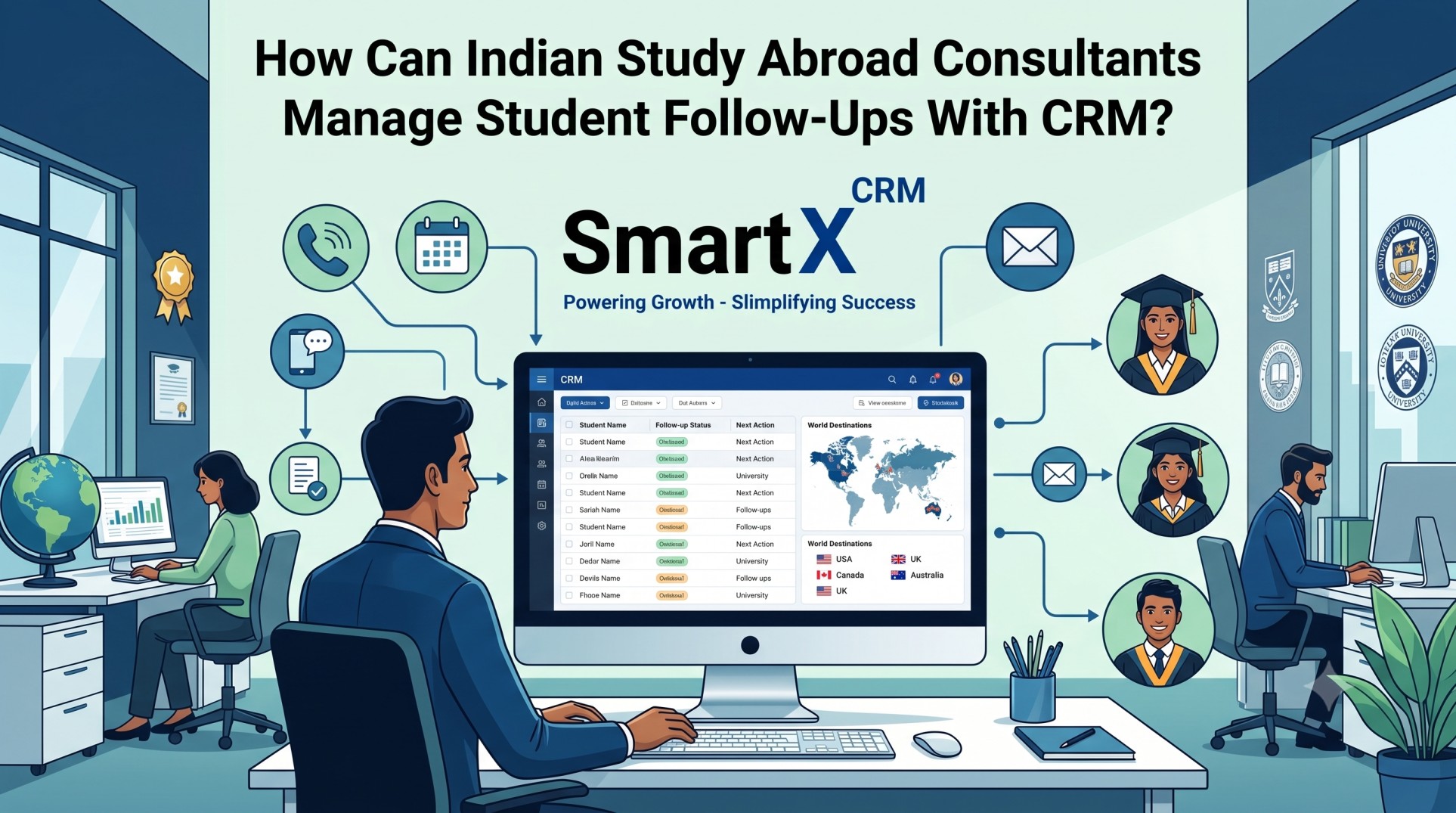
Late follow-up is one of the most common reasons a warm lead goes cold. Automated reminders — for a counsellor to call back, for a student to submit a pending document, or for a visa renewal date approaching — keep cases moving without relying on someone remembering manually. This is the exact problem addressed in never miss student visa or university deadlines again.
Multi-Branch and Team Visibility
Firms like Collins Quarters, which operates across Sydney, Melbourne, Chennai, and Kuala Lumpur, need a system where leadership can see performance across every branch, while each branch team only sees what’s relevant to their own casework. Role-based access control matters as much as raw features here.
Reporting on Conversion and Source Performance
Owners and managers need to know which marketing channel actually produces enrolled students or approved visas, not just raw enquiries. A CRM for study abroad and immigration consultancy should report conversion rate by lead source, by counsellor, and by destination country or visa category, so marketing spend and staffing decisions rest on data rather than gut feeling.
WhatsApp and Communication Integration
Given how much of this industry’s communication already happens on WhatsApp, integrating messaging directly into the CRM — rather than forcing staff to switch apps — keeps conversation history attached to the student’s file permanently, even after the staff member who handled it moves on. See CRM software for study abroad agents with WhatsApp automation for how this works in practice.
How Smartx CRM Approaches These Requirements
Smartx CRM was built around the specific workflow of overseas education and immigration consultancies rather than adapted from a general-purpose sales tool. A few areas where that shows:
Purpose-built pipelines. Instead of one rigid sales funnel, Smartx CRM lets a firm configure separate pipelines for student visas, skilled migration, partner visas, and university applications, each with its own stages and document checklists.
Centralized lead capture. Enquiries from Facebook, Instagram, a website form, or a walk-in register land in one dashboard, tagged by source, so nothing depends on someone remembering to log it manually.
Document tracking built in. Each student or applicant file carries its own document checklist, with status markers for received, pending, or rejected — useful when a case involves a dozen or more required files. This ties into the broader visa and immigration CRM software approach Smartx CRM takes for case management.
WhatsApp-based communication. Messages sent and received through WhatsApp stay logged against the applicant’s record, so a new counsellor picking up a file can read the full history instead of starting from scratch.
Multi-branch reporting. For a firm with offices in more than one country, Smartx CRM gives management a consolidated view of pipeline health while keeping each branch’s day-to-day work self-contained.
Automation for repetitive follow-ups. Reminders for document deadlines, visa expiry dates, and stalled leads are automated, so counsellors spend their time on conversations that need a human, not on remembering to send a nudge. The pipeline logic behind this is covered in automated CRM for immigration consultants.
Smartx CRM isn’t the only option on the market, and firms evaluating a CRM for study abroad and immigration consultancy should compare a shortlist against their own workflow before committing — but the underlying principle worth carrying into that evaluation is the same: choose software built around visa and admissions casework, not one repurposed from generic B2B sales.
What to Look for When Choosing a CRM for This Industry
If you’re evaluating options, a short checklist helps cut through marketing claims:
- Does it support multiple, configurable pipelines for different visa categories or service lines, or does it force everything into one generic funnel?
- Can it capture leads automatically from your actual marketing channels, or will staff need to import spreadsheets manually?
- Does it track documents per applicant, with checklist status, or just store generic file attachments?
- Does it support WhatsApp or your team’s primary communication channel natively, or will staff still juggle two apps?
- Can management see reporting by branch, counsellor, and source without exporting data into Excel by hand?
- Is pricing transparent and scalable as your team and lead volume grow, without punishing early-stage firms for growth? Smartx CRM’s pricing plans are worth checking against this question directly.
- Does the vendor understand visa and admissions terminology, or does their support team need everything explained from scratch?
A firm that answers “no” to more than one or two of these questions on their current setup is probably paying in lost leads and staff hours what they’d save on a properly fitted CRM for study abroad and immigration consultancy.
The Cost of Not Having a CRM: A Realistic Scenario
It’s worth walking through what actually happens inside a firm that hasn’t yet adopted CRM in overseas consultancy, because the losses are rarely dramatic on any single day — they accumulate quietly.
A prospective student fills out a Facebook lead form on a Tuesday evening. The lead sits in the ad platform’s dashboard until someone remembers to check it on Thursday. By then, the student has already spoken to two competing consultancies and booked a counselling session with one of them. That’s one lost enquiry, and it happened without anyone doing anything obviously wrong — the process simply had no built-in speed.
A different student, already in counselling, is asked for a bank statement and an English test score. She sends both over WhatsApp a week later. The counsellor who requested them is on leave, and the colleague covering for him doesn’t see the message because it’s buried in a different chat thread. The application misses its intake deadline by four days. Nobody decided to let that happen; the system simply had no shared visibility into pending documents.
A third case: a firm running paid ads across three destination countries wants to know which campaign is producing actual enrollments, not just clicks. Without a CRM tracking source-to-conversion data, the answer is a guess based on whichever counsellor happens to remember which leads “felt” strong. Budget gets allocated on instinct rather than evidence, and it stays that way until someone builds a manual tracking sheet — which usually falls out of date within a month.
None of these failures are about staff competence. They’re structural, and they’re exactly what a CRM for study abroad and immigration consultancy is designed to prevent — not by adding more work, but by making sure information doesn’t depend on any one person’s memory or availability. A closer look at this scenario is available in smart lead management with custom pipeline for immigration consultants.
CRM Adoption in Numbers
The scale of the overseas education and immigration sector makes manual tracking increasingly impractical. Indian students alone accounted for well over a million enrollments abroad in recent years, and Australia, Canada, the UK, and other destination countries continue to see sustained demand from consultancy-assisted applicants. When a single firm is fielding hundreds of enquiries a month across multiple destination countries and visa categories, the arithmetic of manual tracking stops working — there simply aren’t enough hours in a counsellor’s day to hold that much detail accurately without a system behind them.
This is also why CRM in overseas consultancy has shifted from a “nice to have” for large firms to a baseline expectation even for small teams. A two-person consultancy handling forty active files at once faces almost the same coordination problem as a fifty-person firm handling four hundred — the difference is scale, not kind, a distinction covered in India’s most efficient CRM purpose-built for education counsellors.
CRM for Study Abroad vs. CRM for Immigration Casework
Firms that offer both education consulting and immigration services — a common combination, especially where a consultancy sits alongside a migration law practice — sometimes assume they need two separate systems. In practice, a single CRM for study abroad and immigration consultancy can usually handle both, as long as it supports genuinely separate pipelines rather than forcing every case type through the same stages.
A student visa file typically moves through counselling, university shortlisting, offer letter, tuition payment, and visa lodgement. A skilled migration or partner visa file moves through eligibility assessment, evidence collection, application lodgement, and decision — a different rhythm entirely, often with longer timeframes and different document types (police clearances, medical exams, relationship evidence) than a study visa case. Running both through one undifferentiated pipeline tends to produce a system nobody trusts, because half the stages are irrelevant to any given case.
The fix isn’t two separate CRMs — that reintroduces the exact fragmentation a CRM is supposed to solve, with client data split across two logins. The fix is one platform, like Smartx CRM, configured with distinct pipelines for each service line, so a caseworker handling immigration files sees a workflow built for immigration, and a counsellor handling university applications sees one built for that. This exact combined-pipeline approach is detailed in CRM for study abroad and immigration consultancy: the ultimate 2026 guide.
Common Questions About CRM in Overseas Consultancy
Is a CRM only useful for large consultancies?
No. Even a solo consultant handling twenty to thirty active files benefits from centralized lead capture and document tracking, since the alternative — memory and spreadsheets — breaks down quickly once a few students need attention in the same week.
How is a study abroad CRM different from a general sales CRM?
A general sales CRM tracks a single transaction from lead to close. A CRM for study abroad and immigration consultancy has to track a longer, multi-stage journey involving documents, deadlines, and regulatory steps that a generic sales pipeline was never designed to hold.
Can a CRM handle both education consulting and immigration casework in one system?
Yes, provided the CRM supports separate, configurable pipelines. Many firms — including law-firm-backed consultancies — run education and immigration services side by side, and need one system that keeps both workflows distinct without duplicating data entry.
Does adopting a CRM replace the need for trained counsellors?
No. A CRM organizes information and automates reminders; it doesn’t replace the judgment a counsellor brings to advising a student on program fit or a client on visa strategy. The software’s job is to make sure that expertise isn’t wasted chasing missing paperwork.
How long does it take a consultancy to switch from spreadsheets to a CRM?
Migration timelines vary by data volume, but most firms moving to Smartx CRM can import existing leads and active case files within a few days, with staff onboarded on the basic workflow inside a week. The bigger factor is usually team habit change — getting counsellors to log activity in the CRM instead of a personal notebook — more than the technical setup itself.
What happens to historical data if a firm switches CRM providers later?
A properly built CRM for study abroad and immigration consultancy should allow data export in standard formats (CSV or similar), so a firm isn’t locked in indefinitely. It’s worth confirming this with any vendor before signing a contract, since some platforms make exit deliberately difficult.
Is cloud-based CRM secure enough for sensitive visa and passport documents?
Reputable cloud CRM providers use encryption, role-based access control, and regular backups, which in most cases offers stronger protection than a shared office laptop or an unsecured spreadsheet. Firms handling passport copies, medical records, and financial documents should confirm a vendor’s specific security certifications and data storage location before onboarding — see this education consultancy CRM data security guide for what to check.
Bringing It Together
CRM in overseas consultancy isn’t a buzzword — it’s the operational backbone that lets a growing firm keep every lead, document, and deadline in one place instead of scattered across inboxes and personal notes. For firms specifically handling student visas, skilled migration, or university admissions, a general sales tool usually falls short, because the casework simply doesn’t map onto a generic pipeline.
A properly chosen CRM for study abroad and immigration consultancy should centralize lead capture, track documents against checklists, automate follow-ups, and give management honest reporting across branches and sources. Smartx CRM was built around exactly that workflow, which is worth keeping in mind if your team is still running its pipeline out of spreadsheets and WhatsApp chats.
If your consultancy is evaluating a move to a dedicated system, start by mapping your current process end to end — every stage a student or applicant passes through — before comparing software. The right CRM should fit that process, not force you to redesign your business around the software. You can also compare this checklist against the best CRM for study abroad and immigration consultancy to fix lead follow-up issues for a deeper feature-by-feature breakdown.
Leave a comment: