
Quick answer: Student journey mapping is a stage-by-stage picture of what a student and their family do, ask and worry about from first enquiry to arrival abroad, along with every touchpoint your consultancy owns. For a study abroad consultancy, the map shows where students go quiet, who is responsible at each stage and what should happen next.
By SmartX CRM Product Team. Last updated 24 November 2026.
Most Indian consultancies already know their pipeline: enquiry, counselling, application, offer, visa. What they rarely know is why a student who was keen in week one stops answering calls in week four. Student journey mapping answers that question. It looks at the process from the student’s side, adds the parents (who often decide), and shows you the exact point where the experience breaks. This guide is written for study abroad consultants and education agents in India. It covers the stages, a 7-step method, a worked example, the numbers to track, what the DPDP Rules mean for your student data and a template you can copy today.
What is student journey mapping for a study abroad consultancy?
Student journey mapping is a method of laying out every stage a student passes through with your consultancy and recording, for each stage, what the student wants, what worries them, how they contact you and who on your team responds. The result is a student journey map: usually one table or one wall chart.
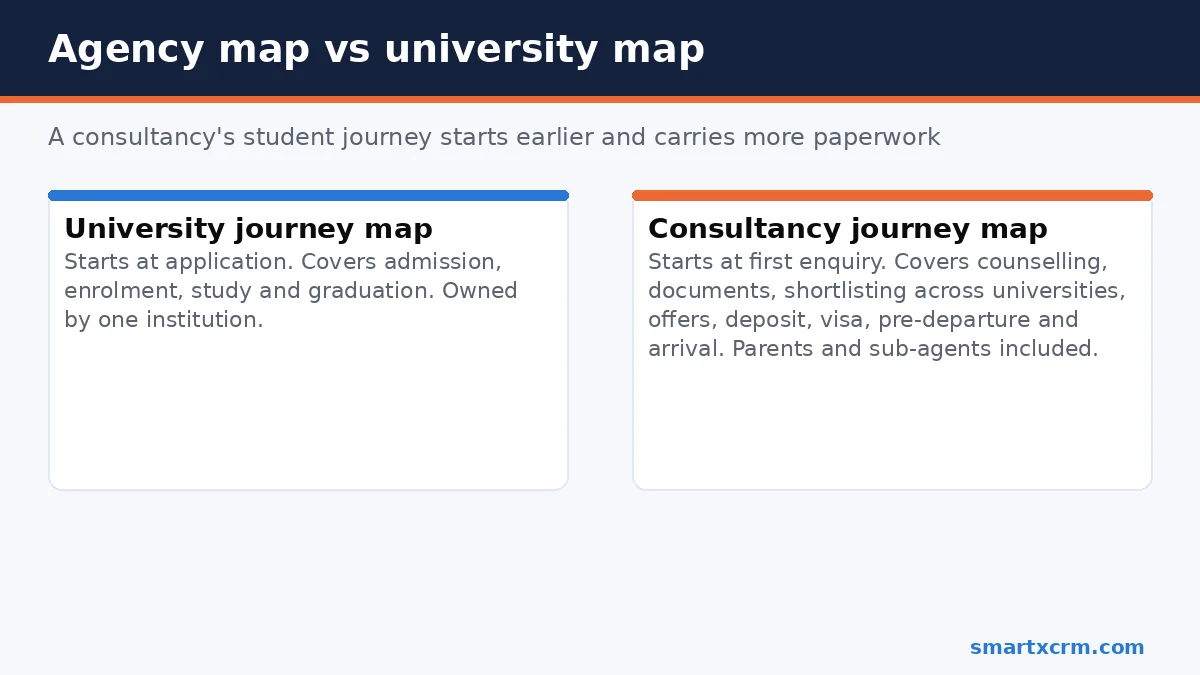
Universities use journey maps too, but their map starts when a student applies and ends at graduation. An agency’s map is different. It starts earlier, often with a seminar, a WhatsApp forward or a parent’s friend, and it carries the student through steps a university never sees: comparing countries, shortlisting courses across several universities, arranging funds, filing the visa and getting ready to fly. Studyportals, in its guide to mapping the student journey, describes six decision milestones (discover, shortlist, apply, commit, prepare, study). A consultancy’s map needs a few more, because so much of the paperwork sits with you.
Why does a consultancy need a student journey map?
A journey map shows you where students leave and why, so you can fix the stage instead of chasing more leads. Without one, most teams only notice drop-offs when the monthly numbers look thin.
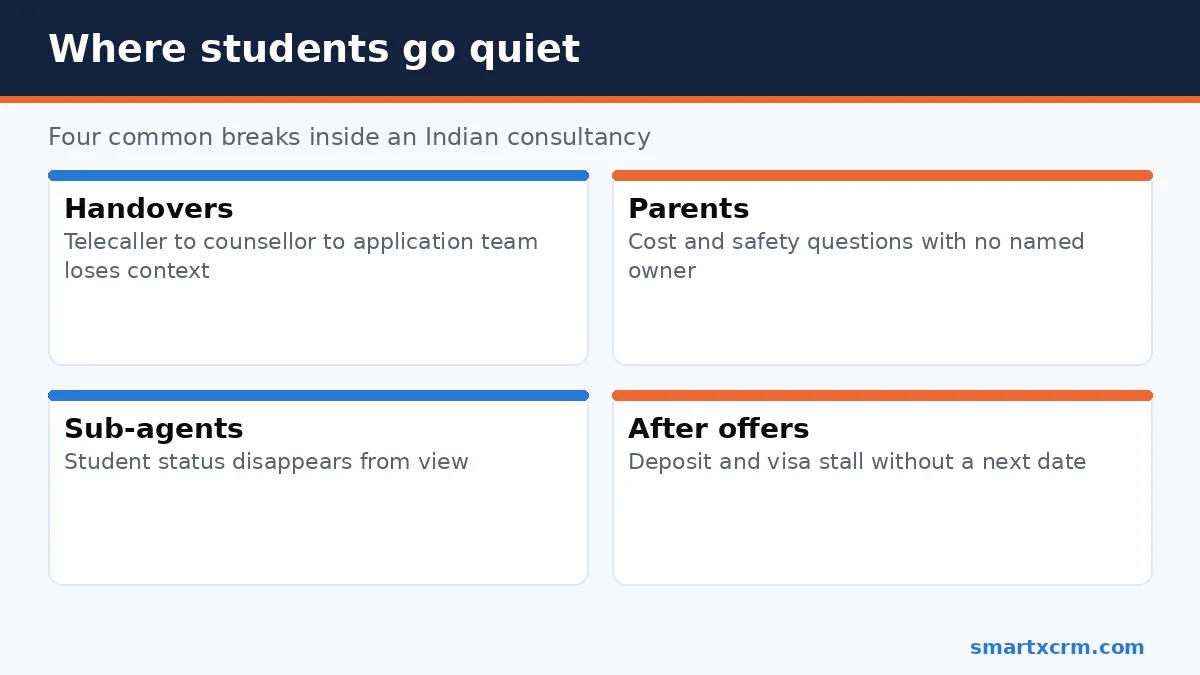
Some patterns appear in almost every Indian consultancy we speak to:
- A student is handed from a telecaller to a counsellor to an application executive, and each handover loses context.
- Parents call with questions about cost and safety, but nobody on the team is assigned to them.
- Sub-agents send students in, then the student’s status disappears from view.
- Offer letters arrive, but the deposit and visa steps stall because nobody set a next date.
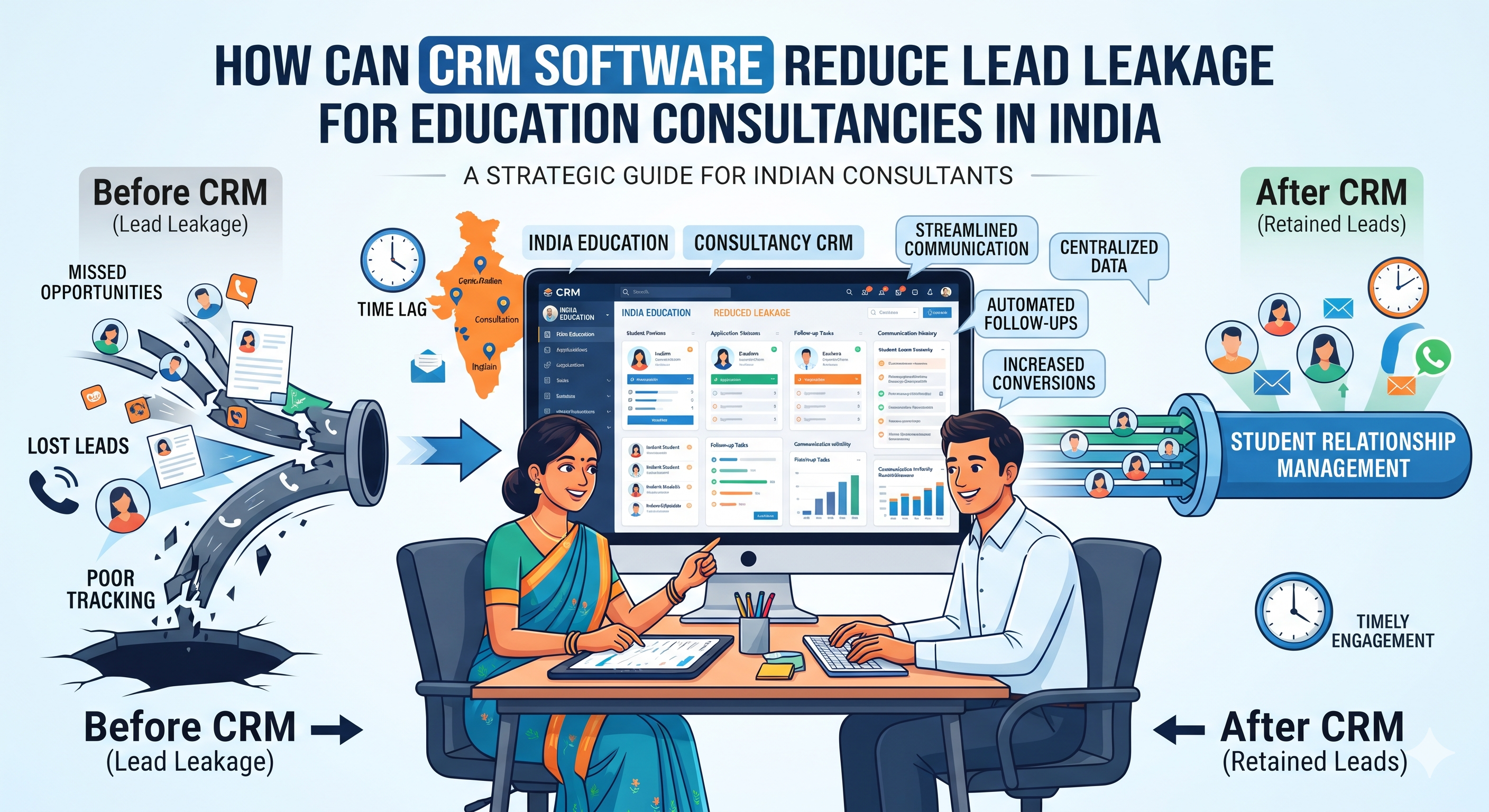
More leads will not fix any of these. They sit inside the journey, after the student has already contacted you. If enquiries are slipping before counselling even starts, read our guide on how to reduce lead leakage in an education consultancy alongside this one.
What are the stages of a study abroad student journey?
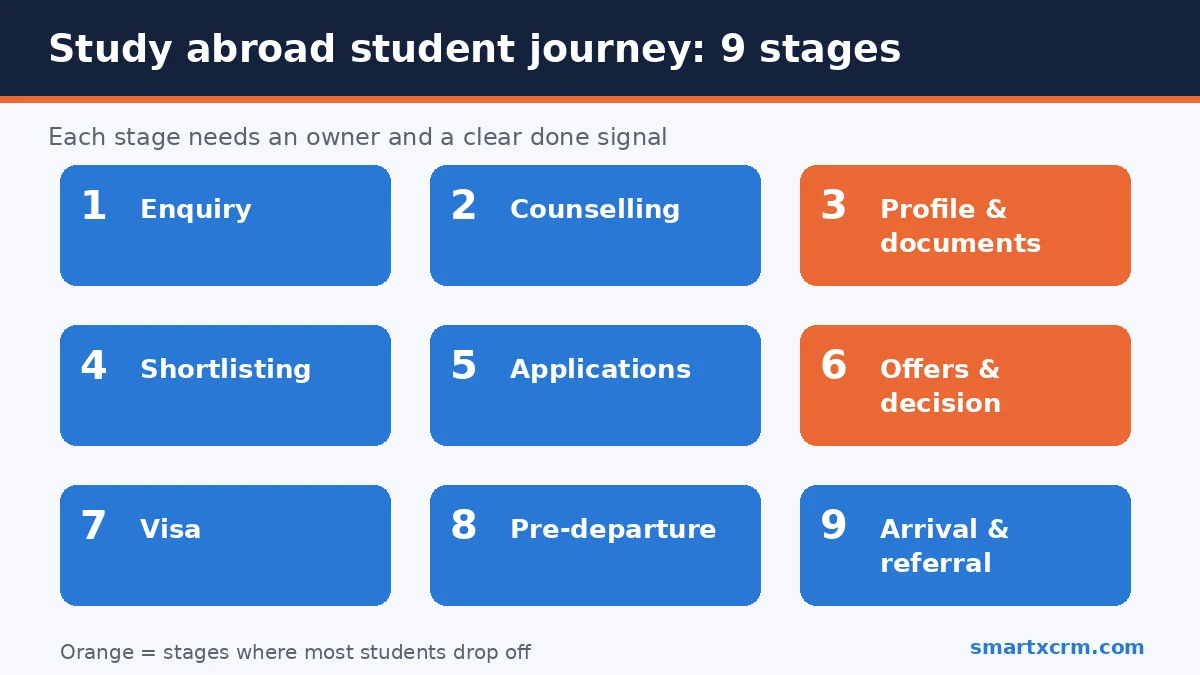
A typical study abroad student journey at an Indian consultancy has nine stages, from first enquiry to arrival and referral. Your exact list may be shorter or longer, but every stage below needs an owner and a clear “done” signal.
| Stage | What the student wants | What the family worries about | Main touchpoints | Owner | Stage is done when |
|---|---|---|---|---|---|
| 1. Enquiry | A fast, real answer | Is this consultancy genuine? | Website form, WhatsApp, call, walk-in, seminar | Telecaller | First call completed and lead qualified |
| 2. Counselling | Which country and course fit me | Total cost, safety, job prospects | Office or video meeting, parent call | Counsellor | Country and intake agreed |
| 3. Profile and documents | A clear checklist | Missing papers, loan eligibility | Document upload, reminders | Counsellor or documents team | All core documents verified |
| 4. Shortlisting | Good options within budget | Ranking, fees, scholarships | Course list shared, comparison call | Counsellor | Final list of universities approved |
| 5. Applications | Know what was submitted and when | Deadlines | Status updates, university portals | Application executive | All applications submitted |
| 6. Offers and decision | Help choosing between offers | Deposit amount, refund terms | Offer review call | Counsellor | Offer accepted and deposit paid |
| 7. Visa | A correct file, no surprises | Refusal risk, funds proof | Visa checklist, mock interview, appointment booking | Visa team | Visa decision received |
| 8. Pre-departure | Travel, stay, first weeks sorted | Accommodation, forex, safety | Briefing session, checklist | Counsellor or partner desk | Ticket booked and briefing attended |
| 9. Arrival and referral | Settle in | Did they reach safely? | Welcome message, check-in call, review request | Relationship owner | Arrival confirmed, review or referral asked |
Most consultancies lose the most students between stages 2 and 3 (keen after counselling, then documents never arrive) and between stages 6 and 7 (offer received, deposit delayed). Those two gaps are where a map pays off first. A study abroad and education consultant CRM can hold these nine stages as pipeline stages, so each student’s position is visible to the whole team.
How do you build a student journey map in 7 steps?
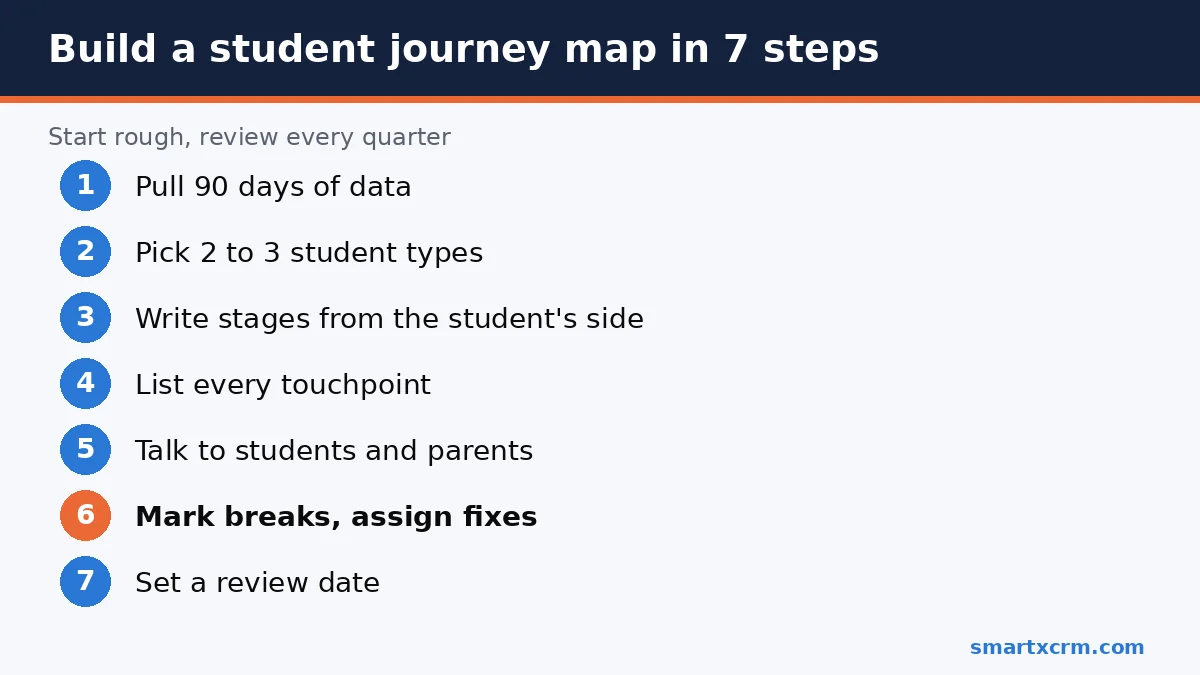
You can build a first student journey map in about a week using data you already have. Start rough, then improve it every quarter.
- Pull 90 days of real data. Export your enquiries and their current status from your CRM or spreadsheet. Count how many reached each stage. This gives you the drop-off at every step.
- Pick two or three student types. For example: a final-year B.Tech student going for a master’s in the UK, a Class 12 student going for a bachelor’s in Canada with parents paying, and a working professional considering Australia. Their journeys and worries differ.
- Write the stages from the student’s side. Use the nine stages above as a starting list and rename them in the words students use (“Which country?”, “Will I get the visa?”).
- List every touchpoint per stage. Include the ones you do not control, such as university emails, bank loan calls and visa centre appointments.
- Talk to recent students and parents. Call ten students who enrolled and ten who dropped. Ask where they felt unsure and what nearly made them stop. Note the exact words.
- Mark the breaks and assign a fix. For each stage with a high drop-off, write one concrete action, one owner and one deadline. “Counsellor calls parent within 48 hours of first meeting” is a fix. “Improve communication” is not.
- Set a review date. Revisit the map every quarter and after every intake, because visa rules, deadlines and student questions change.
If your first stage is the weak one, our article on how CRM helps consultants manage student enquiries covers response times and lead routing in more detail.
Example: one student’s journey map from enquiry to arrival
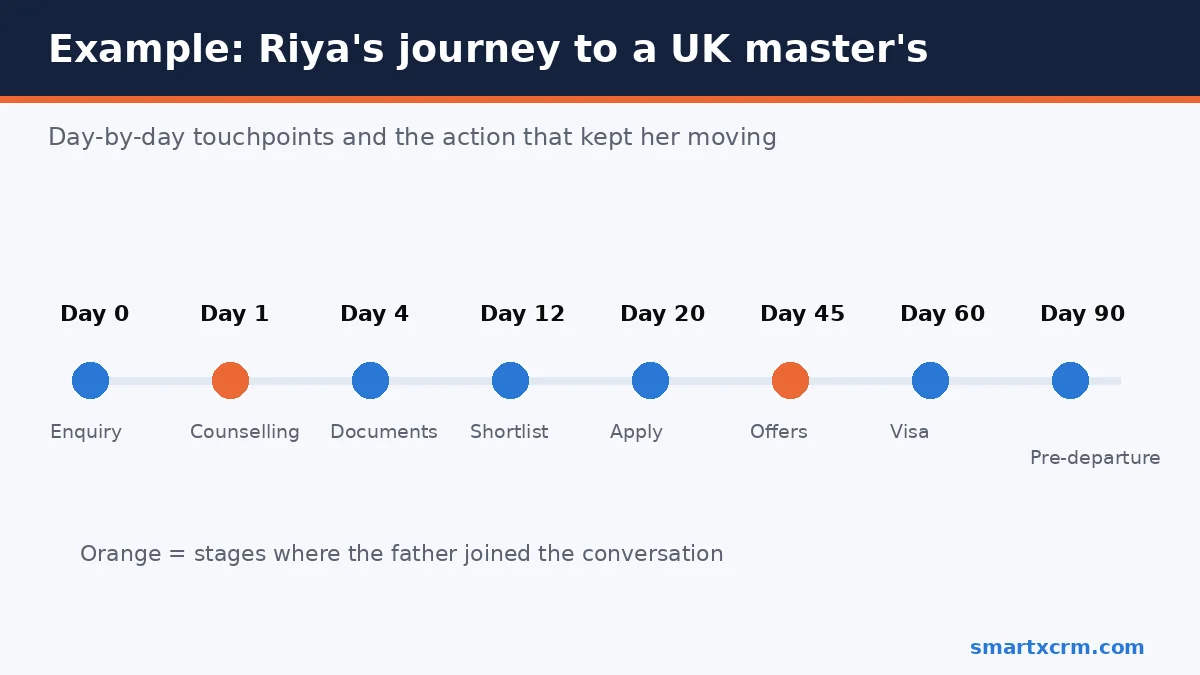
Here is a simplified map for one realistic case: Riya, a final-year B.Com student from Ahmedabad, enquires about a master’s in the UK for the September intake. Her father is paying and wants to speak to someone before every payment.
| When | Stage | Touchpoint | Risk at this point | Action that keeps her moving |
|---|---|---|---|---|
| Day 0 | Enquiry | Fills the website form at 11 pm | Hears from three other agents first | Auto WhatsApp reply with counsellor name, call booked for next morning |
| Day 1 | Counselling | Video call with counsellor | Father not on the call | Second call booked with father, cost sheet sent in writing |
| Day 4 | Documents | Checklist shared | Transcripts delayed by college | Reminder every 3 days, status visible to Riya |
| Day 12 | Shortlisting | Six-course comparison shared | Confused by too many options | Narrow to four with a one-line reason each |
| Day 20 | Applications | Four applications submitted | Silence while universities decide | Weekly status message, even when nothing changed |
| Day 45 | Offers | Two offers received | Father unsure about deposit | Offer review call with father, refund terms explained |
| Day 60 | Visa | Visa file prepared | Funds proof not in the right format | Visa checklist reviewed line by line before booking |
| Day 90 | Pre-departure | Briefing session | No accommodation yet | Accommodation options shared, check-in date set |
| Arrival | Arrival and referral | Welcome message | Relationship ends | Check-in call after two weeks, referral request |
Two things stand out. The father appears at three stages, so he needs his own touchpoints in the map. And the longest gaps (documents and applications) are where students feel ignored, so a short, regular update matters more there than anywhere else. A shared document checklist that both the student and the counsellor can see removes most of the back-and-forth in stage 3.
Which metrics show where your student journey breaks?
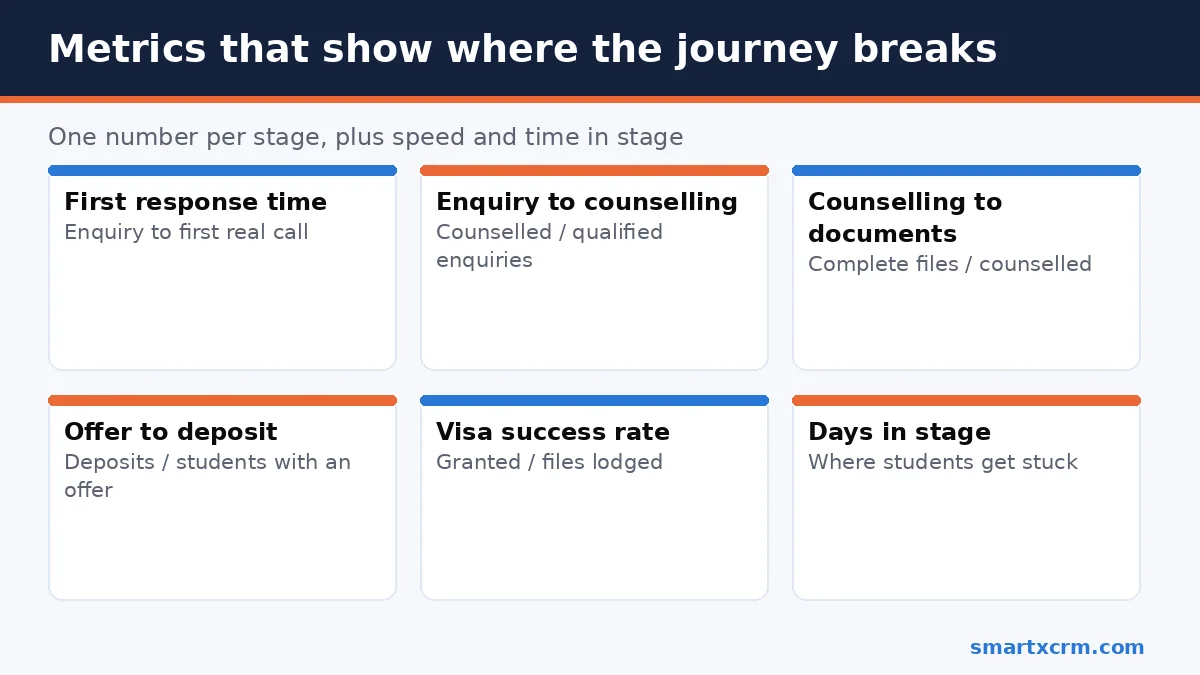
Track one conversion number per stage, plus response time and time spent in each stage. These numbers tell you which stage to fix first.
| Metric | How to calculate it | What it tells you |
|---|---|---|
| First response time | Time from enquiry to first real conversation | Whether you lose students to faster agents |
| Enquiry to counselling rate | Students counselled ÷ qualified enquiries | Quality of first calls and lead sources |
| Counselling to documents rate | Students with complete documents ÷ students counselled | Whether students and parents are truly committed |
| Applications per student | Applications submitted ÷ students in stage 5 | Shortlisting quality and workload |
| Offer to deposit rate | Deposits paid ÷ students with at least one offer | How well you handle the decision stage |
| Visa success rate | Visas granted ÷ visa files lodged | File quality and counselling accuracy |
| Days in stage | Average days a student stays in each stage | Where students get stuck |
| Referral rate | New enquiries referred by past students ÷ students who travelled | Whether the last stages are working |
Do not copy targets from other agencies. Measure your own baseline for one intake, then set a realistic improvement for the next. Stage-wise CRM reports make these numbers available without manual counting.
How do you handle student data and consent under the DPDP Rules?
A journey map runs on personal data: phone numbers, marks, passports, bank statements. In India this falls under the Digital Personal Data Protection Act, 2023 and the DPDP Rules, 2025, which the government notified on 14 November 2025 with an 18-month period for phased compliance, according to the official PIB explainer.
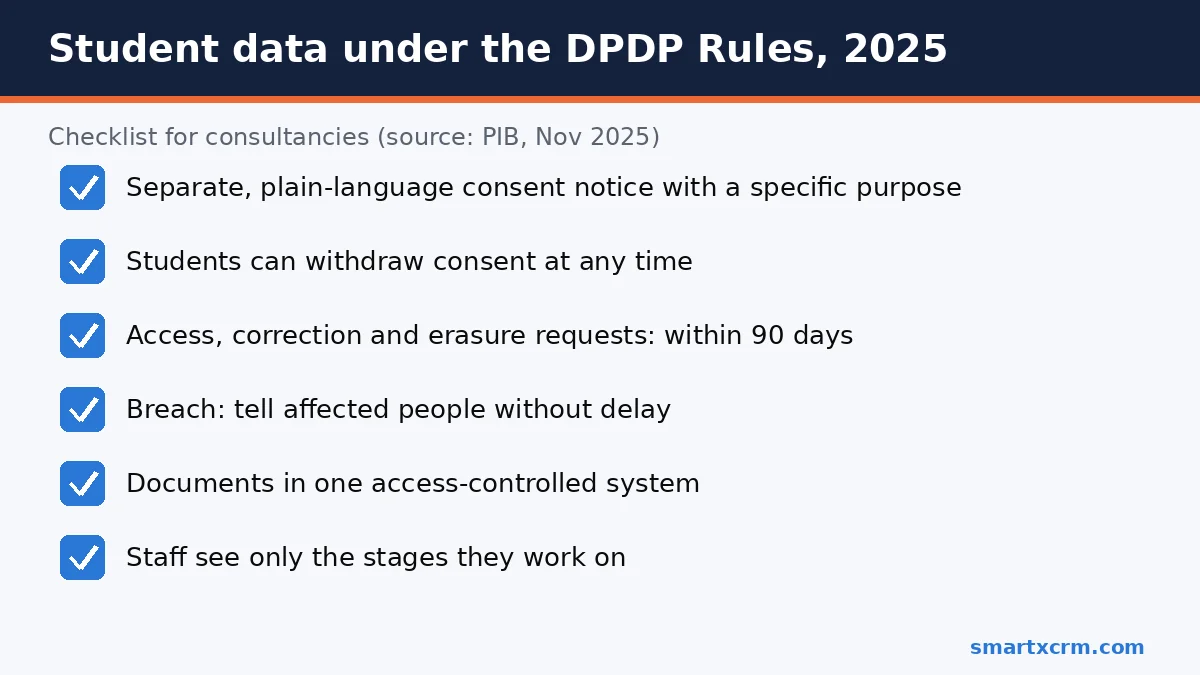
Points from that explainer that matter for a consultancy’s journey map:
- Give a separate, plain-language consent notice that states the specific purpose for collecting each kind of data.
- Let students withdraw consent at any time, and record when they do.
- Requests to access, correct, update or erase data must be handled within a maximum of 90 days.
- If there is a data breach, affected people must be told without delay, in plain language, with what happened and what you are doing.
- Penalties under the Act go up to ₹250 crore for failing to keep reasonable security safeguards.
In practice: add a consent step at stage 1, keep documents in one access-controlled system instead of personal WhatsApp chats and email inboxes, and give each team member access only to the stages they work on. This is general information, not legal advice, so check your own obligations with a qualified adviser.
How does a CRM turn the map into daily work?
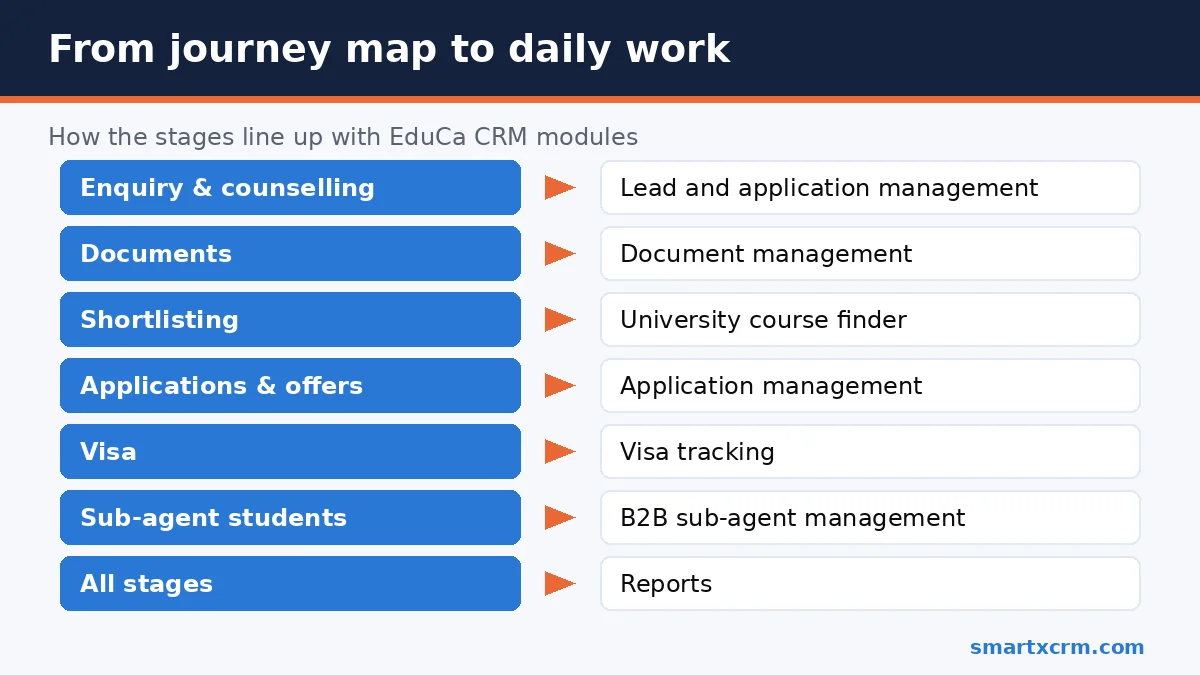
A map on a wall changes nothing unless each stage becomes a task, a reminder and a status that the whole team can see. That is the job of a CRM. Here is how the stages line up with modules in EduCa CRM by SmartX CRM, our CRM software for education and study abroad consultants in India:
| Journey stage | What you need | EduCa module |
|---|---|---|
| Enquiry and counselling | Every lead captured, assigned and followed up | Lead and application management, automation engine |
| Profile and documents | Checklist, uploads, reminders | Document management |
| Shortlisting | Course and university search | University course finder |
| Applications and offers | One record per application, across countries | Application management |
| Visa | Visa stage tracking and deadlines | Visa tracking |
| Sub-agent students | Partner view of their students’ status | B2B sub-agent management |
| All stages | Stage-wise conversion and time in stage | Reports |
Whatever system you use, the test is simple: can any counsellor open a student’s record and see the current stage, the next action and its date? If not, the map has not reached daily work yet.
Common mistakes when mapping the student journey
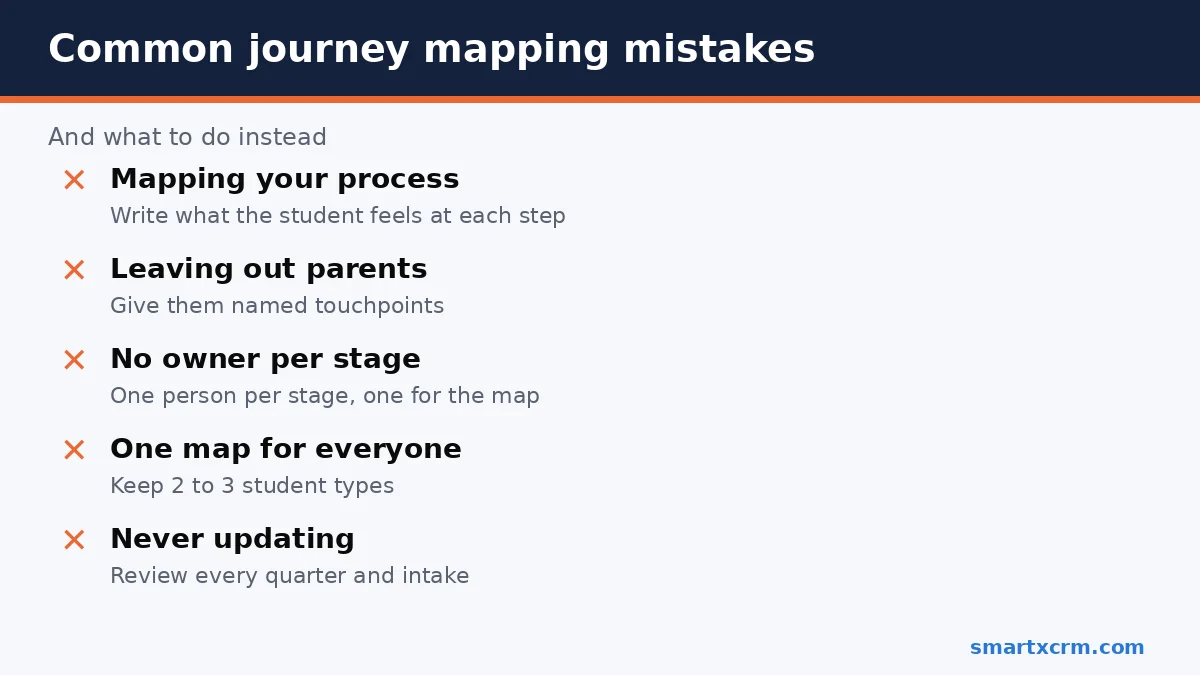
- Mapping your process instead of the student’s experience. “Application submitted” is your milestone. “I don’t know if anything is happening” is the student’s experience at the same moment.
- Leaving out parents. In many Indian families the parent approves every payment. Give them named touchpoints.
- No owner per stage. If a stage belongs to everyone, follow-ups slip.
- One map for every student. A bachelor’s student with parents paying and a working professional with a loan move differently. Keep two or three versions.
- Never updating it. Intakes, visa rules and student questions change every year, so a map from last year will mislead you.
Free student journey map template
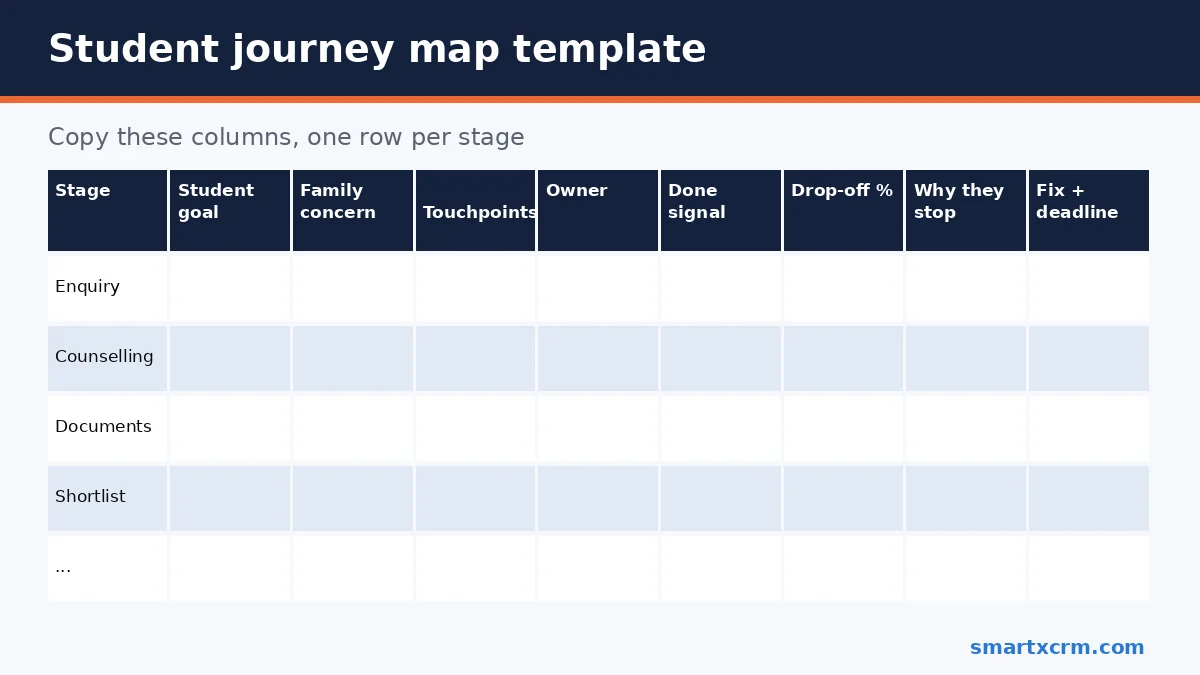
Copy these columns into a sheet and fill one row per stage. Start with the nine stages listed earlier.
| Stage | Student goal | Family concern | Touchpoints | Owner | Done signal | Drop-off % (last intake) | Main reason students stop | Fix and deadline |
|---|---|---|---|---|---|---|---|---|
| 1. Enquiry | ||||||||
| 2. Counselling | ||||||||
| 3. Profile and documents |
When the sheet gets too big to manage by hand, see EduCa CRM pricing or book a demo and we will set up your stages with you.
Frequently asked questions
What is a student journey map?
A student journey map is a table or diagram that lists every stage a student goes through with your consultancy, with their goals, worries, touchpoints and the team member responsible at each stage.
How many stages should a study abroad student journey have?
Most consultancies work well with seven to nine stages, from enquiry to arrival. Fewer than five usually hides the stages where students drop out, such as documents and deposit.
How often should we update our student journey map?
Review it every quarter and after each intake. Update it sooner if a destination country changes its visa or financial requirements.
Who should own the student journey map in a consultancy?
One senior person, usually the branch head or operations manager, should own the map. Each stage then has its own owner who is responsible for the numbers at that stage.
Can we map the student journey in a spreadsheet?
Yes, a spreadsheet is fine for the first version. Once you have more than a few counsellors or branches, a CRM keeps stage, next action and history in one record, which a spreadsheet cannot do reliably.
Do the DPDP Rules apply to study abroad consultancies?
The DPDP Act and Rules apply to organisations that process digital personal data of people in India, which includes most consultancies that collect student details online or store documents digitally. Check the specifics for your business with a qualified adviser.


Leave a comment: