

Quick answer: Student visa processing priority in Australia decides how fast Home Affairs starts working on an offshore Subclass 500 application. Under Ministerial Direction 115, Priority 1 starts in 1 to 4 weeks, Priority 2 in 5 to 8 weeks and Priority 3 in 9 to 12 weeks. From 15 November 2026, new lodgements count against 2027 provider allocations.
Last updated: 27 November 2026 · By SmartX CRM Product Team
Student visa processing priority is now the first thing Indian families ask about when they plan an Australian degree. A new allocation year started on 15 November 2026, and on 26 November The PIE News reported that some private higher education providers are already in the slower lanes for 2027. For a student aiming at a February or July 2027 intake, the choice of provider can now add weeks to the wait before a case officer even opens the file.
This guide explains how the system works, what changed this month, which students always stay in the fast lane, and how study abroad consultants in India can check a provider’s level before they lodge. All figures come from Australian Government pages and reports linked in the text.
What is student visa processing priority in Australia?
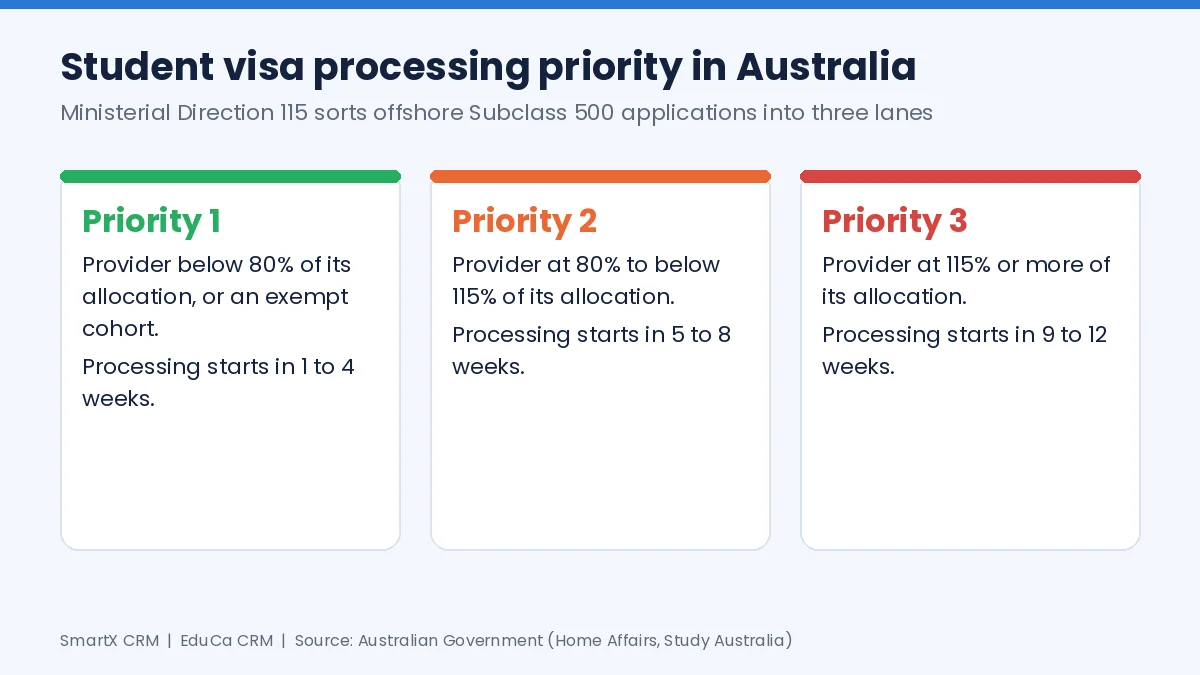
Student visa processing priority is the order in which the Department of Home Affairs starts assessing offshore Student (Subclass 500) visa applications. It is set by Ministerial Direction 115 (MD115) and depends mainly on how close the student’s education provider is to its yearly allocation of new international students.
Australia manages growth through a National Planning Level (NPL). For 2027 the NPL is 295,000 new overseas student commencements, the same as in 2026. Study Australia confirmed this figure on 15 July 2026 and said no active provider would get a smaller allocation than it had in 2026. Each university or college receives an indicative share of that number.
MD115 took effect on 14 November 2025 and replaced the older direction, MD111. According to Home Affairs, a Ministerial Direction is not a visa cap and does not set the criteria to grant or refuse a visa. It only decides the queue. Two points matter for consultants:
- It applies only to applications lodged outside Australia.
- Priority is fixed on the day the application is lodged, so the provider’s level on that date is what counts.
What changed for applications lodged from 15 November 2026?
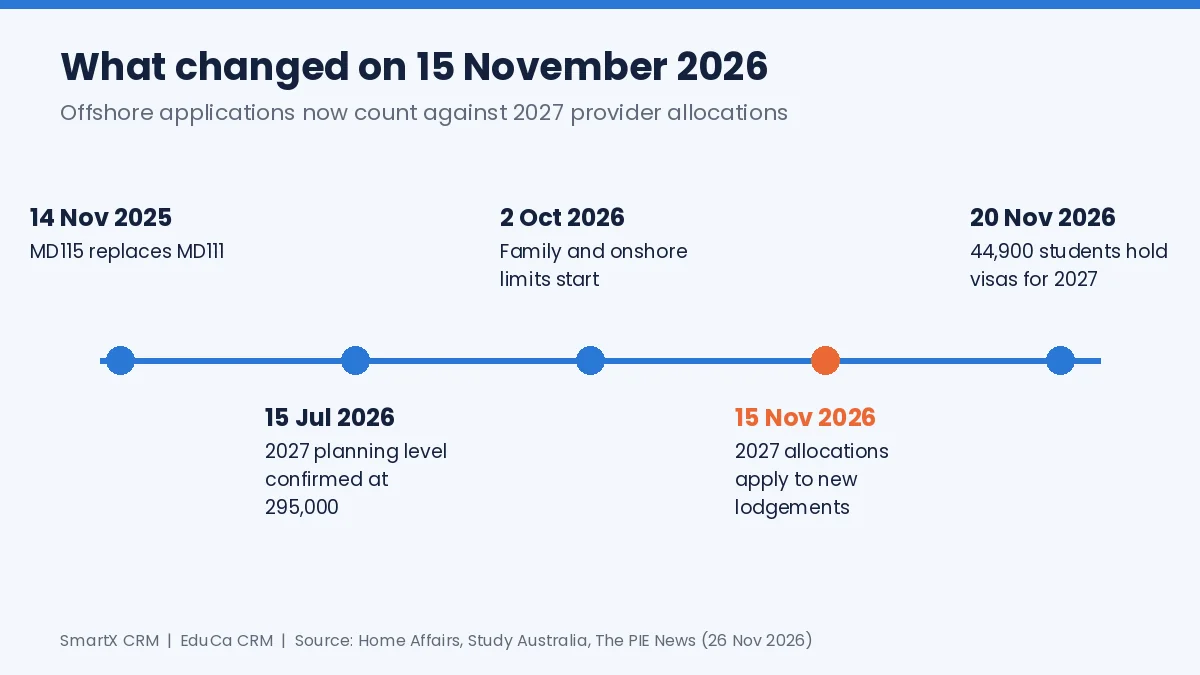
From 15 November 2026, offshore student visa applications are measured against each provider’s 2027 allocation, not its 2026 allocation. Home Affairs says applications lodged between 15 November and 31 December use the following calendar year’s allocation, so a file lodged today is judged on 2027 progress.
That reset sounds like good news, because most providers start the year with room. But early data shows the queue is already moving. The PIE News reported on 26 November 2026, using Department of Education data, that:
- As of 20 November, 44,900 prospective students already held student visas for 2027, about 15% of the 295,000 planning level.
- Public universities had used almost 19% of their 2027 allocations and all of them were at Priority 1.
- Eight other higher education providers were already at Priority 2 and three were at Priority 3 for 2027.
The same report gives context for 2026. As of 6 November, the sector had reached 83% of its 2026 allocation. Public universities stood at 67%, while other higher education providers were at 150%. The report also notes that the government is consulting on student visa settings because refusal rates are high in key source markets.
The message for Indian consultants is simple. A private provider with an attractive fee can still sit in a slower lane. That is not a reason to avoid it, but it has to be part of the advice.
How do Priority 1, 2 and 3 compare?
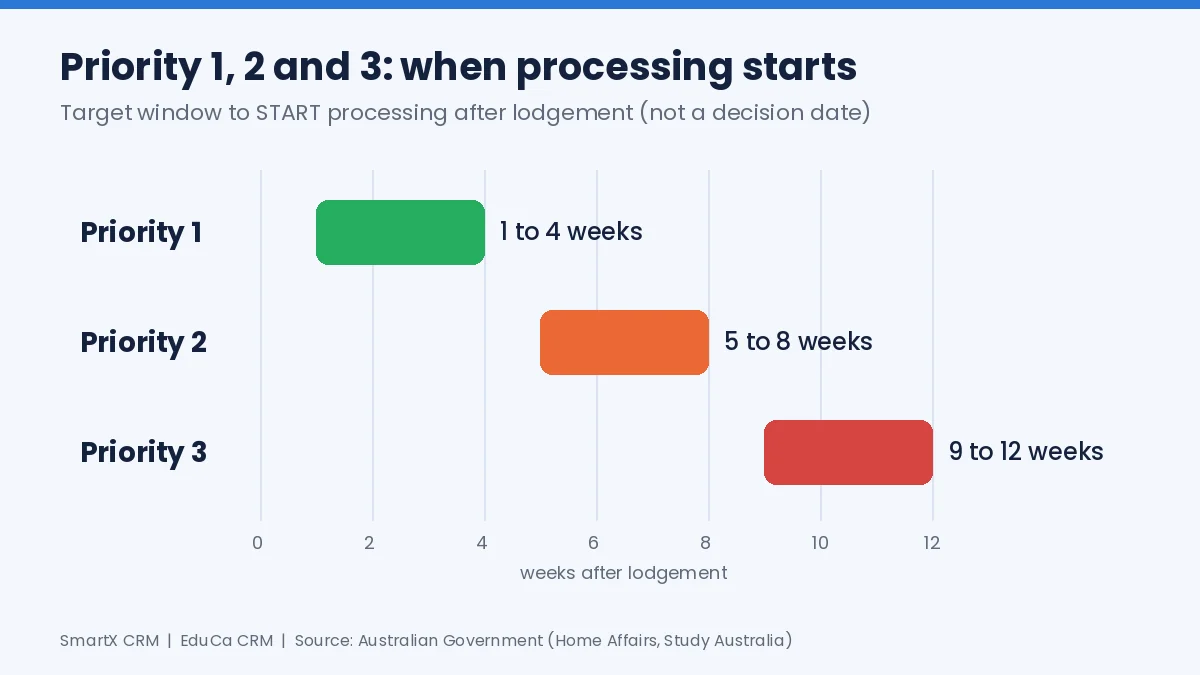
Priority 1 is the fastest lane, Priority 2 is the middle lane and Priority 3 is the slowest. The lane depends on the provider’s progress against its new overseas student allocation, unless the student belongs to an exempt group.
| Priority level | Who is in it | Provider progress against allocation | Target to start processing |
|---|---|---|---|
| Priority 1 | Exempt cohorts, plus higher education and VET students whose provider is below its threshold | Below 80% | 1 to 4 weeks |
| Priority 2 | Higher education and VET students whose provider has reached its threshold; subsequent entrants without a minor | 80% to below 115% | 5 to 8 weeks |
| Priority 3 | Higher education and VET students whose provider has passed its upper threshold | 115% or more | 9 to 12 weeks |
Two details are often misread. First, these windows are targets for when processing starts, not for when a decision arrives. Home Affairs says they are based on 2025 lodgements and can change, especially in peak periods. Second, a Priority 3 lodgement is still a valid application. A complete, genuine file in Priority 3 can be granted, and a weak file in Priority 1 can be refused.
For packaged courses, such as an English course followed by a degree, the priority follows the provider of the main Confirmation of Enrolment (CoE). So a student doing ELICOS at a college and a master’s at a university is judged on the university’s level.
Which students always get Priority 1?
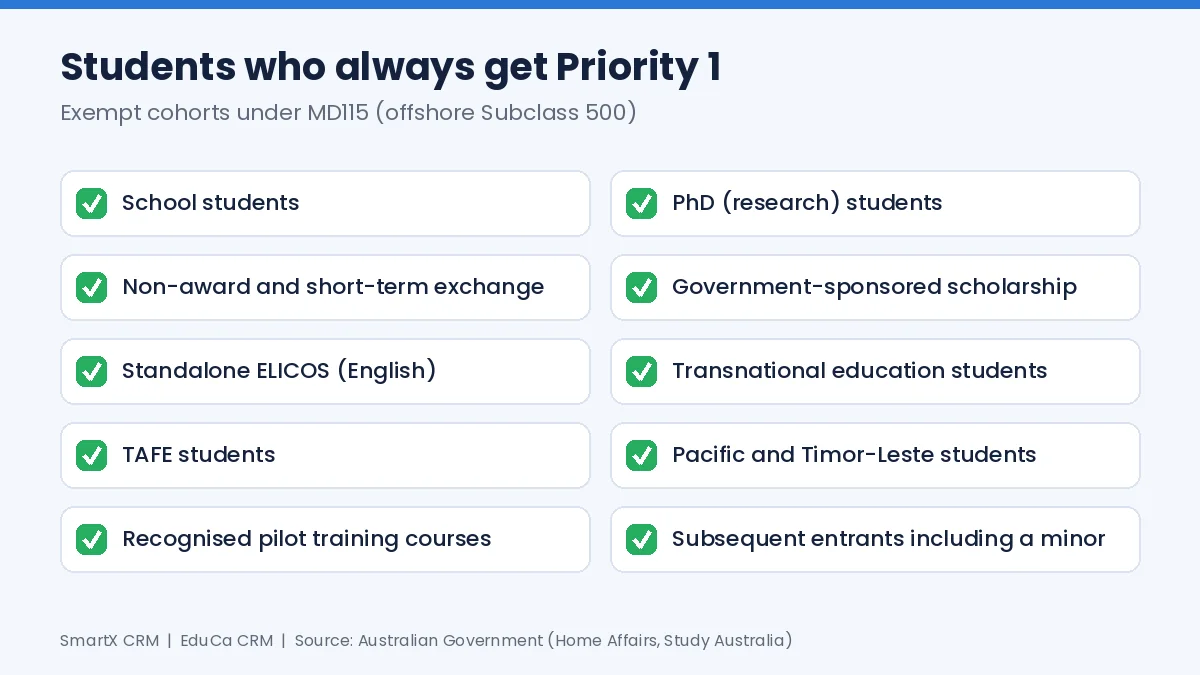
Some groups stay in Priority 1 whatever their provider’s level. Home Affairs lists these cohorts under MD115:
- School students
- Non-award students, including short-term exchange students
- Standalone ELICOS (English language) students
- TAFE students, and specified Charles Darwin University TAFE courses
- Students in recognised pilot training courses
- PhD students
- DFAT, Defence and other foreign or Australian government scholarship students
- Transnational education students
- Students from the Pacific and Timor-Leste (specified countries)
- Subsequent entrants whose application includes a minor
Most Indian applicants do not fall into these groups. A typical master’s or bachelor’s student at a private college or a university is judged on the provider’s progress. TAFE and PhD pathways are the main exceptions that Indian consultants see often.
Where do Australian providers stand for 2027?
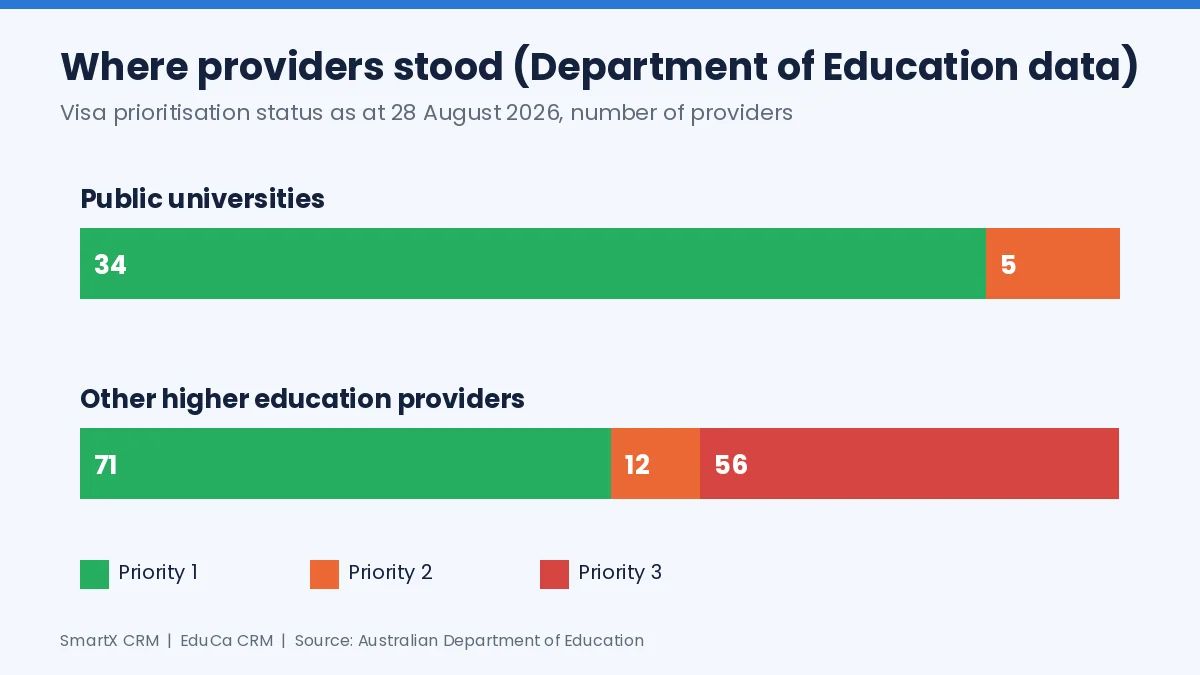
Public universities are mostly in Priority 1, while many smaller private higher education providers reach Priority 2 or 3 during the year. The Department of Education publishes a provider list showing each institution’s level, and Home Affairs points applicants to it.
The Visa Prioritisation Status list with data as at 28 August 2026 showed this pattern for the 2026 year:
- Public universities: 34 at Priority 1, 5 at Priority 2 and none at Priority 3.
- Other higher education providers: 71 at Priority 1, 12 at Priority 2 and 56 at Priority 3.
The 2027 year has only just started, so most providers are back at Priority 1. The PIE News figures above show the movement has begun with a small number of private providers. Expect more to move into Priority 2 as the February and July 2027 intakes fill. VET providers are not shown the same way, so you need to ask them directly.
What does this mean for Indian students and consultants?
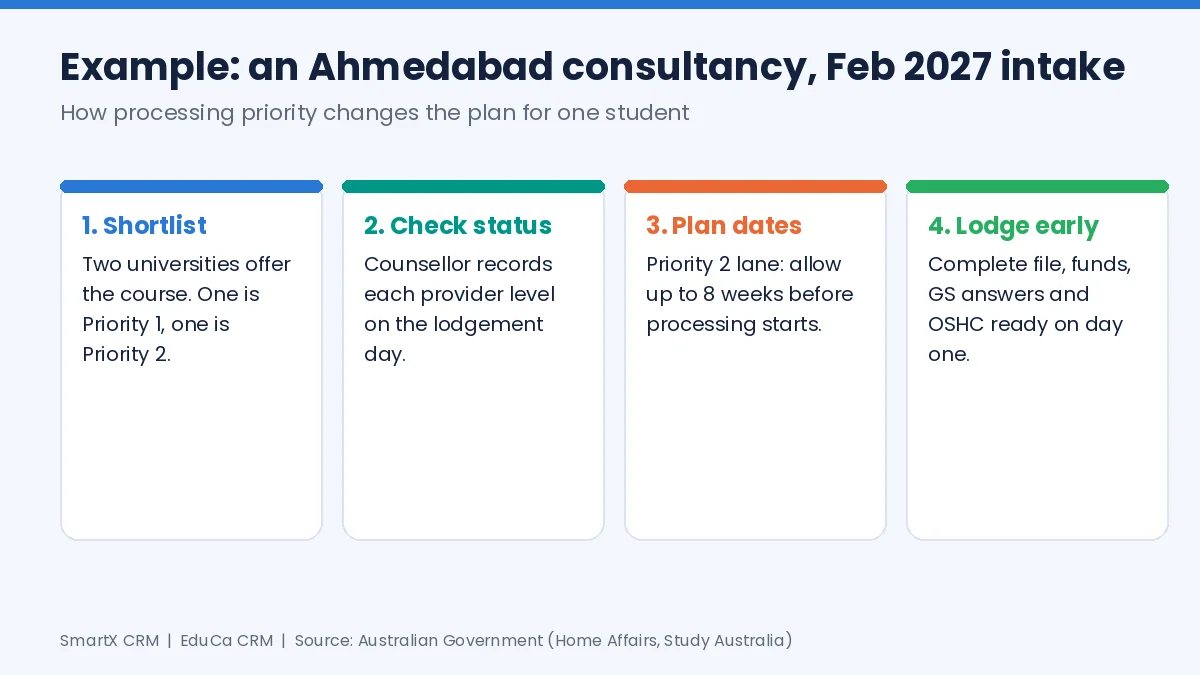
For Indian students, provider choice now affects timing as well as cost and course quality. For consultants, it means every Australia file needs a priority check on the lodgement day and a clear message to the family about the expected wait.
A worked example from Ahmedabad
Take a study abroad consultancy in Ahmedabad. A B.Com graduate wants a Master of Professional Accounting starting in February 2027. Two offers are on the table: a public university and a private higher education provider with lower fees.
- The counsellor checks the Visa Prioritisation Status list and finds the university at Priority 1 and the private provider at Priority 2.
- She explains to the student and parents that, at Priority 2, Home Affairs aims to start processing within 5 to 8 weeks instead of 1 to 4 weeks.
- If the family prefers the private provider, the team plans backwards from the course start date and lodges as early as possible.
- The file goes in complete: CoE, Genuine Student answers, financial documents, English test results and health insurance, so there is no extra delay from missing papers.
Neither choice is wrong. The point is that the family decides with the timing in front of them, and the consultant has a record of what was advised.
Other Australia student visa changes to factor in
Processing priority is not the only 2026 change. Study Australia’s October 2026 update for education agents says that from 2 October 2026 most Student visa applicants can no longer include family members unless an exemption applies. Most temporary visa holders, including Working Holiday Maker holders, also lost the option to apply for a Student visa from inside Australia. A transfer stream for students changing providers is still being developed. Married Indian applicants who planned to bring a spouse need this conversation early.
If your consultancy also handles visitor, PR or dependant cases, our guide on CRM for study abroad and immigration consultancy shows how to run student and immigration files in one system. For US-bound students, the recent court decision on the F-1 duration of status rule is the other policy change families are asking about this month.
How to check a provider’s processing priority before you lodge
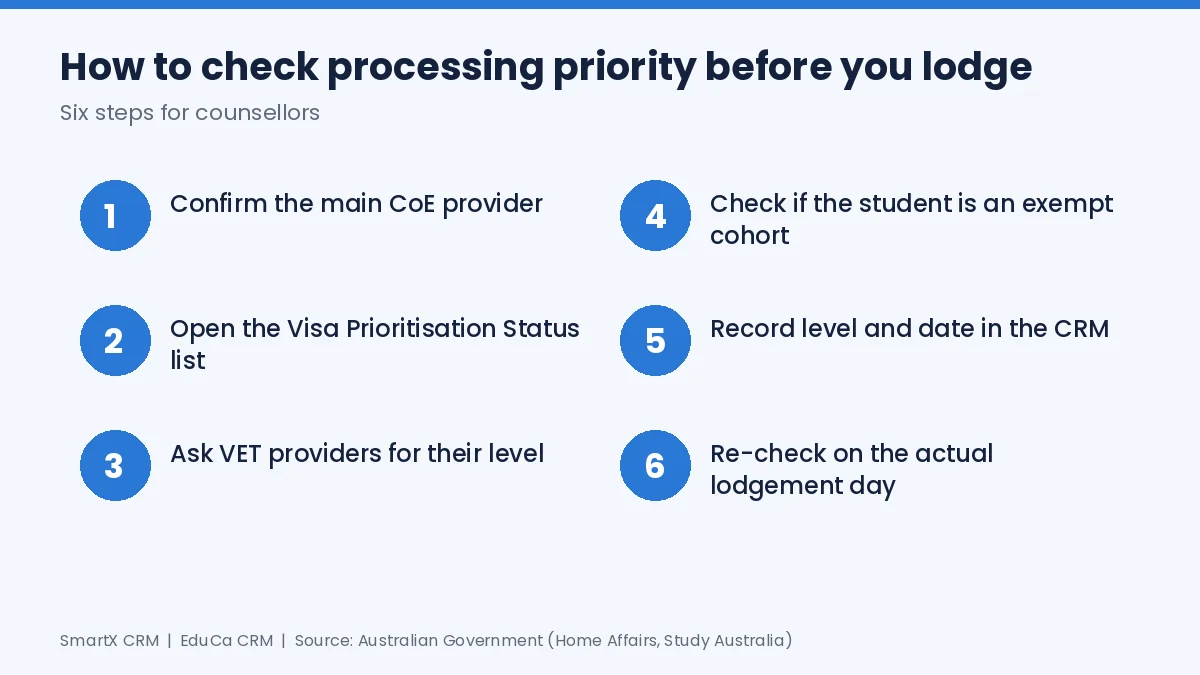
Check the provider’s level from the official list on the day you lodge, and save the result in the student’s file. These six steps follow the Home Affairs guidance for applicants.
- Confirm the main provider. For a packaged course, note the provider on the main CoE, because that provider decides the lane.
- Open the Visa Prioritisation Status list. Find the university or higher education provider and note its current priority level.
- Ask VET providers directly. If the main course is vocational, ask the college whether it has reached the Priority 2 or Priority 3 threshold.
- Check for an exempt cohort. If the student is a TAFE, PhD, school or scholarship student, record that they stay in Priority 1.
- Record the level and date. Save the priority level and the date you checked in the CRM against the application.
- Re-check on the lodgement day. Levels can change during the year, and priority is fixed on the day you lodge, so confirm again before you submit.
A visa tracking tool helps here. The visa tracking module in EduCa CRM keeps lodgement dates, status updates and documents together, so the check is not lost in a WhatsApp chat.
How EduCa CRM helps consultants track student visa processing priority
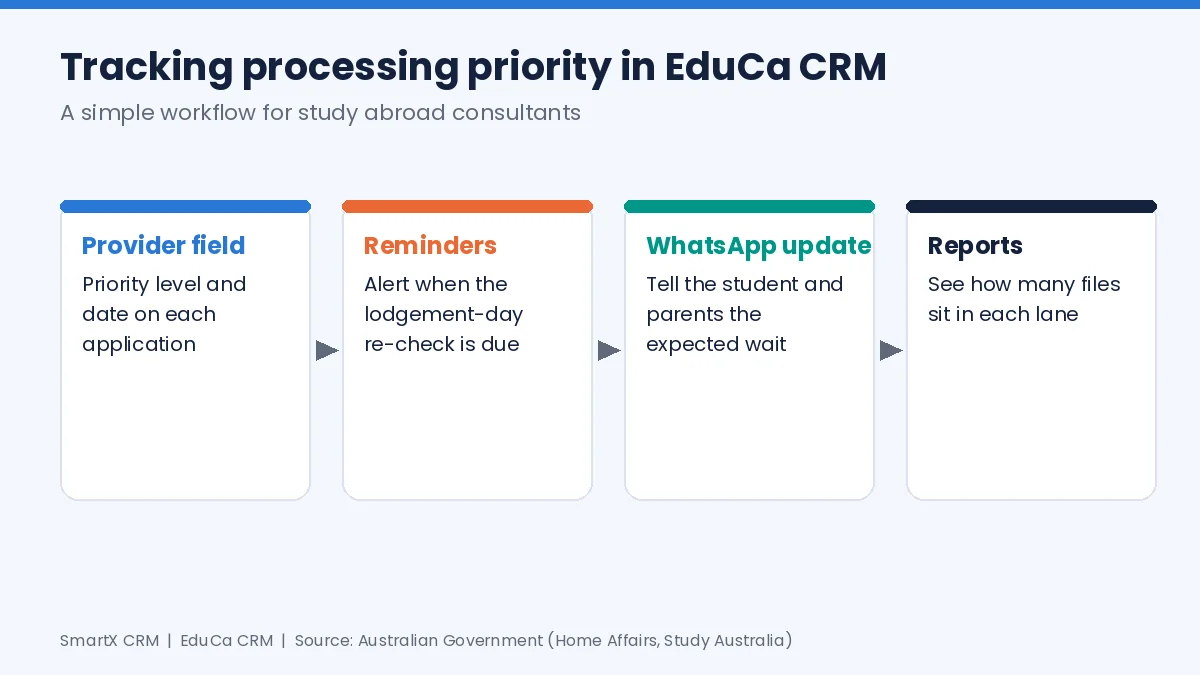
EduCa CRM by SmartX CRM, CRM software for education and study-abroad consultants in India, lets your team store the processing priority on each Australian application, set reminders for the lodgement-day check and send students timely updates. A typical setup looks like this:
- A custom field on each application for provider, priority level and the date it was checked.
- A task that reminds the counsellor to re-check the level on the planned lodgement date.
- WhatsApp and email templates that explain the expected wait to students and parents in plain words.
- Reports that show how many active Australia files sit with Priority 1, 2 and 3 providers, so managers can plan follow-ups.
- A document checklist per student, so the file is complete when it goes in.
If you are comparing tools, start with our guide to choosing a study abroad consultant CRM, or see what EduCa CRM for overseas education consultants includes. You can also book a free EduCa CRM demo and ask the team to set up a priority field for your Australia desk.
Frequently asked questions
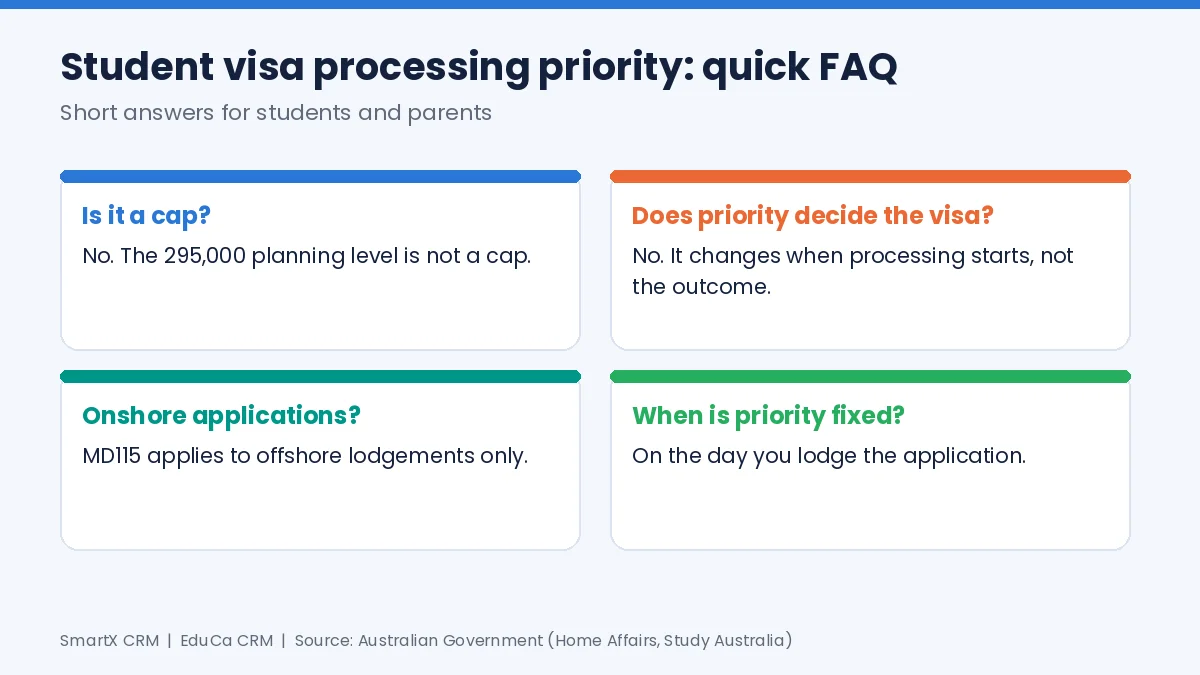
Is the 295,000 National Planning Level a cap on Indian students?
No. The government describes the National Planning Level as a planning tool, not a cap. Genuine students who meet the requirements can still apply and be granted a visa, but applications for providers past their thresholds start processing later.
Does a Priority 3 provider mean my visa will be refused?
No. Priority only changes when processing starts. Home Affairs says it does not affect whether a visa is granted or refused. The outcome still depends on the Genuine Student requirement, funds, English, health and character.
How long does Priority 2 student visa processing take?
Home Affairs aims to start processing Priority 2 applications within 5 to 8 weeks of lodgement. That is a start window, not a decision date, and it can stretch in peak periods.
What is the difference between MD111 and MD115?
MD115 replaced MD111 for offshore applications lodged on or after 14 November 2025. It uses three priority levels tied to each provider’s allocation, with thresholds at 80% and 15% above the allocation. Applications lodged earlier stayed under MD111.
Does student visa processing priority apply to onshore applications?
No. MD115 covers offshore Subclass 500 applications only. Onshore applications follow other rules, and since 2 October 2026 most temporary visa holders cannot apply for a Student visa from inside Australia.
How can I check my university’s processing priority?
Search the Department of Education’s Visa Prioritisation Status list for the provider, or ask a VET provider directly. Check again on the day you lodge, because that date fixes your priority.



Leave a comment: