Last updated 25 November 2026. Written by the SmartX CRM Product Team, which builds Dr. Hub CRM for clinics and hospitals in India.
Quick answer: Patient relationship management software (PRM) keeps every patient’s appointments, visits, reminders, messages, feedback and follow-ups in one place, so a clinic can keep patients coming back and reduce no-shows. It sits next to clinical records: the EHR stores the medical history, while PRM manages the relationship before, between and after visits.
Most clinics in India already have some software for billing or prescriptions. What they rarely have is one view of the patient as a relationship: who missed a follow-up, who has not returned after a first consultation, who is waiting for a report, and who left unhappy. This guide explains what patient relationship management software is, how it differs from a CRM, EHR and hospital management system, the features to look for, and how a clinic can set one up in 30 days.
What is patient relationship management software?
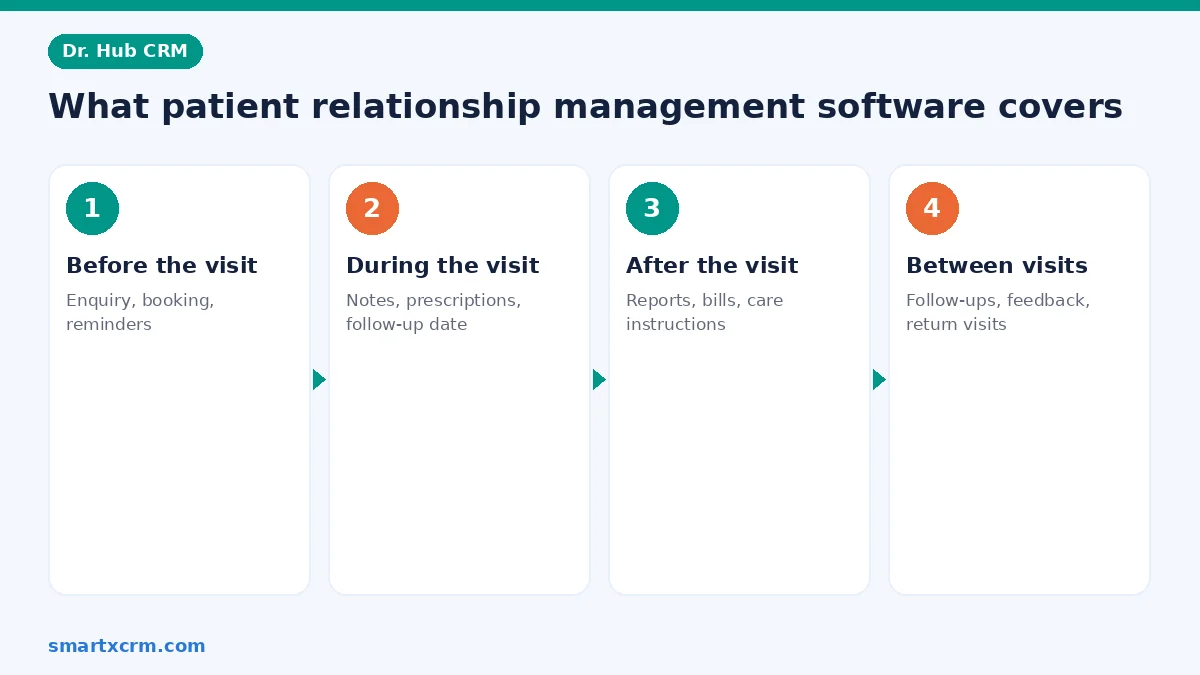
Patient relationship management software is a system that manages a patient’s journey with a provider, from first enquiry and booking to reminders, follow-ups, feedback and repeat visits. It brings patient contact history, communication and tasks into one record that the front desk, doctors and managers can all see.
The idea is broader than a sales-style CRM. Salesforce describes PRM as a set of strategies, processes and technologies that providers use to manage patient interactions across the whole care journey (Salesforce PRM guide). G2’s PRM category lists criteria such as tracking the patient journey, supporting patient and provider interaction including feedback, and supporting patients between care episodes (G2). Chilmark Research made the same point back in 2018: PRM has to reach patients between visits, beyond the services the provider itself offers (Chilmark Research).
PRM vs CRM vs EHR vs hospital management system
PRM manages the patient relationship, a general CRM manages sales leads and deals, an EHR stores clinical records, and a hospital management system (HMS) runs operations such as billing, beds and pharmacy. Many Indian clinics need parts of all four, ideally in one connected tool.
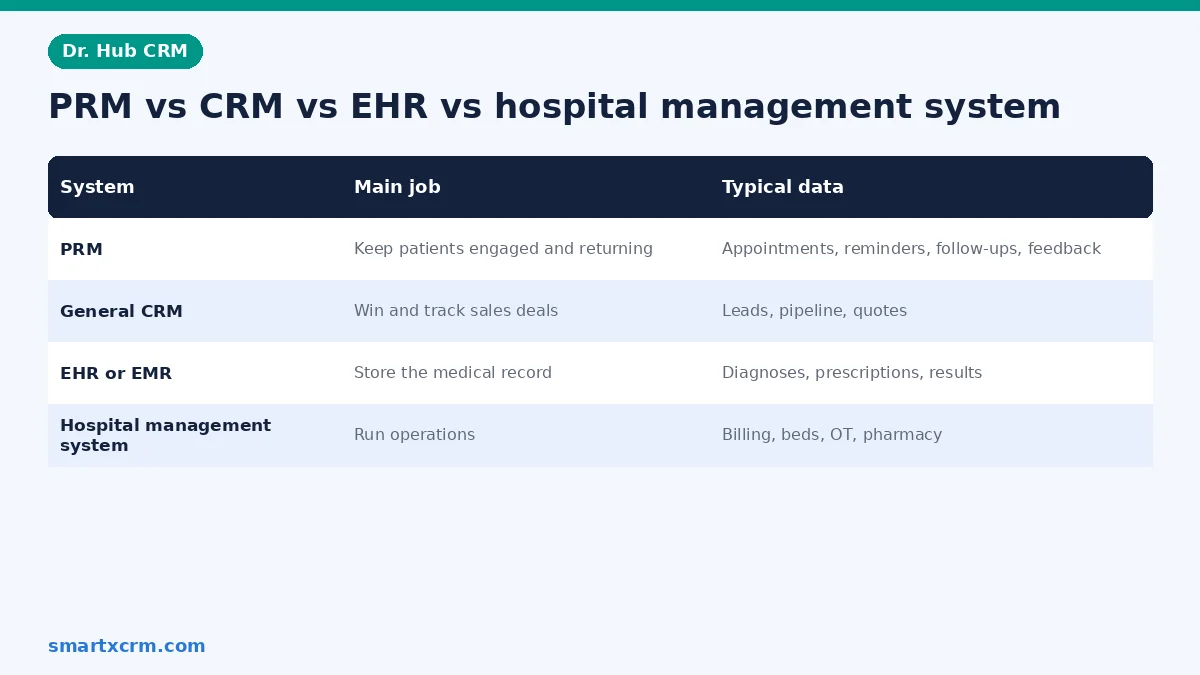
| System | Main job | Typical data | Who uses it |
|---|---|---|---|
| Patient relationship management (PRM) | Keep patients engaged and returning | Appointments, reminders, messages, follow-ups, feedback | Front desk, clinic manager, doctors |
| General CRM | Win and track sales deals | Leads, pipeline stages, quotes | Sales teams |
| EHR or EMR | Store the medical record | Diagnoses, prescriptions, lab results, case notes | Doctors and nurses |
| Hospital management system | Run hospital operations | Billing, IPD beds, OT, pharmacy, inventory | Admin, accounts, pharmacy |
In practice the lines blur. A clinic CRM such as Dr. Hub CRM (healthcare CRM for clinics) combines PRM features (appointments, WhatsApp reminders, patient portal, follow-up planning) with OPD records, IPD management, GST billing and pharmacy inventory, so a small hospital does not have to connect four separate systems.
Key features of patient relationship management software
The core features are appointment booking with reminders, a single patient profile, two-way messaging, follow-up planning, a patient portal, feedback collection, segmentation for outreach, and reports on visits and returns.
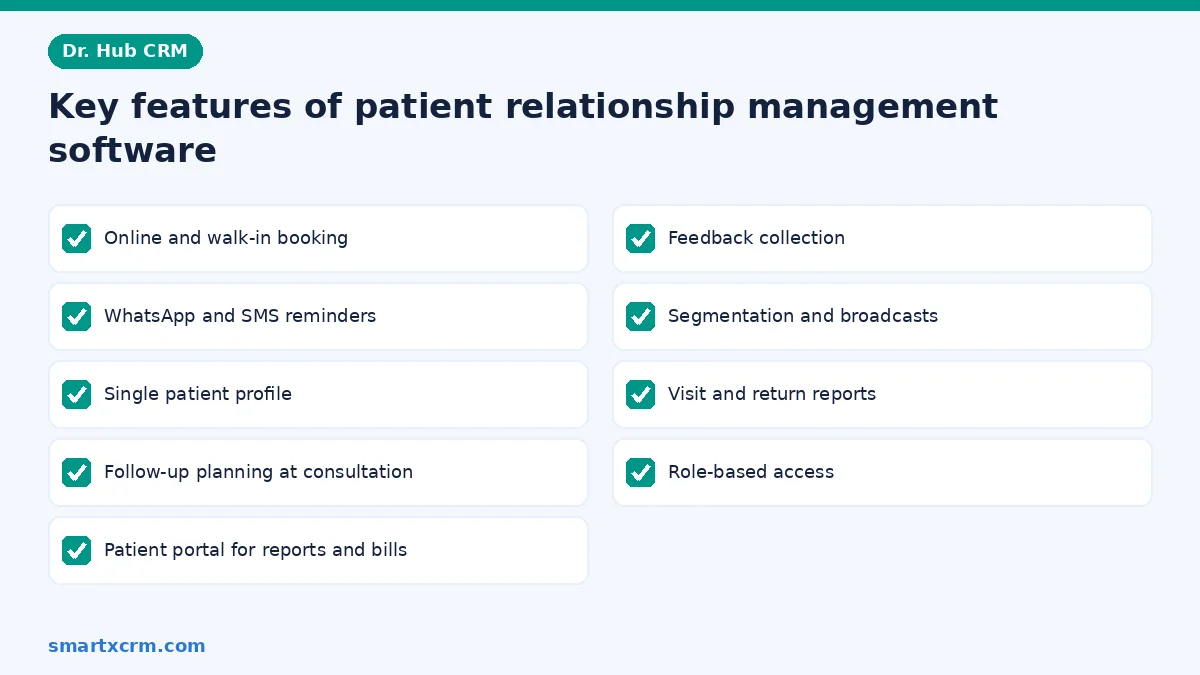
| Feature | What it does | Why it matters for an Indian clinic |
|---|---|---|
| Online and walk-in booking | Books by doctor or department, including walk-ins | Mixes appointment and walk-in patients without double booking |
| WhatsApp and SMS reminders | Sends booking, follow-up and report reminders | Patients in India reply on WhatsApp far more than email |
| Single patient profile | Shows visits, prescriptions, bills and messages together | Any staff member can answer a patient call |
| Follow-up planning | Sets the next visit date at consultation | Fewer patients drop out of long treatments |
| Patient portal | Patients view prescriptions, reports and invoices | Fewer calls to the front desk |
| Feedback and reviews | Collects feedback after visits | Problems are caught before they turn into public reviews |
| Segmentation and broadcasts | Groups patients by condition, doctor or last visit | Targeted health camp or vaccination reminders |
| Reports | Visits, conversions, revenue by doctor and service | Owners see which doctors and services drive returns |
| Role-based access | Separate logins for doctor, receptionist, accountant | Keeps medical data visible only to the right people |
How patient relationship management works in a clinic
PRM follows the patient through six stages, and each stage has a clear task for the clinic team.
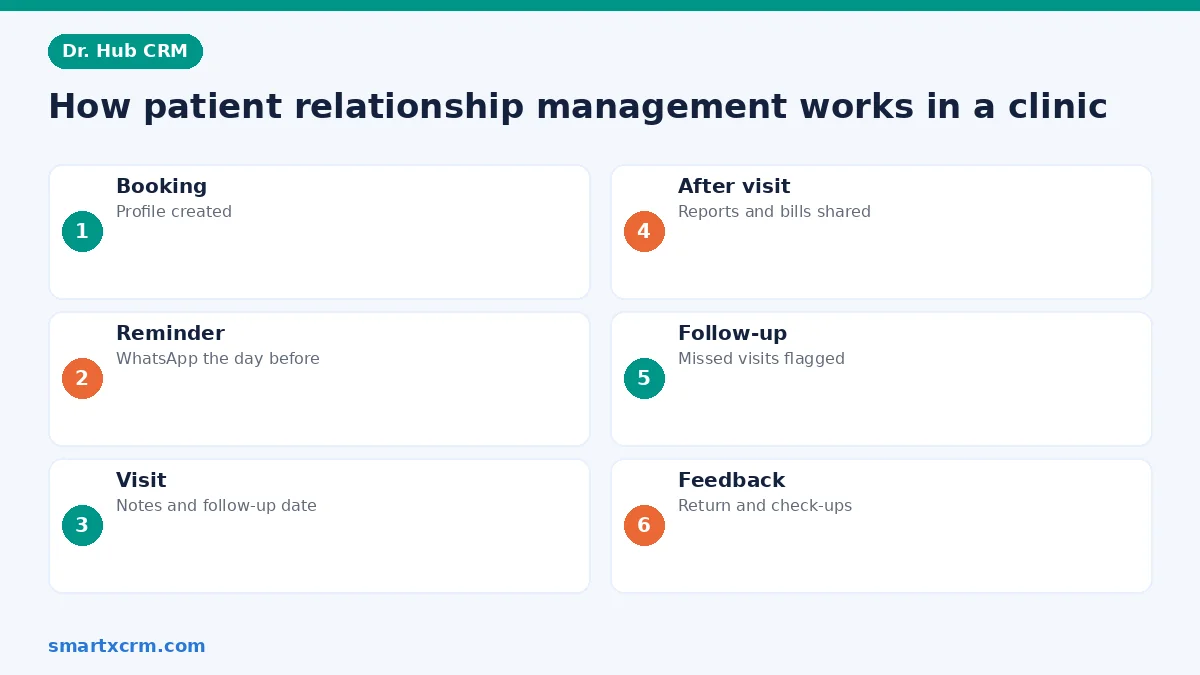
- Enquiry and booking: a patient books online, by phone or as a walk-in, and a profile is created.
- Reminder: the patient gets a WhatsApp reminder the day before the appointment.
- Visit: the doctor records notes and prescriptions and sets a follow-up date.
- After the visit: reports, invoices and care instructions are shared through the portal or WhatsApp.
- Follow-up: the system reminds the patient before the next visit and flags anyone who misses it.
- Feedback and return: the clinic collects feedback and sends relevant reminders, such as annual check-ups.
Example: a dermatology clinic in Jaipur
This is an illustrative scenario, not a customer story.
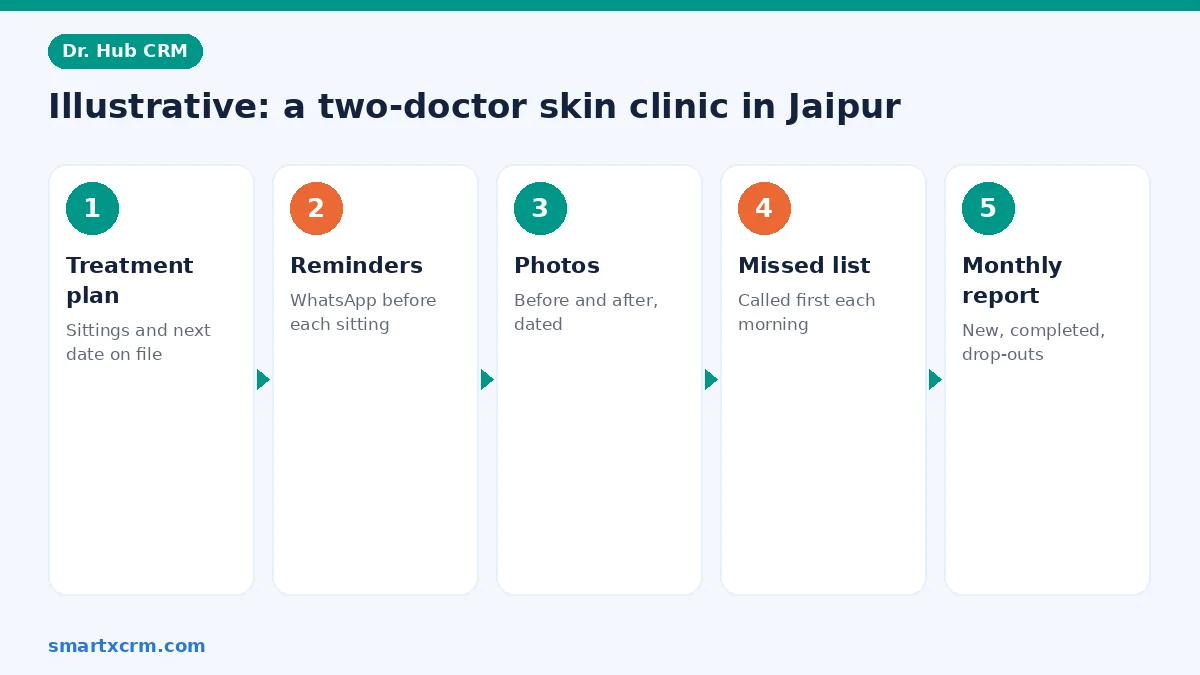
A two-doctor skin clinic in Jaipur runs acne and pigmentation treatments that need four to six sittings. Before using PRM, appointment details were written in a register and the receptionist called patients one by one. Patients who skipped a sitting were often not noticed until weeks later.
With patient relationship management software in place:
- Every patient has a treatment plan with the number of sittings and the next date.
- A WhatsApp reminder goes out the day before each sitting.
- Before and after photos are stored with dates on the patient profile.
- Each morning, the front desk sees a list of patients who missed a sitting in the last 7 days and calls them first.
- The doctors review a monthly report of new patients, completed treatment plans and drop-outs.
How to choose patient relationship management software
Choose PRM software by checking how well it fits your daily clinic work, how patients will be contacted, and how data is protected. Use this checklist in demos.
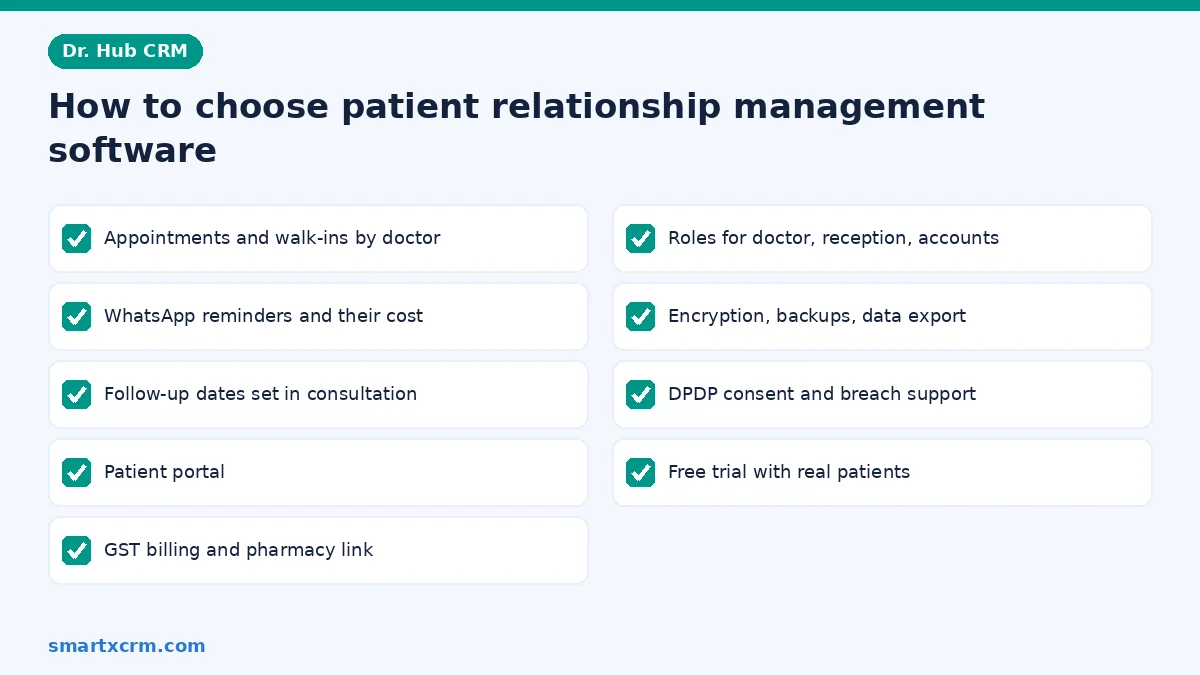
- Does it handle both appointments and walk-ins by doctor and department?
- Are WhatsApp reminders built in, and what do they cost?
- Can doctors set follow-up dates during consultation?
- Is there a patient portal for prescriptions, reports and bills?
- Does it include or connect to billing with GST and to your pharmacy stock?
- Are there separate roles for doctors, reception and accounts?
- Where is data stored, is it encrypted and backed up, and can you export it?
- How does the vendor support consent and breach reporting under India’s DPDP Rules?
- Is there a free trial long enough to test with real patients?
On data protection: India’s Digital Personal Data Protection Rules were notified in November 2025 with a phased rollout over 12 to 18 months, covering consent notices and breach reporting, with penalties under the Act of up to Rs 250 crore per breach (YourStory, November 2025). Health data is sensitive, so ask every vendor how their system helps you meet these duties.
Patient relationship management software options
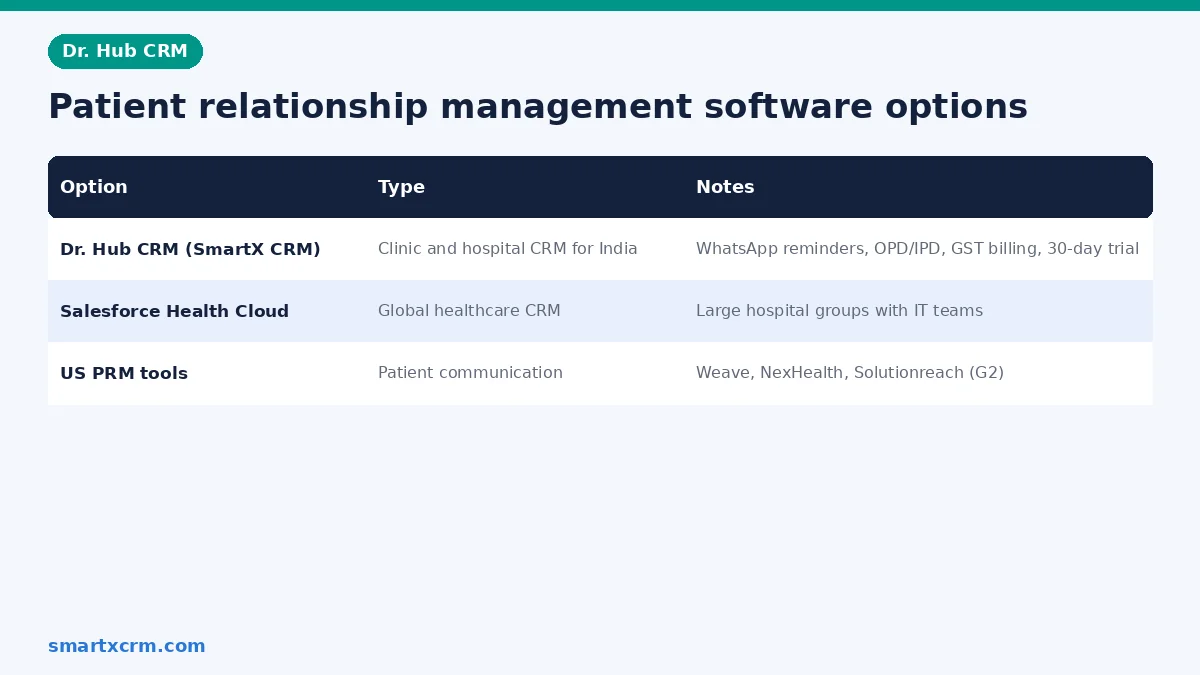
Most PRM tools reviewed online are built for the US market. For Indian clinics, the practical choice is usually between a clinic CRM built for India and a large global platform.
| Option | Type | Notes |
|---|---|---|
| Dr. Hub CRM by SmartX CRM | Clinic and hospital CRM for India | Appointments, WhatsApp reminders, OPD and IPD, GST billing, pharmacy, patient portal; 30-day free trial on its page |
| Salesforce Health Cloud | Global healthcare CRM platform | Very flexible, suited to large hospital groups with an IT team |
| US PRM tools (for example Weave, NexHealth, Solutionreach) | Patient communication platforms | Listed in G2’s PRM category; built around US practice systems |
For a wider comparison of clinic CRMs, see our list of online healthcare CRM software for patient management. If your growth depends on referrals from other doctors, DrLinks is the SmartX doctor referral CRM.
How to set up PRM in a clinic in 30 days
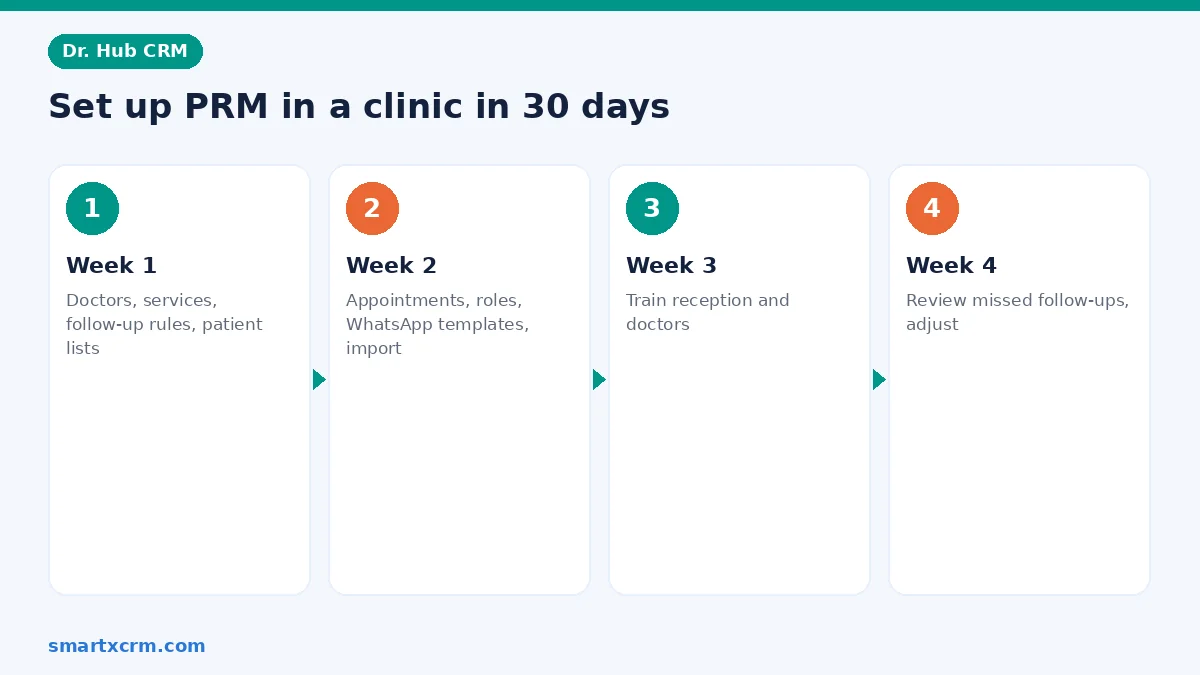
A single clinic can usually go live with patient relationship management software in about four weeks.
| Week | Task | Result |
|---|---|---|
| Week 1 | List doctors, services, timings and follow-up rules; collect existing patient lists | Setup plan and clean data |
| Week 2 | Configure appointments, roles, WhatsApp templates; import patients | Working system |
| Week 3 | Train reception and doctors on booking, notes and follow-up dates | Daily use starts |
| Week 4 | Review missed follow-ups and reminder replies; adjust templates | Fewer drop-outs |
Frequently asked questions
What is patient relationship management software?
Patient relationship management software manages a patient’s journey with a clinic or hospital: booking, reminders, messages, follow-ups, feedback and repeat visits, in one shared record.
Is PRM the same as a healthcare CRM?
They overlap. A healthcare CRM is often used to mean the same thing, but PRM puts more weight on care between visits, follow-ups and patient experience than on sales-style lead tracking.
What is the difference between PRM and an EHR?
An EHR stores the clinical record, such as diagnoses, prescriptions and results. PRM manages communication and the relationship: appointments, reminders, follow-ups and feedback. Many clinic systems combine both.
Does patient relationship management software work with WhatsApp?
Many tools built for India do. Dr. Hub CRM sends appointment reminders on WhatsApp through WA Daddy, the SmartX CRM WhatsApp tool, and shares prescriptions and invoices on WhatsApp.
Is PRM software only for large hospitals?
No. Solo practitioners and small clinics benefit most from reminders and follow-up lists, because a few missed follow-ups a week make a visible dent in revenue for a small practice.
How much does patient relationship management software cost in India?
Prices vary by vendor and by modules such as billing, IPD and pharmacy. Dr. Hub CRM does not list a price on its page but offers a 30-day free trial; ask for a quote based on your number of doctors and branches.
Next step
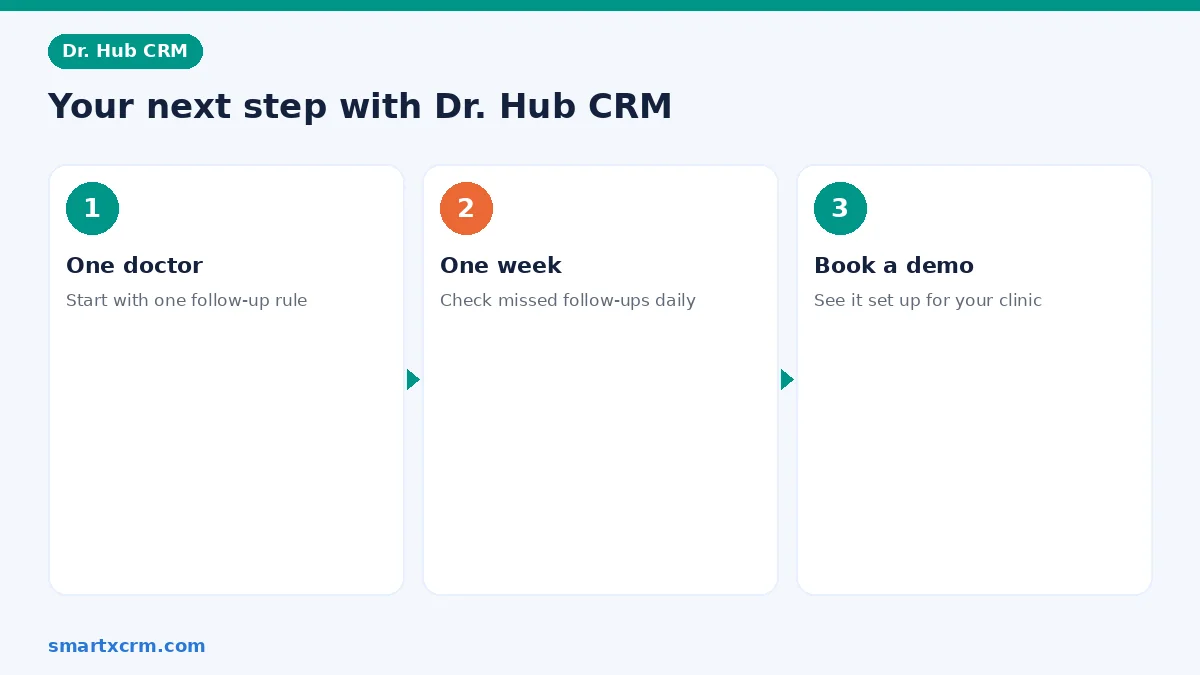
Start with one doctor and one follow-up rule for a week, then expand. Book a Dr. Hub CRM demo to see appointments, WhatsApp reminders and follow-up lists set up for your clinic. Related reading: how CRM software improves patient experience.
About the author: The SmartX CRM Product Team builds Dr. Hub CRM, DrLinks and other CRM tools for Indian businesses. Sources in this guide were checked on 25 November 2026.

Leave a comment: